
Sofa Table That Converts to Dining Table: The Complete Guide
One piece of furniture, two essential functions. Learn how a convertible sofa table transforms from a behind-the-couch console into a full dining surface, and discover which mechanisms, sizes, and materials actually work for real homes.
Why this guide matters: If you live in a studio apartment, a compact condo, or an open-plan home where every square meter counts, a sofa table that converts to a dining table solves two problems with one footprint. But not all convertible designs are equal. Some lift, some unfold, some slide — and each mechanism suits a different room layout and lifestyle. This guide walks you through the options so you can choose with confidence.
What Is a Sofa Table That Converts to a Dining Table?
A sofa table that converts to a dining table is a hybrid furniture piece that normally sits behind or beside your sofa as a narrow console, then transforms into a dining-height surface when you need to eat, work, or host. The transformation usually happens in one of three ways: the top lifts vertically, leaves fold out horizontally, or a secondary tabletop slides out from underneath.
These designs are part of the broader space-saving furniture category that includes coffee to dining table convertible models and compact dining table solutions. What sets the sofa-table variant apart is its starting position: it is designed to live behind the sofa, a zone that is often wasted space in small living rooms.
The concept overlaps with the round coffee table that raises to dining height, but the sofa-table form factor is typically rectangular, narrower, and taller in its resting state — roughly the height of a standard console table. When deployed, it reaches the ideal height of a dining table, usually between 74 and 76 cm.
How the Conversion Mechanism Works
Understanding the mechanism is the single most important step before buying. The three main systems behave very differently in daily use, and each has trade-offs in stability, speed of conversion, and footprint.
1. Lift-Top Mechanism
The tabletop rises vertically on a scissor-lift or pneumatic frame from console height to dining height. The footprint stays the same, which makes this the best option for narrow rooms. Higher-tier models use a dual-locking scissor mechanism that stays rigid when fully raised; entry-level versions can feel slightly shaky at full extension. A lift-top model is ideal if you eat in the same spot where the table rests and do not need extra seating width.
2. Leaf-Extension Mechanism
Folding or drop leaves swing out from the sides or ends of the console, expanding the surface area rather than the height. This is the closest relative to a traditional drop-leaf dining table, but the starting form is a sofa console. Leaf models are excellent for hosting because they add seating width, but they need clear space on both sides when open. If your sofa backs onto a wall, a leaf-extension model will not deploy — it requires open floor on the sides.
3. Slide-Out or Pull-Out Mechanism
A secondary tabletop nests beneath the main console and slides out on rails, sometimes with a height adjustment. This design is less common but works well when you want to keep a permanent console surface while adding a dining zone beside it. Stability depends heavily on the rail quality — look for metal rails with a locking detent rather than friction-fit slides.
Who Should Consider a Convertible Sofa Dining Table
This furniture category is not for everyone. It shines in specific living situations and falls short in others. Here is a clear breakdown so you can decide quickly.
Best suited for
- Studio and small apartments where the living and dining zones share one room and a dedicated dining table would crowd the space. Pair it with small dining table ideas to plan the full layout.
- Open-plan homes where you want a dining surface that disappears visually when not in use.
- Remote workers who need a console-height desk during the day and a dining surface in the evening.
- Hosts who occasionally need extra seating but do not want a permanent dining set. A leaf-extension model can seat four where a console stood.
- Renters who move often and want one piece that adapts to different floor plans, similar to how a convertible dining table desk adapts between work and meals.
Less suitable for
- Families who eat together daily with four or more people — a dedicated dining table is more stable and comfortable.
- Homes with heavy daily hosting where the mechanism would be cycled multiple times a day.
- Rooms where the sofa backs directly onto a wall and you need a leaf-extension model — there will be no room to open the leaves.
- Buyers who want a formal dining room centerpiece — these tables are functional tools, not statement furniture.
Comparing the Three Conversion Types
Use this table to match a mechanism to your room and routine. Tiers refer to market positioning, not to any specific currency figure.
| Conversion Type | How It Works | Best For | Space Requirement | Typical Tier |
|---|---|---|---|---|
| Lift-Top | Top rises vertically on a scissor or pneumatic frame | Narrow rooms, solo diners, dual-use work and eat | Same footprint in both modes; needs overhead clearance | Entry-level to premium |
| Leaf-Extension | Side or end leaves fold out to widen the surface | Occasional hosting, couples who seat guests | Needs open floor on both sides when deployed | Mid-range to premium |
| Slide-Out | Secondary top slides out on rails from beneath the console | Keeping a permanent console plus a dining zone | Needs linear clearance in the slide direction | Mid-tier to high-end tier |
Sizing: What to Measure Before You Buy
Convertible tables fail in real homes for one main reason: the buyer measures the table but not the room around it. Work through these measurements before ordering.
Console mode dimensions
A typical sofa table console is 120 to 160 cm long, 30 to 40 cm deep, and 70 to 80 cm tall. Check that the height sits at or just below the back of your sofa — a console that is too tall looks unbalanced, and one that is too short disappears behind the cushions.
Dining mode clearance
When converted, you need at least 75 to 90 cm of clear floor on each seating side so chairs can pull out and people can stand up. If the table converts against a wall, only one long side may be usable for seating. Factor in the depth of the chairs when pushed in — roughly 45 to 50 cm — and add the walkway behind them.
Seating capacity by width
- 120 cm wide: comfortable for two, tight for three.
- 140 cm wide: comfortable for two to four depending on chair width.
- 160 cm and above: four adults can sit with reasonable elbow room.
If your target is four regular diners, compare the deployed width against a dedicated dining table for 4 set to see whether the convertible option truly matches the comfort level you expect. For two-person households, a dining table and chair set for 2 is often more stable than a convertible model used daily.
Materials and Build Quality
The conversion mechanism gets all the attention, but the tabletop material and frame construction determine how the table looks after two years of daily use.
Tabletop materials
- Solid wood: The most durable and repairable option. Oak and walnut are common; a butcher-block style top resists scratches well and can be sanded. See how solid wood performs in our oak butcher block dining table overview.
- Engineered wood with laminate or veneer: Lighter and more stable across humidity changes, which matters for a moving tabletop. Higher-tier laminates resist heat and water rings; entry-level veneers can chip at the edges.
- Glass tops: Visually light and easy to wipe, but heavy and prone to chipping at edges. A small glass dining table and chairs set shows how glass works in compact layouts — the same considerations apply to a glass-topped convertible.
- Stone-look ceramic or sintered surfaces: Scratch- and heat-resistant, increasingly common on high-end convertible models. Heavier than laminate, so the lift mechanism must be rated for the load.
Frame and hardware
Look for a steel scissor frame with a dual-lock, or solid hardwood legs with metal pivot plates. The hinge and locking hardware is where entry-level models cut corners. A useful test: request the weight capacity and check whether it is stated per position (console vs. dining). Premium models usually publish both figures; starter-tier models often list only one.
Leg style and stability
Trestle and pedestal bases are more stable for convertible tables than four thin legs, because the load path is centered. If you prefer a leg-based look, check the dining table leg guide for joint styles that resist racking. Turned legs add visual weight but can interfere with chair clearance when the table is in dining mode — see the turned dining table legs reference for depth considerations.
Placement and Room Layout
Where the table lives in console mode determines which mechanism will actually work. Three common layouts cover most homes.
Behind-the-sofa console
This is the classic placement and the one the category is named for. It works best with a lift-top mechanism, because the table rises in place and never needs side clearance. Keep at least 70 cm between the back of the sofa and the nearest wall or furniture so people can walk behind and pull chairs out when the table is raised.
Against a side wall
A console placed against a wall can host a leaf-extension model if one end is free. A corner dining table arrangement is a natural fit here, and a dining corner table setup can combine the console with a banquette or bench on the open side. This layout suits couples who mostly eat with two people and occasionally seat four.
Freestanding in an open plan
When the console floats between the living and dining zones, all three mechanisms are viable, but the slide-out type works particularly well because it can extend toward the dining zone without moving the whole piece. Pair it with a long dining table runner only when deployed — runners on a console look out of place in living mode.
Buying Checklist: Seven Questions to Ask
- Does it lock in both positions? A table that only locks in dining mode will wobble as a console.
- What is the weight capacity in each mode? Dining mode carries more load; the figure should be stated separately.
- How many seconds does conversion take? Lift-top models convert in under five seconds; leaf models take longer. Match this to how often you will convert.
- Is the deployed width enough for my chairs? Measure your chair width and add 5 cm of elbow room per side.
- Does the finish resist heat and water? Dining surfaces see hot plates and spills. Look for heat-rated laminates or sealed solid wood.
- Are replacement parts available? Mechanisms wear out. A brand that sells replacement hinges or lift kits is a safer long-term choice.
- Does it match my existing seating? A console height of 72 to 78 cm pairs well with most sofa backs; check the ideal height of a dining table guide for the dining-mode target.
Alternatives Worth Comparing
A convertible sofa table is one answer to the small-space dining problem, but it is not the only one. Comparing two or three alternatives before buying often reveals a better fit.
- Wall-mounted folding table: A wall bed dining table or a fold-down wall table frees floor space entirely when stowed. Less convenient to deploy but zero footprint.
- Folding table and chair set: A foldable dining table and chair set is the most portable option and works well for temporary setups.
- Compact set with storage: A corner dining table with storage adds shelving, which a convertible console usually cannot.
- Bar-height convertible: A bar height dining table with storage suits kitchens and doubles as a prep surface, but the taller seat height is less comfortable for long meals.
- Nesting tables: A nesting dining table approach uses two tables that tuck together, giving a similar two-in-one benefit without a mechanism to wear out.
If your primary need is a dining set rather than a console, a compact dining table and chairs set or a small space dining table set for 4 may deliver more comfort per square meter. And if you are furnishing a very small apartment, the dining table and chairs for small apartment guide covers layouts that combine these options.
Recommended Convertible & Space-Saving Dining Tables
⚠️ AFFILIATE DISCLOSURE: This website contains affiliate links. As an affiliate Associate, we earn from qualifying purchases. If you make a purchase through these links, we may receive a small commission at no additional cost to you. Read our full affiliate policy.
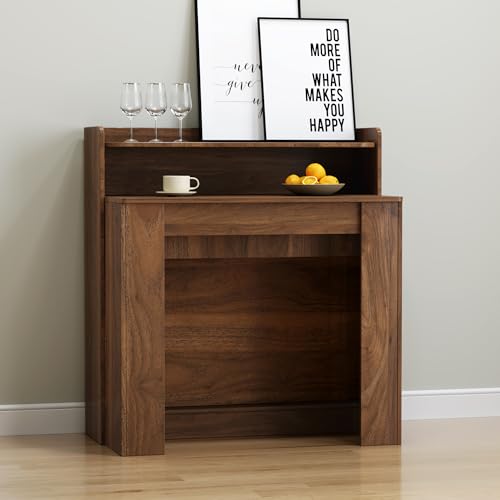
Varelynn 20"-98" Extendable Dining Table with Storage for 2-10, Walnut | Convertible Console Table with Storage, Extendable Design, Space Saving Solution, Ideal for Family Meals and Holiday Events
Check price on Amazon
3 in 1 Lift Top Coffee Table, Fluted Convertible Coffee Tables Converts to Dining Tables, Modern Oval Wooden Center Table with Storage for Living Room Office Small Space, Partial Assembly (Natural)
Check price on Amazon
Extendable Dining Table with Charging Station, Convertible Folding Console Table for 6-8 People, Space-Saving Dining Table with LED Lights, Wood Rectangle Kitchen Table for Homes, Walnut (No Chairs)
Check price on Amazon
YUHFERA Swivel Table for Recliner Chair with Tilting Top, Adjustable Laptop Side Table for OverCouch & Sofa, Slide Under Tray Tables for Eating & Reading, Armchair Desk (Rustic Brown)
Check price on Amazon
Semoic 40-Inch Farmhouse Lift Top Coffee Table with Storage (White+Walnut) | 4-in-1 Multi-Function Lift Top Coffee Table, Storage Drawers and Hidden Compartment, Converts to Dining Table for Living Room
Check price on Amazon
AMHANCIBLE C Shaped End Table Set of 2, Couch Side Table that Slide Under | TV Trays for Eating on Couch, Narrow Small Space Side Tables for Living Room Bedroom, Rustic Brown
Check price on Amazon
Conabaen Solid Wood Convertible Lift Top Coffee Table to Dining Table | 31.5" to 59" Expandable Folding Dining Table for 4-6, Adjustable Space-Saving Center Table, Walnut
Check price on AmazonFrequently Asked Questions
What is a sofa table that converts to a dining table?
A sofa table that converts to a dining table is a multifunctional furniture piece designed to sit behind a sofa in its compact form, then expand or raise into a full dining surface when needed. It typically uses a lift mechanism, folding leaves, or a pull-out extension system.
How much space does a convertible sofa dining table need?
In sofa-table mode, most models need about 30 to 40 cm of depth behind the sofa. When converted to dining height, you should allow at least 75 to 90 cm of clearance on each seating side so chairs can pull out comfortably.
Are convertible sofa dining tables sturdy enough for daily meals?
Premium and mid-range convertible tables with reinforced steel lift mechanisms and solid wood or high-grade laminate tops are built for daily use. Entry-level models may wobble slightly when fully extended, so check the locking mechanism and weight capacity before buying.
What is the difference between a lift-top and a leaf-extension convertible table?
A lift-top model raises the tabletop vertically from coffee or sofa height to dining height, keeping the same footprint. A leaf-extension model expands horizontally with folding or drop leaves, increasing the surface area rather than the height. Some premium models combine both mechanisms.
Can a convertible sofa table be used outdoors?
Most indoor convertible tables are not weather-resistant. For patio or balcony use, choose a model explicitly rated for outdoor conditions with rust-proof hardware and UV-resistant finishes. Indoor models should stay in climate-controlled spaces.
Ready to Choose Your Convertible Table?
Use the checklist above to narrow your options by mechanism, deployed width, and material. Then compare the recommended models in the product section and read the full feature breakdown before you decide.