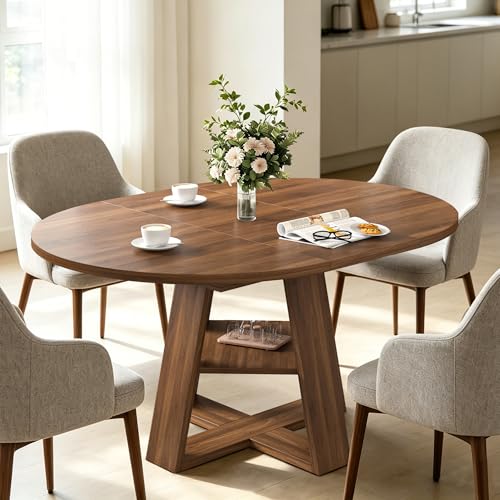
Extendable Dining Table Guide: Flexible Seating Without Compromise
Everything you need to know about extension mechanisms, leaf types, sizing, materials, and room layout — so you can host a crowd on demand and reclaim your floor space the rest of the week.
Explore MechanismsWhy an Extendable Dining Table Makes Sense
An extendable dining table solves one of the most common tensions in home dining: you want a table that feels right for daily meals but can also seat guests comfortably. A fixed table forces a compromise — either it crowds your everyday space or it falls short when friends and family arrive. Extension tables remove that trade-off by changing footprint on demand.
The appeal goes beyond occasional hosting. Households with changing compositions, remote workers who need a surface for projects, and apartment dwellers who value floor space all benefit from a table that adapts. When you start browsing dining table types, you will notice that extendable models appear across nearly every shape category, from rectangular and oval to round designs that grow into generous gathering surfaces.
Another practical advantage is long-term flexibility. A table that seats four today can seat eight later without replacing the furniture. If you are comparing table shapes before committing, the rectangular dining table guide and oval dining table guide both explain how extension leaves interact with each silhouette, which helps you visualize the extended form before you buy.
Key insight: The best extendable table is not the one with the largest maximum length — it is the one whose closed size fits your daily life and whose extension mechanism you can operate confidently and regularly.
Extension Mechanisms Explained
The mechanism is the heart of any extendable table. It determines how easy the table is to expand, how stable it feels when extended, and how much maintenance it needs over the years. There are four main systems to understand.
1. Butterfly Leaf (Self-Storing) Mechanism
A butterfly leaf folds in half and stores inside the table body, typically beneath the tabletop. To extend, you pull the two halves of the table apart and the folded leaf swings up and unfolds into the gap. This is the most user-friendly design for solo operation, and it eliminates the storage problem that plagues separate leaves.
Butterfly mechanisms are common on mid-range and premium tables because they require tighter tolerances and sturdier hardware. When well-built, the leaf locks firmly and the seams sit nearly flush. Cheaper butterfly designs can develop a slight flex at the center seam over time, so inspect the locking latch and frame reinforcement before committing.
2. Separate Leaf (Loose Leaf) Mechanism
With this classic design, the table splits or slides apart and you insert one or more loose leaves stored elsewhere — a closet, under a bed, or in a dedicated storage bag. Separate-leaf tables are often simpler mechanically and tend to be stable when extended, but they require two people for smooth handling on larger tables and demand storage space for the leaves.
If you only extend a few times a year, a separate-leaf table can be a solid choice. If you expect to expand weekly, the handling friction becomes a real annoyance, and a self-storing design is worth prioritizing.
3. Synchronized Slide Mechanism
Synchronized slides use geared tracks so both halves of the table move apart evenly with a single pull. This system is often paired with butterfly leaves on higher-tier tables. The result is a smooth, controlled expansion that reduces the risk of misalignment and makes the table feel engineered rather than improvised.
High-end tier tables frequently combine synchronized slides with reinforced steel tracks and dual locking points. These are the mechanisms to look for if you want the table to feel as solid extended as it does closed.
4. Drop-Leaf and Gateleg Mechanisms
Drop-leaf tables use hinged sections that fold down at the sides, supported by swing-out legs or brackets. They are technically expandable, but they change shape rather than inserting a leaf. For a deep dive on this family, the drop-leaf dining table guide covers the trade-offs in detail. Gateleg designs are closely related and worth understanding if your priority is a compact closed footprint.
| Mechanism | Ease of Use | Storage Needed | Stability When Extended | Best For |
|---|---|---|---|---|
| Butterfly (self-storing) | Very easy, one person | None | Excellent on quality builds | Frequent hosts, small homes |
| Separate loose leaf | Moderate, often two people | Leaf storage required | Very good | Occasional hosting, larger rooms |
| Synchronized slide | Easy and smooth | None (with butterfly leaf) | Premium | High-end tier buyers |
| Drop-leaf / gateleg | Easy | None | Good for compact use | Studio apartments, kitchen nooks |
Types of Extendable Tables by Leaf Style
Beyond the mechanism, the leaf style shapes how the table looks and functions. Understanding the differences helps you match the table to your room and hosting habits.
Rectangular Extension Tables
Rectangular tables are the most common platform for extension leaves because the geometry is straightforward and the extended length scales predictably. A rectangular table that seats four can often reach six or eight seats with one or two leaves. The rectangular dining table guide explains how to size the extension for your room, and the same principles apply whether the leaf is butterfly-style or separate.
Oval Extension Tables
Oval tables soften the visual weight of a long surface and improve flow around corners. When extended, an oval table keeps its curved ends, which can make a large gathering feel less formal. Oval extension tables pair well with pedestal bases, and the dining table pedestal guide explains why pedestal bases matter for legroom on extended oval designs.
Round Extension Tables
Round tables that extend typically convert to an oval or a larger round, depending on the leaf design. Round tables are sociable and space-efficient in their closed form, making them a natural fit for smaller dining areas. The round dining table guide covers how round tables behave in compact rooms and how extension changes their seating geometry.
Square Extension Tables
Square tables are less commonly extended, but some designs add a central leaf to become rectangular. These are useful in open-plan spaces where a square table anchors a zone but needs occasional extra length. The square dining table guide is a useful companion for understanding how a square footprint converts when extended.
Sizing and Seating Capacity
Extension tables are defined by two dimensions: the closed footprint and the fully extended length. Both matter, but buyers often focus on the extended size and forget to verify the closed size fits their daily routine.
As a general rule, allow about 24 inches of table width per seated diner along the long edge, and roughly 30 inches of clearance on all sides for chair pull-out and walkway flow. A closed table that seats four comfortably might extend to seat six or eight, depending on the leaf width. When planning seating, the seating capacity guides for 4-seater, 6-seater, and 8-seater configurations help you translate length into real headcount.
| Closed Seating | Typical Extended Seating | Extension Added | Room Clearance to Plan |
|---|---|---|---|
| 4 seats | 6 seats | 18–24 inches | Plan for extended footprint plus 30 inches all sides |
| 4–6 seats | 8 seats | 24–36 inches | Verify walkway width at full extension |
| 6 seats | 10 seats | Two leaves, 36–48 inches | Consider a pedestal base for legroom |
For a broader reference across all table categories, the dining table size chart is a practical companion to this guide. If your room is tight, the narrow dining room furniture layout guide explains how to position an extension table so it does not choke the traffic path when expanded.
Materials and Frame Construction
An extension table is only as good as its frame. Moving parts concentrate stress at the apron, slides, and locking hardware, so construction quality matters more than on a fixed table.
Solid wood frames — particularly oak, walnut, and teak — are the benchmark for durability in extension tables because they hold screws and tolerate repeated movement. The solid oak dining table guide and walnut dining table guide both discuss how these species behave under repeated mechanical use. Mango wood offers a more accessible entry into solid wood construction, and the mango wood dining table guide explains its characteristics.
If you prefer stone or glass surfaces, note that extension mechanisms on these tables are usually engineered differently. The marble dining table guide and glass dining table guide cover the weight and reinforcement considerations specific to those materials. For a full overview of surface options, the materials and finishes hub is the central reference.
Finish also affects longevity. Matte and oiled finishes are easier to spot-repair, while lacquered and glossy surfaces resist staining but show scratches more readily. The matte finish guide and oiled dining table guide explain maintenance expectations for each.
Room Layout and Clearance Planning
Extension tables demand a two-state layout plan: one for the closed configuration and one for the fully extended state. The most common mistake is measuring only the closed footprint and discovering the extended table collides with a sideboard or blocks a doorway.
Start by mapping the fully extended length plus 30 inches of clearance on each side. Then check the closed position against your daily traffic flow. If the extended state only works when a chair is removed or a sideboard is cleared, decide whether that is acceptable for the few times a year you host.
The dining table space planning guide walks through the measurement process step by step. For tight rooms, the walkway clearance guide gives concrete minimums, and the flow and traffic planning guide helps you test whether the extended table will obstruct circulation.
Also plan chair storage. If your table seats four closed and eight extended, you need a place for the extra four chairs. Stackable chairs are one solution, and the stackable dining chair guide covers the options. Bench seating can also compress the chair count, as explained in the dining bench seating guide.
Extendable vs Fixed vs Folding Tables
Extendable tables sit between fixed tables and folding tables on the flexibility spectrum. Fixed tables are the most stable and simplest to maintain but cannot adapt. Folding tables are the most space-efficient when stored but compromise on stability and aesthetics for daily use.
If your priority is a permanent dining surface that occasionally grows, an extendable table is the balanced choice. If your priority is storing the table away entirely between uses, the folding dining table guide is the better starting point. If you need a table that shrinks to a very small footprint but stays in place, the drop-leaf dining table guide covers that middle ground.
Decision shortcut: Host weekly or more → prioritize a self-storing butterfly mechanism. Host a few times a year → a separate-leaf table is perfectly adequate. Live in a studio or very small flat → consider drop-leaf or gateleg before a full extension table.
Buying Checklist
Use this checklist to evaluate any extendable table before you commit. It is organized around the factors that most often cause buyer regret.
- Mechanism type and operation: Test the extension yourself if possible. Does it glide smoothly? Does the leaf lock firmly? Can one person operate it?
- Closed and extended dimensions: Confirm both measurements and map them against your room. The extended length is the number that determines hosting capacity; the closed length determines daily comfort.
- Frame material and joinery: Look for solid wood or high-grade metal frames, reinforced aprons, and mechanical fasteners rather than glue-only joints at stress points. The dining table frame guide explains what to inspect.
- Leaf storage: Self-storing leaves eliminate clutter; loose leaves need a dedicated storage plan.
- Stability when extended: A table that wobbles at full extension is a safety and usability problem. Check leg splay and pedestal design against the extended length.
- Seating compatibility: Confirm chair height and clearance. The dining table chair height guide covers the ergonomics.
- Finish and care requirements: Match the finish to your maintenance willingness. The care and maintenance hub is the central reference for ongoing upkeep.
- Warranty on mechanism: Extension hardware is the most likely failure point; check whether the warranty covers it specifically.
Before finalizing any purchase, the first dining table checklist and the dining table buying mistakes guide are worth a read — they catch the oversights that extension-table buyers commonly make. If terminology feels unfamiliar, the dining table spec glossary decodes the language used in product listings.
Ready to Compare Extendable Dining Tables?
Browse curated options across entry-level, mid-range, and premium tiers — filtered for mechanism quality, frame construction, and real-world seating capacity.
Explore Shopping & ReviewsCare and Maintenance
Extension tables need slightly more attention than fixed tables because of their moving parts. The routine is simple but worth building into your habits.
- Keep tracks clean: Crumbs and dust in the slides are the leading cause of stiff mechanisms. Wipe the tracks monthly with a dry cloth.
- Lubricate sparingly: Use a dry lubricant recommended by the manufacturer once or twice a year. Liquid oils attract dust and can stain wood.
- Never force a stuck mechanism: Forcing a leaf can bend tracks or crack the apron. If the table resists, check for debris or misalignment first.
- Protect the surface during use: A table pad reduces scratches and heat marks; the dining table pad protection guide explains the options.
- Address wobble early: A wobbly extended table usually signals loose hardware or a leveling issue. The wobbly dining table fix guide and surface leveling guide cover the fixes.
- Seasonal checks: Wood expands and contracts with humidity. The humidity care guide explains how to keep an extension mechanism moving freely through seasonal shifts.
For a complete maintenance routine, the routine upkeep guide and the care and maintenance hub are the central references.
Frequently Asked Questions
How much space does an extendable dining table need when fully extended?
Measure the fully extended length and add at least 30 inches of clearance on every side for chair pull-out and walkway flow. For a typical extension that adds 18 to 24 inches, plan your room around the fully extended footprint rather than the closed size, so the table always fits comfortably during gatherings.
Are butterfly leaf tables as stable as fixed tables?
A well-built butterfly leaf table with a reinforced frame and a reliable locking mechanism is stable enough for everyday use. Stability depends more on frame construction, apron depth, and leg design than on the leaf type itself. Always test the leaf lock and check for any wobble at the seams before purchase.
Which extension mechanism is easiest for one person to operate?
Self-storing butterfly leaf tables are generally the easiest for a single person because the leaf folds and tucks under the tabletop. Synchronized butterfly mechanisms on premium tables glide open with one pull. Traditional separate-leaf tables require storing the leaf elsewhere and two people for smoother handling.
Can an extendable table be used outdoors?
Only if it is explicitly rated for outdoor use. Extension mechanisms have moving joints that trap moisture, so indoor tables moved to a patio will swell, jam, or rust. Look for weather-resistant coatings, stainless hardware, and sealed seams if you need an outdoor expandable option.
How do I maintain the extension mechanism over time?
Keep the tracks and slides free of crumbs, wipe them monthly, and apply a dry lubricant recommended by the manufacturer once or twice a year. Avoid liquid oils that attract dust. Tighten any loose screws on the locking hardware, and never force a stiff mechanism — jamming usually signals debris or misalignment rather than a design flaw.
For more context on how extendable tables compare with other flexible designs, the dining table types hub and the shopping and reviews hub are the next stops. If you are still deciding between an extension table and a fixed design, the extendable vs fixed dining table comparison walks through the trade-offs directly.
Recommended Extendable Dining Tables
⚠️ AFFILIATE DISCLOSURE: This website contains affiliate links. As an affiliate Associate, we earn from qualifying purchases. If you make a purchase through these links, we may receive a small commission at no additional cost to you. Read our full affiliate policy.

Briwooody 2 Pack 26" Standard Table Extension Slides Set Table Extender | (allows for Max 52" Opening) for Dining Table with 4 Legs Smooth Extension and Easy Installation, 26" L, 2.75" W, 2.38" H
Check price on Amazon
Heavy Duty Table Extension Brackets (Set of 2), 26" Steel Support Rails for DIY Dining Table Leaf, Matte Black Steel Hardware for Extending Solid Wood Dining Tables
Check price on Amazon
Heavy Duty Slide Rails for Table Extension – Center Rack and Pinion Design Wooden Table Extender Slides with Flawless Alignment – Smooth Center Mount Slides with One-Handed Operation
Check price on Amazon
WOODCRAFT Project Paper Plan to Build Round Pedestal Extension Table - Material Not Included
Check price on Amazon
Ariiles Extendable Dining Table, 54-85 Inch Expandable Table for 4-10 People, Modern Rectangular Dining Table, Space-Saving for Kitchen & Dining Room
Check price on Amazon
TimesGate Extendable Dining Table 8 to 12 People, 63"-93.5" W, Dark Gray | Stainless Steel Guide Rail,Flexible Stretch, Tabletop Made from Rock Plate and Tempered Glass
Check price on Amazon
Extendable Dining Table with Charging Station, Convertible Folding Console Table for 6-8 People, Space-Saving Dining Table with LED Lights, Wood Rectangle Kitchen Table for Homes, Walnut (No Chairs)
Check price on Amazon