
Round Dining Table Guide: Sizes, Materials & Buying Tips
Everything you need to choose a round dining table that fits your space, seating needs, and design style — from size planning to material selection and long-term care.
Why a round dining table? Round tables bring people together. With no corners to navigate and no head-of-table hierarchy, they encourage conversation and make small dining rooms feel larger. This guide walks you through the key decisions — diameter, seating capacity, base style, material, and finish — so you can buy with confidence.
Why Choose a Round Dining Table?
A round dining table is one of the most versatile pieces of furniture you can own. Its circular shape eliminates sharp corners, improves foot traffic flow, and creates an intimate setting for meals and conversation. Whether you have a compact breakfast nook or an open-plan dining room, a round table adapts to the layout with remarkable ease.
Compared with rectangular designs, a round table distributes seating evenly around the perimeter, so every guest has comfortable elbow room. This makes round tables especially popular in homes that entertain frequently but lack the floor area for a long rectangular footprint. If you are still weighing shapes, our dining table types overview and the rectangular dining table guide can help you compare layouts side by side.
Space Efficiency
No corners means easier navigation in tight rooms. A round table uses floor area more efficiently than a rectangular table of similar seating capacity.
Social Connection
Everyone can see and hear each other. Round tables foster natural conversation and work beautifully for family meals and dinner parties.
Design Flexibility
Round tables pair well with almost any interior style — modern, farmhouse, Scandinavian, or industrial — and suit both casual and formal settings.
Child-Friendly
No sharp corners reduces bump risk for young children, making round tables a smart choice for family homes.
Round Dining Table Sizes and Seating Capacity
Choosing the right diameter is the single most important decision. A table that is too small feels cramped, while one that is too large overwhelms the room and blocks walkways. As a general rule, allow about 24 inches (60 cm) of table edge per person for comfortable dining, plus at least 36 inches (90 cm) of clearance around the table for chair pull-out and walkways.
| Diameter | Typical Seating | Best For | Room Size Guidance |
|---|---|---|---|
| 30–36 inches (76–91 cm) | 2 people | Breakfast nooks, balconies, small kitchens | Compact spaces from about 6×6 ft |
| 42–48 inches (107–122 cm) | 4 people | Small dining rooms, apartments, casual family meals | Rooms from about 8×8 ft |
| 54–60 inches (137–152 cm) | 4–6 people | Standard family dining rooms, everyday entertaining | Rooms from about 10×10 ft |
| 60–72 inches (152–183 cm) | 6–8 people | Larger dining rooms, frequent hosting | Rooms from about 12×12 ft |
For a deeper breakdown of seating by table size, see our dining table size chart. If you are furnishing a small apartment, the 2-seater dining table guide and 4-seater dining table guide offer practical layout advice. For larger families, the 6-seater dining table guide and 8-seater dining table guide explain how to plan around bigger circular tables.
Best Materials for Round Dining Tables
The material you choose affects durability, maintenance, and the overall look of your dining space. Round tables are available in a wide range of materials, each with distinct strengths. Here is how the most common options compare.
Solid Wood
Solid wood remains the most popular choice for round dining tables thanks to its warmth, durability, and ability to be refinished over time. Oak, walnut, teak, and mango wood are all excellent options. A solid oak dining table offers a hard, resilient surface with beautiful grain, while a walnut dining table brings a rich, dark tone that suits contemporary interiors. For humid climates, a teak dining table is naturally resistant to moisture and pests. Explore the full range in our materials and finishes hub.
Stone and Marble
A marble dining table delivers a luxurious, elegant look with a cool, smooth surface. Marble and granite dining tables are heavy and durable, but they require sealing to resist stains. These are best suited to formal dining rooms where the table is used for entertaining rather than heavy daily craft projects.
Glass
A glass dining table creates an airy, open feel that makes small rooms appear larger. Glass tops are easy to clean but show fingerprints and require careful handling. Tempered glass is the standard for safety and durability. Pair a glass round table with a solid base to anchor the design.
Metal and Composite
A metal dining table with a powder-coated finish is a durable, low-maintenance option for modern and industrial interiors. Concrete dining tables offer an architectural, heavy-duty presence, while resin dining tables provide weather resistance for covered outdoor dining areas.
Pedestal vs. Legged Bases
Round tables typically use one of two base styles, and each has practical implications for seating and comfort.
Pedestal Base
- No corner legs to bump into — chairs tuck in freely all around
- Maximizes seating capacity for a given diameter
- Great for small rooms and tight chair arrangements
- Choose a wide, weighted foot for stability
Legged Base
- Traditional, sturdy appearance
- Legs can interfere with chair placement at the corners
- Often easier to repair or tighten over time
- Better suited to larger diameters where legs sit inward
For a detailed comparison of base construction, read our dining table pedestal guide and dining table leg guide. Frame construction also matters for long-term stability — the dining table frame guide explains what to look for in joinery and bracing.
Round vs. Other Table Shapes
Round tables are not the right fit for every room. Here is a quick comparison to help you decide whether a round, oval, square, or rectangular table suits your space best.
- Round vs. rectangular: Round tables save space in compact rooms and improve conversation, while rectangular dining tables suit long rooms and larger gatherings. See our full round vs rectangular dining table comparison for a deeper analysis.
- Round vs. oval: An oval dining table keeps the soft, social feel of a round table but stretches to seat more people in narrow rooms.
- Round vs. square: A square dining table offers similar corner-free seating for four but uses wall space differently and can feel boxier.
- Round vs. extendable: If you host occasionally, an extendable dining table lets you grow the table for guests. Some round tables feature butterfly-leaf extensions, though they are less common than on rectangular models.
Measuring Your Space and Planning the Layout
Before you buy, measure your room carefully. Place painter’s tape on the floor to outline the table’s diameter, then add the chair pull-out zone. Aim for at least 36 inches (90 cm) of clearance between the table edge and walls or other furniture, and 44–48 inches (110–120 cm) in main walkways. Our dining table space planning guide and walkway clearance guide walk you through the numbers in detail.
Lighting is another key consideration. A round table pairs beautifully with a single pendant or chandelier centered above. The dining table lighting placement guide explains how high to hang fixtures and how to size them to the table. If your dining area is narrow, the narrow dining room furniture layout guide offers specific arrangements that work.
Choosing Chairs for a Round Table
Round tables work best with chairs that have a curved or rounded back, as they echo the table’s shape. Armless chairs are usually easier to tuck in, especially when seating four or more. For a cohesive look, consider a mix of upholstered chairs and a bench on one side, though benches are less common with round tables. Our dining chair selection guide covers proportions and comfort, and the dining table chair height guide explains the ideal seat-to-table clearance. If you want softness and comfort, see the upholstered dining chair guide.
Styling a Round Dining Table
Round tables are a natural canvas for centerpieces. A low, circular arrangement of flowers or greenery works better than a long runner, which can look awkward on a circular surface. A dining table centerpiece guide will help you choose scale-appropriate decor, and the dining table candle styling guide covers safe, elegant candle arrangements. For casual meals, placemats in a circular or scalloped shape follow the table’s curve beautifully.
If you want to change the look seasonally, tablecloths and runners (used as a short center strip rather than edge-to-edge) can refresh the table without a major investment. For overall design inspiration, browse the style and design hub.
Care and Maintenance for Round Dining Tables
Round tables need the same care as any quality dining surface. Wood tables benefit from regular dusting and periodic polishing — see the wood dining table wax and polish guide. Always use coasters and trivets to prevent water rings and heat marks. A protective dining table pad is useful during holidays and craft sessions. For stone tops, follow the marble dining table sealing guide and the glass dining table cleaning guide for glass surfaces. The care and maintenance hub collects all routine upkeep advice in one place.
Round Dining Table Buying Checklist
Before you finalize your choice, run through these key checkpoints. They reflect the questions most buyers ask at the research stage and help you avoid common mistakes.
- Measure the room and walkways — confirm at least 36 inches of clearance around the table and 44+ inches in main paths.
- Confirm seating capacity — match the diameter to your household size, accounting for occasional guests.
- Choose a base style — pedestal for maximum chair freedom, legs for traditional stability.
- Select a durable material — solid wood for warmth and refinishing, stone for luxury, glass for an airy look, metal for low maintenance.
- Check the finish — matte and oiled finishes feel natural but need upkeep; lacquered and glossy finishes resist stains but can show scratches. See the matte finish guide and oiled table guide for details.
- Verify stability — a pedestal foot should be wide and weighted; legs should be firmly joined with quality hardware.
- Plan for assembly — most round tables ship flat-packed; check the dining table setup guide for what to expect.
- Review the return and warranty policy — large furniture returns are costly in time and effort, so confirm terms before ordering.
For a broader pre-purchase review, the first dining table checklist and dining table buying mistakes articles cover the full decision process. If you are shopping across tiers, the mid-range dining table picks and luxury dining table collections pages offer curated starting points.
Recommended Round Dining Tables
⚠️ AFFILIATE DISCLOSURE: This website contains affiliate links. As an affiliate Associate, we earn from qualifying purchases. If you make a purchase through these links, we may receive a small commission at no additional cost to you. Read our full affiliate policy.

Food & Drink Infographics. A Visual Guide to Culinary Pleasures (multilingual Edition)
Check price on Amazon
Vipbear 35.5'' Round Dining Table for 2-4 with 2-Tier Storage Shelf | Small Space-Saving Dining Room Table Wood Kitchen Fluted Dinner Tables with Pedestal Base for Restaurant Kitchen(Walnut)
Check price on Amazon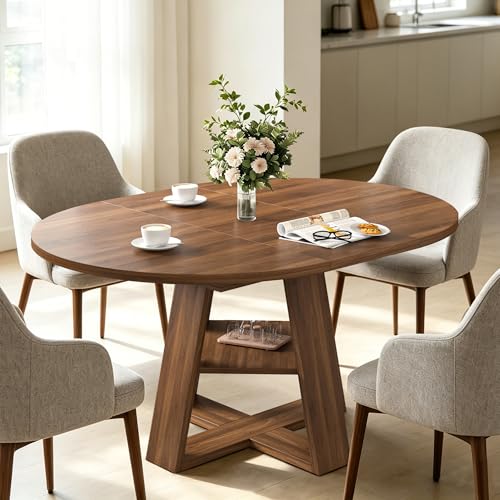
43.3"-59" Extendable Round Oval Dining Table for 4-8 with Storage Shelf | Modern Kitchen Oval Dining Table with Removable Leaves,Space Saving Extendable Table Wood Base for Kitchen Living Room Walnut
Check price on Amazon
The Year-Round Harvest: A Seasonal Guide to Growing, Eating, and Preserving the Fruits and Vegetables of Your Labor
Check price on Amazon
CHOEZON 47.2 inch Round Dining Table, Kitchen Table for 4-6 People, Walnut | Round Kitchen Table, Dining Room Table, Dinner Table, Geometric Base, Compact Profile, for Dining Room and Kitchen MCZ05HT
Check price on Amazon
47" Natural Wood Round Wooden Dining Table, Round Pedestal Dining Table | Unique Natural Wood Grain,Stable Pedestal Support, Mid-Century Modern
Check price on Amazon
ARDUINO: 3 in 1: Beginners Guide + Simple and Effective Strategies + Advance Methods and Strategies To Learn Arduino
Check price on AmazonFrequently Asked Questions
What size round dining table seats four people comfortably?
A 42–48 inch (107–122 cm) diameter table seats four adults comfortably. If you want extra elbow room or plan to serve platters on the table, choose 48 inches. For very tight spaces, a 36-inch table can seat four, but it will feel snug.
Is a round dining table good for small rooms?
Yes. Round tables eliminate corners and generally feel less imposing in compact spaces. They also allow chairs to be tucked in at multiple angles, which improves flow. Just be sure to leave enough clearance around the perimeter.
Can a round dining table seat six?
Yes, a 54–60 inch (137–152 cm) round table can seat six, though 60 inches is more comfortable. Seating six around a smaller round table works for casual meals but leaves little room for serving dishes.
What is the best base for a round dining table?
A pedestal base is usually best for round tables because it frees up legroom all around and maximizes seating. Choose a pedestal with a wide, weighted foot for stability. Legged bases are fine for larger diameters where the legs sit well inward from the edge.
How much clearance do I need around a round dining table?
Allow at least 36 inches (90 cm) from the table edge to walls or other furniture for chair pull-out and comfortable movement. In main walkways, aim for 44–48 inches (110–120 cm) so people can pass while others are seated.
Ready to Find Your Perfect Round Dining Table?
Browse our curated selection above, or explore more table shapes and materials to compare options before you decide.
Explore Table Types