
Convertible Dining Table Desk: The Ultimate Space-Saving Solution
Discover how a convertible dining table desk transforms a single surface into a dining area by day and a productive workspace by night. Learn the mechanisms, materials, and design considerations that make this dual-purpose furniture a smart choice for compact living.
Explore the Buying GuideWhy a Convertible Dining Table Desk? In modern homes, multipurpose furniture is no longer a compromise—it is a design strategy. A convertible dining table desk lets you reclaim square footage without sacrificing function, style, or comfort. Whether you live in a studio apartment, a compact urban flat, or a home office that doubles as a dining room, this hybrid piece delivers flexibility that single-purpose furniture simply cannot match.
What Exactly Is a Convertible Dining Table Desk?
A convertible dining table desk is a single piece of furniture engineered to switch between two modes: a dining table for meals and a desk for work, study, or creative projects. Unlike a standard table with a fixed height or surface, a convertible model uses a mechanical system—folding panels, lifting mechanisms, sliding extensions, or pivoting tops—to transform its shape, height, or usable surface area.
The concept has evolved significantly over the past decade. Early models were purely functional and often visually utilitarian, but today's convertible designs are available in premium finishes, solid hardwood constructions, and elegant silhouettes that blend seamlessly into contemporary interiors. The core appeal remains the same: one footprint, two lifestyles.
How Do Convertible Mechanisms Work?
Understanding the mechanism is the most important step before choosing a convertible dining table desk. Different systems suit different living situations, and each has distinct advantages and trade-offs. Below are the most common mechanisms you will encounter.
Drop-Leaf Panels
Hinged side panels fold down to shrink the table into a compact desk or console. Lift the leaves to extend the surface for dining. Simple, reliable, and ideal for narrow spaces.
Lift-Top / Height-Adjustable
A gas-spring or manual lift raises the tabletop from desk height to dining or bar height. Some models also adjust the surface angle, making them excellent for reading or drafting.
Sliding / Extending Tops
The top slides horizontally or an extension leaf unfolds from the center. These models preserve a stable frame while expanding the usable surface for guests.
Pivot & Flip Mechanisms
The tabletop rotates or flips to reveal a different surface—often one side finished for dining and the other configured as a writing desk. Pivot systems offer the cleanest transformation.
When evaluating a mechanism, test the smoothness of operation and look for reinforced hardware. Entry-level models may use basic hinges, while mid-range and premium models typically feature locking mechanisms, soft-close hinges, or gas-spring assists that make daily conversion effortless. If you plan to convert the table multiple times per day, invest in a mechanism rated for frequent use.
Space Planning: Who Benefits Most from a Convertible Design?
A convertible dining table desk is particularly valuable in several living scenarios. If you recognize your own situation below, this furniture category deserves a place on your shortlist.
- Studio and micro-apartments: When every square foot counts, a single convertible surface eliminates the need for separate dining and work zones. Many models fold flat or compact enough to tuck against a wall.
- Remote workers with limited space: A dedicated home office is a luxury many cannot spare. A convertible desk-dining table lets you close the laptop and seat guests without rearranging the room.
- Open-plan living areas: In kitchen-dining-living combos, a convertible table keeps the visual footprint light and prevents the dining zone from dominating the room during work hours.
- Guest rooms and multi-use rooms: A room that serves as a guest bedroom, study, and occasional dining space benefits from furniture that adapts to each role.
- First-time renters and frequent movers: One well-built convertible piece is easier to move and reconfigure than two separate furniture items.
If your space is especially tight, consider pairing a convertible model with complementary solutions such as a compact dining table arrangement or a small dining table layout that maximizes flow. For rooms where the table must disappear entirely between uses, a fold-away dining table with chairs can be an excellent alternative to a pure convertible design.
Materials and Build Quality: What to Look For
A convertible table experiences more mechanical stress than a fixed table because its surfaces and joints move regularly. Material choice directly affects longevity, stability, and how the table feels during daily use.
Solid hardwood—oak, walnut, teak, or maple—offers the best long-term durability for hinged and sliding mechanisms because it holds screws and hardware securely. A solid oak butcher block dining table construction, for example, provides a dense, stable surface that resists wear from laptops, plates, and writing instruments. Engineered wood with a quality veneer is a practical mid-range option, but check that the core is moisture-resistant and that hinge points are reinforced with metal inserts.
Steel or aluminum frames paired with wood or laminate tops are common in convertible designs because metal provides rigidity without bulk. Look for powder-coated finishes that resist scratching and rust. A rustic wood dining table with metal legs aesthetic translates well to convertible models, combining warmth with structural strength.
Because the same surface serves meals and hosts laptops, choose a finish that resists water rings, heat marks, and ink stains. Matte lacquers and oiled finishes are popular for their natural look, but they require periodic maintenance. Polyurethane and ceramic-coated tops offer greater stain resistance and are easier to wipe clean—a practical choice for households that convert the table several times a day.
Market Tiers: Matching Specifications to Your Needs
Convertible dining table desks are available across a wide spectrum of build quality and mechanism sophistication. The table below outlines what you can generally expect at each tier, using neutral quality descriptors rather than absolute figures.
| Tier | Typical Mechanism | Materials & Build | Best For |
|---|---|---|---|
| Entry-Level | Basic folding hinges or manual drop-leaves | Engineered wood with laminate finish; light metal fittings | Occasional use, first apartments, temporary setups |
| Mid-Range | Smooth-glide slides, locking hinges, or assisted lift | Wood veneer over moisture-resistant core; reinforced hardware | Daily conversion, remote work, small families |
| Premium | Gas-spring lift, precision pivot, or dual-action extension | Solid hardwood or high-grade engineered panels; heavy-duty steel frame | Frequent use, design-conscious homes, long-term ownership |
| Luxury / Commercial-Grade | Engineered multi-position systems with soft-close and lock-out safety | Solid premium hardwoods, stone or ceramic tops, architectural hardware | High-frequency use, design-led interiors, hospitality settings |
Across all tiers, the key differentiator is not aesthetics alone but the quality of the transformation mechanism. A mid-range model with a well-engineered locking hinge will often outperform a premium-looking table with weak hardware. When comparing options, prioritize mechanism reliability and frame rigidity over decorative details.
Recommended Convertible Dining Table Desk Picks
⚠️ AFFILIATE DISCLOSURE: This website contains affiliate links. As an affiliate Associate, we earn from qualifying purchases. If you make a purchase through these links, we may receive a small commission at no additional cost to you. Read our full affiliate policy.

Transformer Table to Desk, Natural | Simple Modern, Home Office Desk with Storage, Folding Desk into Dining Table, Multiuse Dining Table and Gaming Desk
Check price on Amazon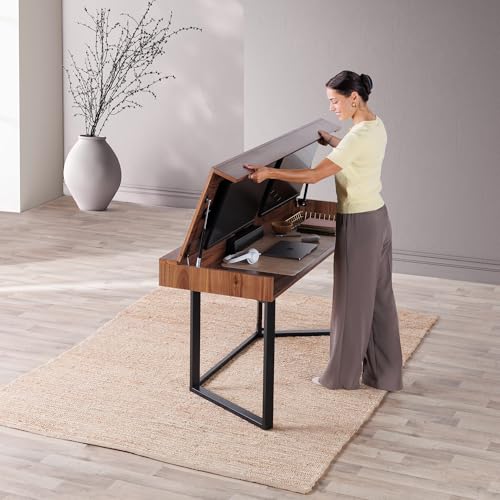
Transformer Table to Desk, Royal Walnut | Dining Table to Computer Desk, Work-from-Home Office, Gaming Desk, Study Desk, Space-Saving Furniture
Check price on Amazon
2 in 1 Multifunction Convertible Dining Table for Small Spaces, 47.2" Long | Convertible Table to Shelf│Pre-Assembled Design for Easy Assembly│25mm Thickened E1-Grade MDF Board│250 lbs load Capacity
Check price on Amazon
Aztecs Folding Console to Dining Convertible Table with Solid American Basswood
Check price on Amazon
DONGMUWUJEE Solid Wood Small Dining Table for 2-6, 23.6"L-47.2"L Expandable Kitchen Table, Designed for Small Spaces, Easy Assembly, Suitable for Kitchen, Dining Room, Living Room, Apartment (Walnut)
Check price on Amazon
Extendable Dining Table with Charging Station, Convertible Folding Console Table for 6-8 People, Space-Saving Dining Table with LED Lights, Wood Rectangle Kitchen Table for Homes, Walnut (No Chairs)
Check price on Amazon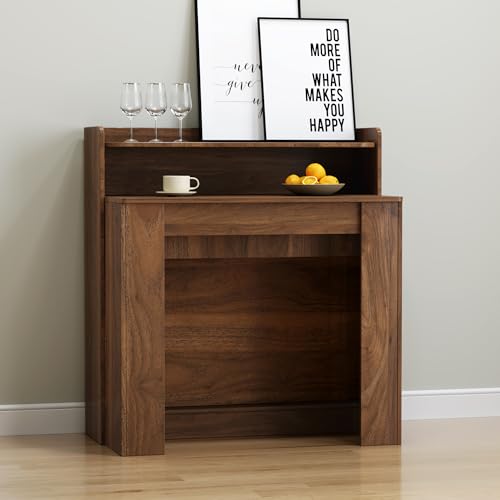
Varelynn 20"-98" Extendable Dining Table with Storage for 2-10, Walnut | Convertible Console Table with Storage, Extendable Design, Space Saving Solution, Ideal for Family Meals and Holiday Events
Check price on Amazon
ModernMate 55" Convertible Computer Desk with Hidden Storage, Light Walnut | 2-in-1 Flip-Top Desk & Dining Table, Built-in Power Strip, Pegboard, Soft-Close Gas Spring, Space-Saving for Small Apartment
Check price on AmazonEssential Buying Checklist for a Convertible Dining Table Desk
Before committing to a convertible model, run through the following checklist. Each point addresses a practical concern that owners commonly encounter after purchase.
- Measure the transformation envelope: A table that extends to dining size needs clearance in every direction. Measure the fully extended dimensions, not just the folded footprint, and confirm that chairs can pull out comfortably.
- Check seated comfort in both modes: Desk height typically ranges from 28 to 30 inches, while dining height sits around 30 inches. Confirm that the model supports comfortable seating for both tasks, or that it adjusts between them. For reference, consult an ideal height of dining table guide to compare standards.
- Test the mechanism action: If possible, try the conversion in person. The motion should be smooth, predictable, and free of wobble when locked. Listen for grinding or rattling, which may indicate loose or low-grade hardware.
- Verify stability at full extension: Extended tables are more prone to tipping or flexing. Look for wide-set legs, a pedestal base, or stabilizing braces that maintain rigidity when the surface is expanded.
- Consider storage and clearance: Some convertible desks require wall clearance for pivoting or lifting. Confirm that your room layout allows the required movement without blocking walkways or doors.
- Review the weight capacity: Dining use involves plates, serving dishes, and leaning elbows; desk use involves monitors and equipment. Check that the rated load suits your heaviest intended use.
- Plan for cable management: If the desk mode will host a laptop, monitor, or lamp, look for integrated grommets, cable trays, or a rear channel to keep wires organized when the table converts.
For very tight rooms, you may also want to compare a convertible design against dedicated small-space solutions such as a super small dining table, a corner dining table, or a wall bed dining table combination. Each approach solves the same problem from a different angle, and the best choice depends on how often you switch modes and how much floor space you can dedicate.
Design and Styling: Making a Dual-Purpose Table Fit Your Interior
Convertible furniture has a reputation for looking purely functional, but modern designs have closed that gap. A well-chosen convertible dining table desk can serve as a design anchor in a studio or open-plan room.
For a cohesive look, match the table's finish to your dominant wood tones or metal accents. A white formal dining table aesthetic works well in bright, minimalist interiors and can make a compact room feel larger. If your style leans warmer and more textured, a round boho dining table influence—natural fibers, rounded edges, and earthy finishes—translates nicely to convertible designs with organic silhouettes.
Lighting is especially important when one surface serves two purposes. A pendant or linear fixture centered over the table works for dining, but it may cast glare on a laptop screen during work hours. Consider dimmable fixtures or a layered lighting plan with a task lamp that can be repositioned when the table converts. For more guidance, see our notes on dining table lighting placement.
Finally, keep the surrounding furniture flexible. Lightweight chairs, a slim console, or a dining table settee can be repositioned quickly when the table changes mode. The goal is a room that supports both functions without requiring a full rearrangement every time you switch from work to dinner.
Care and Maintenance for Moving Parts
A convertible table needs slightly more attention than a fixed one, primarily because its hardware is exposed to repeated motion. Following a simple maintenance routine will keep the conversion smooth and extend the furniture's service life.
- Lubricate hinges and slides periodically: Use a silicone-based lubricant or dry PTFE spray on metal-to-metal contact points. Avoid heavy grease, which attracts dust and can gum up in cool rooms.
- Tighten hardware seasonally: Screws and bolts in folding legs and extension rails can loosen with repeated use. A quarterly check with a screwdriver prevents wobble and premature wear.
- Clean according to the surface finish: Wood surfaces benefit from a damp cloth and a pH-neutral cleaner, followed by a dry wipe. Avoid soaking joints, which can swell wood and corrode metal fittings.
- Protect the surface during meals and work: Use placemats, a desk pad, or a dining table pad protection guide approach to prevent scratches and heat marks. The same surface that holds a hot plate may later hold a laptop, so a protective layer is a practical investment.
- Store in the correct position: If the table folds flat for storage, follow the manufacturer's guidance on locking the mechanism before moving it. Never drag a convertible table across the floor while it is partially converted.
Common Mistakes to Avoid
Most dissatisfaction with convertible dining table desks comes from mismatched expectations rather than defective products. Avoiding the following pitfalls will help you choose a model that fits your daily routine.
- Underestimating clearance: Buyers often measure the folded size but forget the extended footprint. Always plan for the dining configuration, including chair pull-out space.
- Choosing style over mechanism quality: A beautiful finish cannot compensate for a stiff hinge or a wobbly extension rail. Prioritize the transformation system.
- Ignoring seated ergonomics: A table that works as a desk at 30 inches may feel slightly tall for dining, or vice versa. Confirm the height suits your chairs and your posture in both modes.
- Overlooking cable management: If the desk mode is a primary use, a lack of cable routing quickly leads to clutter. Plan for power and data cables before purchase.
- Skipping the stability test: A convertible table should feel solid when locked. If it rocks or flexes at full extension, the frame or locking mechanism is inadequate for daily use.
Frequently Asked Questions
Is a convertible dining table desk sturdy enough for daily use?
Yes, provided you choose a model with a reinforced frame and a mechanism rated for frequent conversion. Mid-range and premium tiers typically use locking hinges, gas-spring assists, or heavy-duty slides that maintain stability across thousands of cycles. Entry-level models are better suited to occasional use.
Can I use a regular dining chair with a convertible desk table?
In most cases, yes. The key is seat height relative to the table surface. Standard dining chairs pair well with tables around 30 inches high, while desk use may call for a chair with adjustable height. If the table also converts to bar height, you will need taller seating for that mode.
How much floor space does a convertible table need?
Plan for the fully extended dining footprint plus at least 24 inches of clearance on each side for chair pull-out. In desk mode, the footprint is usually smaller, but you should still allow room for a chair and comfortable legroom. Corner and wall-adjacent placements work well if the mechanism does not require full 360-degree clearance.
Are convertible tables suitable for outdoor use?
Indoor convertible models are generally not designed for outdoor exposure. If you need a dual-purpose table for a patio or balcony, choose a model explicitly rated for outdoor use with weather-resistant materials. For outdoor-specific layouts, see our guide to a folding patio dining table and chairs.
What is the difference between a convertible dining table desk and a folding table?
A folding table typically collapses for storage and is brought out only when needed. A convertible dining table desk remains in place and transforms between two functional modes—dining and working—without being put away. Convertible models prioritize stability and aesthetics in both modes, while folding tables prioritize portability.
Final Thoughts: Is a Convertible Dining Table Desk Right for You?
A convertible dining table desk is a practical, design-forward solution for anyone who needs two functional zones without two pieces of furniture. It shines in studios, compact apartments, open-plan homes, and any space where flexibility matters more than fixed dedicated rooms.
When choosing, focus on the mechanism first, the materials second, and the finish third. Measure the extended footprint, test the conversion action if possible, and plan for the small details—cable management, seating height, and surface protection—that make daily use effortless. With the right model, a single table can genuinely serve as the heart of both your workday and your dinner table.
If you are still narrowing down your options, explore related layouts such as a small dining table set for 4 or a dining table and chairs for a small apartment to compare how a convertible model fits alongside other space-conscious furniture choices.