
Teak Dining Table Guide: Durability, Style & Smart Buying
Everything you need to know about teak dining tables — from grain patterns and natural oil content to indoor versus outdoor performance, finish options, and long-term care. Make an informed decision before you buy.
Explore Teak PicksWhy Teak Deserves Your Attention: Teak is one of the few natural woods that combines exceptional durability, natural moisture resistance, and a warm golden-brown aesthetic. Whether you are furnishing an indoor dining room, a covered patio, or a sunroom, a teak dining table offers a long-term investment that ages gracefully and handles everyday use with minimal fuss. This guide walks you through what makes teak unique, how to evaluate quality, and how to choose the right teak table for your space.
Recommended Teak Dining Tables
Top Teak Dining Table Picks for Every Dining Space
⚠️ AFFILIATE DISCLOSURE: This website contains affiliate links. As an affiliate Associate, we earn from qualifying purchases. If you make a purchase through these links, we may receive a small commission at no additional cost to you. Read our full affiliate policy.
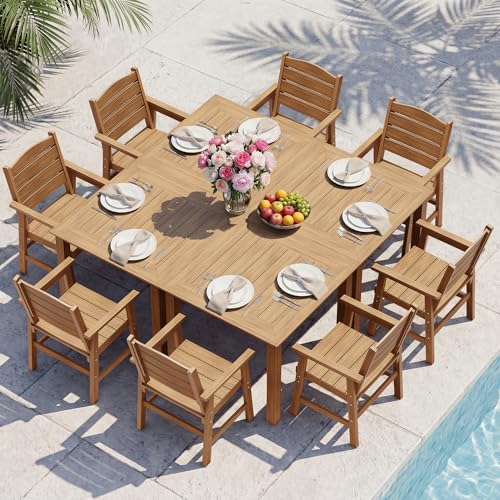
YEFU 12 Piece Square Patio Dining Set, Sturdy Aluminum Frame, HIPS, Teak | All-Weather Outdoor Table and Chairs for 8, Easy Clean & Assembly Modern Outside Furniture for Deck Backyard Poolside
Check price on Amazon
Amazonia Fairview 9 Piece Teak Double Extendable Oval Dining Set
Check price on Amazon
SAFAVIEH Couture Outdoor Collection Samoa Natural Brown Brazilian Teak Solid Wood Patio Accent Table
Check price on Amazon
Tangkula 79" Acacia Wood Patio Dining Table for 8, Large Outdoor Table | 1.9" Umbrella Hole, Metal Legs, Adjustable Foot Pads, Rectangular 8-Person Outside Table for Garden, Poolside, Deck & Yard
Check price on Amazon
HAOCHRYSYPH Oval Patio Dining Table, Solid Acacia Wood, Light Teak | Solid acacia wood, curved vertical slatted legs, 500 lbs weight capacity, light teak finish, for patio garden backyard
Check price on Amazon
LDAILY Acacia Wood Outdoor Bench, 52" Backless Patio Bench, Garden Bench
Check price on Amazon
JIVOIT Outdoor Acacia Wood Round Dining Table with Umbrella Hole, 59" Round Patio Dining Table with Hollow Splicing Design for Garden, Patio and Poolside (Light Teak/4)
Check price on AmazonWhat Makes Teak Wood Different?
Teak (Tectona grandis) is a tropical hardwood native to Southeast Asia. Its reputation in furniture making comes from two key characteristics: a high natural oil content (teak oil) and a dense, tight grain structure. Together, these properties make teak naturally resistant to moisture, rot, and termites — without requiring chemical treatment. That is why teak has been used for centuries in shipbuilding and outdoor furniture, and why it remains a top choice for dining tables that need to withstand daily life.
Beyond durability, teak offers a distinctive visual character. Its grain is straight to slightly wavy, with a warm golden-brown heartwood that deepens over time when exposed to light. The wood also develops a smooth, almost tactile surface that many people find more pleasant than varnished alternatives. For a broader comparison of wood types, see our dining table materials and finishes hub.
Teak vs. Other Popular Dining Table Woods
The table below compares teak with other common dining table woods across the factors that matter most to buyers. Use the "Tier" column to understand relative market positioning rather than absolute figures.
| Wood Type | Durability | Moisture Resistance | Maintenance Level | Market Tier | Best For |
|---|---|---|---|---|---|
| Teak | Excellent — dense grain, natural oils | Very high — naturally water-repellent | Low to moderate | Premium to luxury | Indoor dining rooms, covered patios, sunrooms |
| Solid Oak | Very good — hard and heavy | Moderate — needs sealing | Moderate | Mid-range to premium | Traditional and farmhouse dining rooms |
| Walnut | Very good — strong and stable | Moderate — needs finishing | Moderate | Premium to luxury | Modern and contemporary interiors |
| Mango Wood | Good — medium hardness | Moderate — benefits from sealing | Moderate | Entry-level to mid-range | Casual and eclectic dining spaces |
| Pine | Fair — softer wood | Low to moderate | Higher — dents and scratches easily | Entry-level | Starter homes and informal dining areas |
Key Benefits of a Teak Dining Table
- Natural moisture resistance: Teak's oils make it inherently resistant to spills, humidity, and even occasional rain — a major advantage for busy dining rooms and covered outdoor areas.
- Insect and rot resistance: The same oils deter termites and prevent fungal growth, which extends the table's lifespan considerably compared to softer woods.
- Dimensional stability: Teak expands and contracts less than many other hardwoods, reducing the risk of warping or cracking over time.
- Ages gracefully: Indoor teak develops a rich, deep golden-brown patina. Outdoor teak can be left to silver-grey naturally or oiled to retain its warm tone.
- Low maintenance: A simple routine of dusting, wiping, and occasional oiling keeps a teak table in excellent condition for decades.
- Versatile styling: Teak works across modern, coastal, Scandinavian, and transitional interiors. Its warm tone pairs well with both neutral and bold palettes.
Indoor vs. Outdoor Teak Dining Tables
One of teak's biggest advantages is its ability to transition between indoor and outdoor settings. However, the construction details differ, and choosing the right version matters for longevity.
Indoor Teak Dining Tables
Indoor teak tables are typically finished with a light oil, matte lacquer, or natural wax. These finishes protect the surface from everyday spills and make cleaning easier. Indoor teak does not need the same level of weather protection as outdoor pieces, but it still benefits from consistent humidity control and occasional oiling. If you are planning your dining room layout, our dining table space planning guide can help you size the table correctly.
Outdoor and Covered-Patio Teak Dining Tables
Outdoor teak tables are usually left unfinished or treated with a penetrating oil that lets the wood breathe. They are built with weather-resistant joinery and stainless-steel or brass hardware to prevent corrosion. If you plan to place your teak table on a patio or in a sunroom, consider our dining table humidity care guide and sunlight fade prevention guide to protect the surface year-round.
How to Evaluate Teak Quality Before Buying
Not all teak furniture is created equal. The grade of teak, the age of the wood, and the construction method all affect how the table will perform over time. Here is what to look for:
- Look for solid teak, not veneer: Solid teak planks offer far greater durability and repairability than teak veneer over a lower-grade core. If the listing says "teak veneer" or "teak finish," it is not the same product.
- Check the grain and color consistency: High-grade teak has tight, straight grain and a uniform golden-brown tone. Excessive color variation or loose grain can indicate younger or lower-grade wood.
- Inspect the joinery: Look for mortise-and-tenon joints, dowels, or other sturdy joinery rather than relying solely on screws. Our dining table frame guide explains what to look for in structural construction.
- Confirm the finish type: Indoor tables should have a clearly stated finish (oil, lacquer, or wax). Outdoor tables should specify whether they are pre-oiled or untreated.
- Ask about the wood's origin and age: Plantation-grown teak from reputable sources is typically more consistent and more sustainable than wild-harvested wood.
Teak Dining Table Styles and Shapes
Teak works beautifully across a range of table shapes and styles. Your choice should depend on your room dimensions, seating needs, and design preferences.
| Shape | Best For | Seating Capacity | Guide |
|---|---|---|---|
| Rectangular | Formal dining rooms, larger families, entertaining | 4 to 10+ | Rectangular dining table guide |
| Round | Compact spaces, sociable dining, small families | 2 to 6 | Round dining table guide |
| Oval | Narrow rooms, soft-edged aesthetics | 4 to 8 | Oval dining table guide |
| Square | Small dining nooks, breakfast areas | 2 to 4 | Square dining table guide |
| Extendable | Flexible hosting, dual-purpose rooms | 4 to 12 | Extendable dining table guide |
Teak Dining Table Care and Maintenance
One of teak's greatest strengths is its low-maintenance nature. A simple routine keeps the table looking its best for years:
- Routine cleaning: Wipe with a damp cloth and mild soap after meals. Avoid harsh chemical cleaners that can strip natural oils. Our dining table routine upkeep guide covers daily and weekly habits.
- Oiling: Apply a thin coat of teak oil every six to twelve months for indoor tables, or more frequently for outdoor tables that are exposed to sun and rain. Our oiled dining table guide explains the process in detail.
- Protect the surface: Use coasters, placemats, and a dining table pad to prevent heat marks and scratches during daily use.
- Address spills quickly: Even though teak is water-resistant, wiping up spills promptly prevents surface staining and keeps the finish intact.
- Seasonal care: Indoor teak benefits from stable humidity. Outdoor teak should be covered during harsh weather if left exposed. See our winter moisture control guide and summer heat protection guide.
Styling a Teak Dining Table
Teak's warm, natural tone makes it a versatile base for styling. Here are a few directions depending on the look you want:
- Modern minimal: Pair a clean-lined teak table with simple ceramic tableware, a linen table runner, and a single sculptural centerpiece.
- Coastal and breezy: Combine teak with whitewashed walls, natural fiber chairs, and woven placemats for a relaxed, airy feel.
- Transitional: Mix teak with upholstered dining chairs in neutral tones and layer in candles for warmth.
- Holiday and seasonal: Teak's rich tone is a beautiful backdrop for seasonal tablescapes. See our tablecloth guide for ideas on layering without hiding the wood grain.
Common Teak Dining Table Mistakes to Avoid
- Buying veneer thinking it is solid teak: Always confirm the construction. Veneer may look similar initially but will not last as long or age the same way.
- Skipping measurements: Teak tables are often heavy and substantial. Measure your room and walkways before choosing a size. Our walkway clearance guide and dining table size chart can help.
- Neglecting the finish: Indoor teak needs some protection. An unfinished table is fine for outdoor use but will absorb stains indoors.
- Ignoring humidity: Even teak can be affected by extreme humidity swings. Keep indoor tables away from direct heat sources and consider a humidifier in dry climates.
- Not planning chair compatibility: Table height and chair seat height must work together. Our dining table chair height guide explains the ideal ratios.
Ready to Choose Your Teak Dining Table?
Use our curated selection above as a starting point, then explore our related guides to finalize your decision with confidence.
Browse Shopping & ReviewsFrequently Asked Questions
Is teak a good choice for a dining table?
Yes. Teak is one of the most durable natural woods for dining tables. Its natural oils and dense grain make it resistant to moisture, insects, and everyday wear, which is why it performs well in both indoor dining rooms and covered outdoor spaces.
Does a teak dining table need oiling?
Indoor teak tables often need only occasional cleaning and a light oiling every six to twelve months to maintain their finish. Outdoor teak tables benefit from more frequent oiling if you want to preserve the golden-brown tone, or can be left to age to a natural silver-grey patina.
Can teak dining tables be used outdoors?
Yes. Teak is one of the few woods genuinely suited to outdoor use. Its natural oils resist moisture and rot. For best results, choose a covered patio or use a protective cover during harsh weather to extend the table's lifespan.
How do I know if a teak table is solid wood or veneer?
Check the product description carefully. Solid teak tables are described as "solid teak" or "solid wood." Veneer tables may use phrases like "teak veneer," "teak finish," or "teak effect." You can also inspect the table edges — solid teak will show continuous grain, while veneer may show a visible seam or a different core material.
Will a teak dining table scratch easily?
Teak is harder than pine or mango wood, so it resists scratches better than many alternatives. However, no wood is scratch-proof. Using placemats, coasters, and a protective pad will significantly reduce the risk of surface damage. Minor scratches can often be buffed out with fine sandpaper and a touch of teak oil.
What is the best finish for an indoor teak dining table?
For indoor use, a matte lacquer or a natural oil finish are both excellent choices. Matte lacquer offers more surface protection and is easier to clean, while oil finishes give a more natural look and can be refreshed at home. Our matte finish guide and oiled dining table guide explain the trade-offs.
For more help narrowing down your options, explore our complete dining table types guide or start with the first dining table checklist to make sure you cover every essential before purchasing.