
8-Seater Dining Table Guide: Sizing, Styles & Buying Tips
Everything you need to choose an eight-seater dining table that fits your room, suits your household, and handles gatherings with confidence — from exact dimensions and shape comparisons to material selection and clearance planning.
EXPLORE RECOMMENDED TABLESIn This Guide
- Why an 8-Seater Table Is a Serious Upgrade
- Exact Dimensions & Seating Layout
- Table Shapes: Rectangular, Oval, Round & Square
- Room Size & Clearance Requirements
- Material Selection for Larger Tables
- Fixed vs Extendable: Which Suits You?
- Chair & Bench Pairing
- Pre-Purchase Checklist
- Frequently Asked Questions
Why an 8-Seater Dining Table Is a Serious Upgrade
An eight-seater dining table sits at the intersection of everyday family life and full-scale entertaining. It is large enough to seat a household comfortably on a Tuesday evening, yet flexible enough to host weekend dinners, holiday gatherings, and multi-generation celebrations without folding out extra furniture. For many buyers, this is the point where a dining table stops being a modest piece of furniture and becomes the true anchor of the home.
That added capacity comes with added responsibility. An eight-seater table demands more floor area, more careful planning around walkways, and a more deliberate approach to material and structure than a smaller 4-seater dining table guide would require. A longer span places greater stress on the frame and legs, so build quality matters more than ever. Buyers at this size should think of the table as a long-term investment rather than a quick furnishing decision.
The good news is that the eight-seater category is mature and well-served. You will find options across every tier — from essential-tier solid wood models to flagship-tier pedestal designs — and in every major shape and material family. The challenge is not availability but fit. This guide walks through the decisions in the order that matters: dimensions first, then shape, then room clearance, then materials and pairing.
Exact Dimensions & Seating Layout
The single most useful number for an eight-seater dining table is its length. In practice, most eight-seater tables fall into a fairly narrow band, because seating is governed by the space each person needs rather than by design preference. A comfortable adult place setting requires roughly 24 inches of linear table edge, and a more generous setting approaches 28 to 30 inches. Multiply that across four seats per long side and the arithmetic becomes clear.
| Configuration | Typical Length | Typical Width | Typical Height | Best For |
|---|---|---|---|---|
| Rectangular, 3 per side + 1 per end | 84–96 in (213–244 cm) | 36–42 in (91–107 cm) | 28–30 in (71–76 cm) | Most dining rooms; the standard eight-seater layout |
| Rectangular, 4 per side | 96–108 in (244–274 cm) | 36–40 in (91–102 cm) | 28–30 in (71–76 cm) | Long, narrow rooms; formal dining spaces |
| Oval, 3 per side + 1 per end | 84–96 in (213–244 cm) | 42–48 in (107–122 cm) | 28–30 in (71–76 cm) | Softening traffic flow; transitional interiors |
| Round, 8 seats | 60–72 in diameter (152–183 cm) | Same as length (round) | 28–30 in (71–76 cm) | Square rooms; conversation-focused dining |
| Square, 8 seats | 60–66 in (152–168 cm) per side | Same as length (square) | 28–30 in (71–76 cm) | Symmetrical layouts; compact footprints |
The seating pattern matters as much as raw dimensions. A table that seats three per long side and one at each end (the 3+3+1+1 layout) offers the most balanced experience and keeps the table length manageable. A 4+4 layout seats eight without end positions, which is useful when the table sits against a wall or in a narrow room, but it stretches the table considerably and pushes the far ends out of conversational reach.
Height is the one dimension that rarely varies. Standard dining height remains 28 to 30 inches, and this is what you should pair with standard dining chairs. If you prefer a more casual posture, a counter-height dining table guide covers the 34 to 36 inch alternative, though eight-seater counter-height options are less common. For a more formal, lounge-adjacent feel, the bar-height dining table guide explains the taller format, which is rarely practical at eight seats.
Table Shapes: Rectangular, Oval, Round & Square
Shape is where an eight-seater table begins to express character. Each shape solves a different spatial and social problem, and the right choice depends on your room proportions and how you actually use the table.
Rectangular — The Default Eight-Seater
Rectangular tables are the most common eight-seater configuration for good reason. They use room length efficiently, seat guests along straight edges where place settings are easy to align, and accommodate extension mechanisms cleanly. A rectangular dining table guide explains how leg placement — corner legs versus trestle or pedestal bases — affects seating comfort at the ends. At eight seats, end-position comfort is a real consideration, so favour designs with legs set well inboard or with a trestle base that frees the ends.
Oval — Softer Flow, Same Capacity
Oval tables seat the same number of people as a rectangular table of similar length, but the absence of sharp corners makes traffic flow noticeably easier. In rooms where guests walk past the table to reach a kitchen or hallway, an oval dining table guide is worth reading before committing to a rectangle. Oval tops also soften the visual weight of a large table, which helps in open-plan spaces.
Round — Best for Square Rooms and Conversation
A round eight-seater table is a demanding piece: it needs roughly 60 to 72 inches of diameter to seat eight comfortably, and it demands a genuinely square or generously proportioned room. In exchange, it delivers the most convivial dining experience of any shape — every guest can see every other guest. A round dining table guide covers diameter-to-seat ratios in detail. Round tables also pair naturally with a dining table pedestal guide, since a central pedestal keeps legroom unobstructed around the full perimeter.
Square — Symmetry in Compact Footprints
A square eight-seater seats two per side, which keeps every place setting equidistant from the centre. This is an elegant solution in symmetrical rooms and works well with a single central pendant. However, square tables of this size are visually dominant and require careful clearance planning. The square dining table guide covers the trade-offs in more depth.
Shape Selection Shortcut
Long, narrow room → rectangular or oval. Square room → round or square. Open-plan space where guests circulate → oval. Formal, symmetrical dining room → rectangular or square. When in doubt, rectangular is the safest eight-seater choice because it fits the widest range of room proportions.
Room Size & Clearance Requirements
An eight-seater table is a large object, and the room around it matters as much as the table itself. The planning rule is straightforward: measure the table, then measure the clearance you need on every side, then confirm the room can absorb both. The dining table space planning guide provides a fuller framework, but the essentials for eight seats are as follows.
- Chair pull-out clearance: at least 30 inches between the table edge and any wall, so a chair can be pushed back and a person can stand up comfortably.
- Walkway clearance: at least 36 inches where people walk behind seated guests, and up to 44 inches where the walkway is a main circulation route.
- Sideboard and buffet clearance: keep 36 to 42 inches between the table edge and any sideboard you need to open or stand in front of.
- Overall room footprint: a rectangular eight-seater of roughly 96 x 40 inches, with 36 inches clearance on all sides, needs a room of approximately 168 x 112 inches — about 14 x 9.5 feet of usable floor area, before accounting for additional furniture.
In practice, most comfortable eight-seater dining rooms land somewhere around 12 x 14 feet or larger. If your room is tighter, consider an oval table to ease corner clearance, or review the narrow dining room furniture layout guide for strategies that preserve seating capacity in constrained spaces. The dining table walkway clearance guide is also useful for calculating exact circulation widths.
Do not overlook vertical space and lighting. A large table benefits from a linear pendant or a pair of pendants centred over the table, and the dining table lighting placement guide explains the hanging heights and spacing that keep a long table evenly lit. If your dining area sits on a circulation path, the dining table flow traffic planning guide will help you position the table so it does not become an obstacle.
Material Selection for Larger Tables
Larger tables amplify the strengths and weaknesses of every material. A long span reveals structural weakness in a frame; a large surface exposes every scratch and ring mark; and the weight of a solid eight-seater affects how easily it can be moved or levelled. Material choice at this size is therefore a durability decision as much as an aesthetic one. The dining table materials and finishes hub is the broad overview; the notes below focus on what changes at eight seats.
Solid Wood — The Structural Benchmark
Solid wood remains the most reassuring choice for an eight-seater because it handles long spans well when the frame is properly engineered. Oak and walnut are the most common premium choices, and both are covered in dedicated guides: the solid oak dining table guide and the walnut dining table guide. Oak offers hardness and a calm grain; walnut brings warmth and a more dramatic figure. For a warmer, characterful grain at a lower position in the market, the mango wood dining table guide is a useful reference. Teak, covered in the teak dining table guide, is a strong outdoor-adjacent option, while the pine dining table guide explains why softer woods are generally less suited to long eight-seater spans.
Stone and Glass — Visual Impact With Practical Caveats
Stone tops make dramatic eight-seater tables, but weight becomes a serious factor: a large marble or granite top may require a reinforced base and careful delivery planning. The marble dining table guide and granite dining table guide both address sealing and stain management, which matter more on a large surface. Quartz, covered in the quartz dining table guide, offers a more forgiving surface. Glass is the lightest visual option and keeps a large table from dominating a room — see the glass dining table guide — but large glass tops demand careful cleaning routines. Travertine, in the travertine dining table guide, is a textured middle ground.
Metal and Composite — Modern and Heavy-Duty
Metal tables are well suited to eight-seater configurations because steel frames handle long spans confidently. The metal dining table guide and steel dining table guide cover the structural side, while the aluminum dining table guide explains the lighter-weight alternative. Concrete, in the concrete dining table guide, is visually striking at eight seats but extremely heavy, and the resin dining table guide covers the composite options that balance weight against durability.
Finishes — What Matters at Eight Seats
Finish choice affects maintenance more than most buyers expect. A matte finish hides everyday marks but can be harder to spot-clean; a glossy finish is easier to wipe but shows dust and fingerprints. The matte dining table finish guide and glossy dining table finish guide compare the two. Lacquered surfaces, covered in the lacquered dining table guide, offer strong protection for busy households. Oiled finishes, in the oiled dining table guide, are repairable but need periodic re-oiling. Distressed finishes, covered in the distressed dining table guide, are the most forgiving of wear on a large surface.
Fixed vs Extendable: Which Suits You?
A fixed eight-seater table is the simplest and most structurally robust choice. It is always the right size, requires no mechanism to maintain, and typically offers better long-term rigidity than an extension table of similar quality. If your household regularly seats six to eight people and your room can accommodate the full footprint permanently, a fixed table is the sensible default.
An extendable table is the better answer when eight seats is a peak requirement rather than a daily one. An extendable dining table guide explains the main mechanism types — butterfly leaf, self-storing leaf, and separate-leaf systems — and their trade-offs. For eight-seater use, the key considerations are leaf storage, the smoothness of the extension mechanism, and whether the table remains stable at full extension. Entry-level extension mechanisms can feel stiff and may develop play over time; mid-range and premium models generally offer smoother action and tighter locking. If your room is tight for the rest of the week, an extendable table paired with a thoughtful traffic flow plan can be the difference between a usable room and a cramped one.
A third option worth knowing is the drop-leaf or folding format, though true eight-seater capacity is rare in these categories. The drop-leaf dining table guide and folding dining table guide are useful if you need occasional large-table capacity in a small room, but expect to compromise on stability and finish at this size.
Chair & Bench Pairing
Eight chairs is a significant seating commitment, and the chair choice affects both comfort and the visual weight of the table. The dining chair selection guide is the starting point; the notes below focus on what changes at eight seats.
Uniform chairs are the most formal and visually calm option. Eight matching chairs create a clean rhythm around the table and are the easiest to coordinate. Mixed end chairs — for example, a pair of armchairs at the heads with side chairs along the long edges — add hierarchy and comfort without disrupting the overall pattern. This works particularly well on rectangular and oval tables where the end positions are visually distinct.
Bench seating is a practical alternative on one long side, especially in households with children, because it seats more people in less linear space and tucks neatly under the table. The dining bench seating guide explains how to pair a bench with chairs without creating a lopsided look. For a softer, more upholstered feel, the upholstered dining chair guide covers fabric and frame considerations; if you need to store spare chairs, the stackable dining chair guide is worth a look. Whatever you choose, confirm the seat height against the table height using the dining table chair height guide — a mismatch is far more noticeable at eight seats than at four.
Finish the table with a table runner or placemats to protect the surface, and consider a centre offering that scales to the table length. A tablecloth and table pad are worthwhile additions for a large, frequently used surface. The candle styling guide is useful for evening gatherings, and the setup and accessories hub collects the full range of supporting pieces.
Pre-Purchase Checklist
Before committing to an eight-seater table, run through the following checks. They take ten minutes and prevent most of the regrets that appear after delivery.
- Measure the room, not the table. Confirm usable floor area after accounting for doorways, sideboards, and circulation routes.
- Verify the clearance math. At least 30 inches for chair pull-out and 36 inches for walkways.
- Confirm the seating pattern. Decide between 3+3+1+1 and 4+4, and check that end seats are genuinely usable.
- Inspect the frame specification. Longer spans need stronger frames — read the dining table frame guide and check leg placement via the dining table leg guide.
- Check the base type. Corner legs, trestle, and pedestal bases each change end-seat comfort; the pedestal guide explains the trade-offs.
- Review the edge profile. A rounded edge is kinder on a large table where people brush past; see the edge profile guide.
- Plan for delivery and assembly. Large tables are heavy and may not fit through every doorway; the moving safely guide covers the practicalities.
- Budget maintenance time. A large surface needs routine care; start with the routine upkeep guide and the care and maintenance hub.
If this is your first large-table purchase, the first dining table checklist and the dining table buying mistakes guide are both worth reading before you shortlist. The dining table size chart provides a quick reference for every seating capacity, and the dining table spec glossary decodes the terminology used in product listings. For a broader view of the category, see the dining table types overview and the 8-seater dining table guide you are reading now.
Recommended 8-Seater Dining Tables
⚠️ AFFILIATE DISCLOSURE: This website contains affiliate links. As an affiliate Associate, we earn from qualifying purchases. If you make a purchase through these links, we may receive a small commission at no additional cost to you. Read our full affiliate policy.

Sintered Stone Dining Table, 79 Inch Rectangle, 1 Table + 4 Chairs | Extendable, 6-8 Seaters, V-Shape Carbon Steel Pedestal, Modern Dining Room Table Set
Check price on Amazon
Extendable Sintered Stone Dining Table, 79 Inch, 1 Table + 6 Chairs | 6-8 Seaters, Rectangle Table, V-Shape Carbon Steel Pedestal, Modern Dining Room Table Set
Check price on Amazon
CGHIJDM 79'' Dining Room Table Set for 8,Large Dining Table Set for 8 with Chairs,Mid Century Dining Table with Fluted Double Pedestal Base,9 Piece Kitchen Table Set Ideal for Family Gatherings
Check price on Amazon
TesNus 71" Oval Dining Table Set for 8, Wood Kitchen Table and Chairs Set | 9 Piece Oval Dining Table Set, Farmhouse Kitchen Table Set with 8 Chenille Rubberwood Chairs, 8 Seater Dining Table Set
Check price on Amazon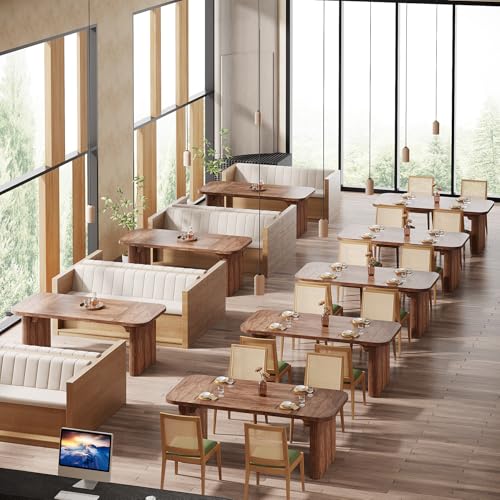
Tribesigns Dining Table Set of 8, Heavy Duty MDF Commercial Kitchen Table Set, Farmhouse Dining Room Tables with Pedestal Legs for Restaurant, Cafe, Home, Easy Assembly (8, Brown)
Check price on Amazon
CGHIJDM 79'' Dining Room Table Set for 8,Large Dining Table Set for 8 with Chairs,Mid Century Dining Table with Fluted Double Pedestal Base,9 Piece Kitchen Table Set Ideal for Family Gatherings
Check price on Amazon
Black Farmhouse Washable 6x8 Dining Room Area Rug, Dark Charcoal Volcanic Textured Rug for Living Room, Non-Slip Low Pile Stain Resistant Carpet for Bedroom Décor
Check price on Amazon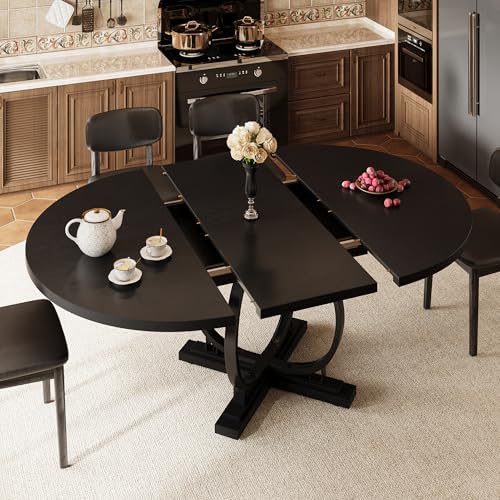
iPormis 59'' Extendable Round Dining Table for 4 to 6, Oval Kitchen Table with Sturdy X-Base Metal Legs, MDF Board with Backboard Clasp, Space Saving, Easy Assembly, Kitchen Dining Living Room, Black
Check price on AmazonFrequently Asked Questions
What size room do I need for an 8-seater dining table?
A comfortable eight-seater dining room is typically around 12 x 14 feet or larger. The exact requirement depends on the table shape: a rectangular table of roughly 96 x 40 inches with 36 inches of clearance on all sides needs about 14 x 9.5 feet of usable floor area before other furniture is added. Oval tables ease corner clearance, while round and square eight-seaters demand a more square room footprint.
What is the ideal shape for an 8-seater dining table?
Rectangular is the most practical default because it fits the widest range of room proportions and uses length efficiently. Oval tables soften traffic flow and suit open-plan spaces. Round tables deliver the best conversation but need a genuinely square room and a 60–72 inch diameter. Square tables work in symmetrical layouts but are visually dominant. Match the shape to the room before matching it to a style.
How much clearance should I leave around an 8-seater dining table?
Leave at least 30 inches between the table edge and any wall or furniture so chairs can pull out and people can stand. Where guests walk behind seated diners, increase this to 36 inches, and up to 44 inches for main circulation routes. For sideboards you need to open or stand in front of, keep 36 to 42 inches.
Is a fixed or extendable 8-seater table better?
A fixed table is more structurally robust and simpler to live with when eight seats is a daily requirement. An extendable table is better when eight is a peak rather than everyday need — it lets the table shrink to a smaller footprint during the week. At eight seats, check the extension mechanism's smoothness and stability at full extension; mid-range and premium mechanisms are noticeably better than entry-level ones.
Which material is best for an 8-seater dining table?
Solid wood — particularly oak and walnut — is the most reassuring choice for long spans because a properly engineered frame handles the length well. Metal frames also perform strongly at this size. Stone and glass make striking large tables but add weight and maintenance considerations. Whatever the material, the frame and base deserve more scrutiny at eight seats than at four, because the span amplifies any structural weakness.
Can I mix chairs and a bench on an 8-seater table?
Yes. A common and practical layout pairs a bench on one long side with chairs on the other side and at the ends. This seats eight comfortably, tucks neatly under the table, and works well in households with children. Keep the bench visually balanced with the chairs by matching wood tone or upholstery, and confirm seat heights against the table height before committing.
Ready to Shortlist Your Eight-Seater Table?
Review the recommended models above, then use the sizing and clearance guidance in this guide to confirm the fit before you buy.
BROWSE SHOPPING & REVIEWS