
Vintage Round Oak Dining Table
Timeless craftsmanship meets warm, natural grain. Explore wood grades, authentic vintage styles, restoration considerations, and how to choose a round oak table that anchors your dining room for decades.
Explore Recommended PicksWhy a vintage round oak dining table deserves your attention: Oak has been a cornerstone of fine furniture making for centuries. Its dense grain, natural resistance to wear, and warm honey-to-amber tones make it uniquely suited to pieces that improve with age. A round table, meanwhile, removes sharp corners, encourages conversation, and flows gracefully in compact or open-plan rooms. Combined, vintage round oak tables deliver a rare blend of heritage character and everyday practicality.
This guide walks you through the wood itself, the design language of different eras, what to inspect before buying, how to care for a vintage finish, and how a round oak table fits into your broader dining room plan. By the end, you will know exactly which characteristics matter for your space and lifestyle.
Understanding Oak as a Dining Table Wood
Oak is a hardwood prized for its closed, tight grain and natural strength. Two species dominate the furniture world: white oak and red oak. White oak offers a cooler, greenish-brown undertone, superior water resistance, and a denser grain that takes stain and oil beautifully. Red oak has a warmer, pinkish cast and a more open grain pattern. Both age gracefully, developing a patina that many enthusiasts consider the defining charm of a vintage piece.
Vintage oak tables often display characteristics you will not find in new factory furniture: hand-planed surfaces with subtle undulations, visible medullary rays on quarter-sawn boards, and joinery details such as through-tenons and pegged mortise-and-tenon joints. These features signal craftsmanship and contribute to structural longevity. When you evaluate a vintage round oak table, the grain pattern itself becomes a fingerprint of the original maker's material selection.
For a broader look at how oak compares to other hardwoods, the vintage teak dining table guide offers a useful contrast in grain density and weather resistance. Teak is denser and more oil-rich, while oak offers a more pronounced grain figure and a wider range of finishes.
Round vs. Rectangular: Why Shape Matters
A round dining table changes the social dynamic of a room. Without a head of the table, every seat feels equally important. In smaller rooms, the absence of corners eliminates awkward navigation and allows chairs to tuck neatly when not in use. Vintage round oak tables in particular tend to have pedestal bases or four splayed legs that keep the footprint compact while the top provides generous usable surface.
For households that frequently host or rearrange furniture, a round table also offers rotational flexibility. Some vintage designs incorporate a rotating dining table top, a clever feature that lets you access dishes from any seat without reaching across the table. If your priority is maximizing floor space, compare round options with a small dining table with four chairs to see how seating density changes between shapes.
Vintage Oak Styles by Era
Mid-Century Modern (1950s–1960s)
Clean lines, tapered legs, and a focus on the wood grain itself. These tables often feature a simple round top with a slightly raised lip and minimal ornamentation. Look for warm honey tones and subtle sculptural leg profiles. Excellent for contemporary and transitional interiors.
Arts & Crafts (1900s–1920s)
Heavy, honest construction with visible joinery, quartersawn oak, and a dark fumed finish. Tables from this era often have sturdy pedestal bases and thick tops. They pair naturally with mission-style chairs and craftsman interiors. Structural integrity is usually outstanding.
Victorian & Edwardian (1880s–1910s)
Ornate carvings, turned pedestals, and richly figured oak veneers over solid cores. These tables carry substantial visual weight and suit formal dining rooms. Inspection should focus on veneer condition, joint tightness, and the integrity of carved details.
Farmhouse & Primitive (1900s–1940s)
Simple, utilitarian construction with thick tops and straightforward legs. Often refinished or left with original patina. These tables are forgiving of wear and ideal for casual, everyday use. Many have drop leaves or extension mechanisms.
Danish & Scandinavian Influence
Light oak, minimalist profiles, and exceptional joinery. These tables prioritize proportion and comfort over ornamentation. If you appreciate clean Nordic design, the vintage circular dining table reference covers similar aesthetic territory with additional examples.
Custom & Studio-Made Pieces
One-off tables crafted by individual makers, often with distinctive grain matching, hand-cut joinery, and unique base designs. These are the most difficult to source but offer the highest level of character and originality.
What to Inspect Before Buying
Buying vintage requires a slightly different checklist than buying new. Structural integrity, finish condition, and originality all influence both usability and long-term satisfaction. Use the following inspection points whether you are shopping in person or reviewing detailed photos from a seller.
- Check the top for warping or cupping. Lay a straightedge across the surface in multiple directions. Minor undulation is acceptable in hand-made pieces; significant cupping indicates moisture exposure.
- Inspect joints and the base connection. Wobble is often fixable, but cracked aprons or split pedestals may require professional repair. Gently rock the table to assess stability.
- Verify solid oak versus veneer. Look at the end grain at the table edge. Solid oak shows continuous grain through the thickness. Veneer shows a thin decorative layer over a different substrate.
- Evaluate the finish. Original patina is desirable, but flaking lacquer or deep scratches through the stain may require refinishing. Consider whether you want a preserved antique look or a refreshed surface.
- Test any extension mechanism. If the table has leaves or a folding mechanism, operate it fully. Sticking or misaligned tracks are common in older pieces.
- Smell the surface. A musty or mildew odor can indicate past water damage or improper storage. This is especially important for pieces sourced from estates or barns.
- Ask about provenance. Original labels, maker's marks, or family history add interest and can inform appropriate care. A small antique dining table with documented history is often a more confident purchase than an unmarked piece.
Size and Seating Guidelines
Round tables scale differently from rectangular ones. The diameter determines both seating capacity and the amount of walkway space required. As a general rule, allow 24 inches of table edge per person and a minimum of 36 inches of clearance from the table edge to walls or other furniture for chair pull-out.
| Diameter | Typical Seating | Best For | Room Size Guidance |
|---|---|---|---|
| 36–42 inches | 2–4 people | Compact kitchens, breakfast nooks, apartments | Rooms from 8 x 8 feet |
| 44–48 inches | 4 people | Standard dining rooms, small families | Rooms from 10 x 10 feet |
| 54–60 inches | 4–6 people | Open-plan dining areas, regular entertaining | Rooms from 12 x 12 feet |
| 60–72 inches | 6–8 people | Formal dining rooms, large families | Rooms from 14 x 14 feet |
If your room is tight, consider a small dining bistro table or a small two-chair dining table as a complement or alternative. For larger gatherings, an antique extension dining table preserves the vintage aesthetic while adding flexibility.
Finishes, Care, and Restoration
Oiled Finish
Penetrates the wood and enhances natural grain. Easy to spot-repair and refreshes with periodic reapplication. Best for a natural, matte look. Avoid harsh solvents and prolonged water exposure.
Lacquered Finish
Forms a protective film on the surface. Common on mid-century pieces. Offers good resistance to spills but can crack or flake over decades. Refinishing requires stripping and reapplication.
Waxed Finish
Traditional and breathable. Imparts a soft sheen and subtle tactile quality. Requires regular dusting and occasional re-waxing. Not ideal for high-moisture environments or heavy daily use without protection.
French Polished
Deep, glossy shellac finish applied in thin layers. Found on finer antique pieces. Beautiful but delicate. Requires specialist care and protection from heat and alcohol.
Regardless of finish, protect your table from direct sunlight, heat, and standing water. Use coasters and trivets, and wipe spills promptly. For routine care, a soft cloth and mild soapy water followed by a dry wipe is sufficient. Avoid silicone-based polishes, which can leave a residue that complicates future restoration.
If you are considering a piece that needs work, factor in the effort and materials required. A redo dining room table project can be rewarding, but structural repairs and veneer replacement are best left to professionals. For a historical perspective on preservation, the second-hand round dining table guide includes notes on evaluating wear.
Integrating a Round Oak Table into Your Dining Room
The visual warmth of oak pairs naturally with a wide range of interior styles. In a farmhouse setting, it anchors the room alongside painted chairs and woven textiles. In a contemporary space, the grain provides organic contrast to minimalist lighting and neutral walls. In a traditional room, it can serve as the centerpiece that ties together inherited furniture and new additions.
Lighting plays a critical role. A pendant or chandelier centered over the table defines the dining zone and enhances the wood's tone. The dining room lighting for round table guide explains how to choose the right scale and hanging height. For finishing touches, explore dining table decoration items and round dining table centerpiece ideas that complement rather than compete with the wood grain.
If your space doubles as a workspace or study, a coffee and dining table combination or a desk that turns into dining table may offer a more flexible solution. For studio apartments, the studio apartment dining table ideas collection includes space-saving strategies that preserve the warmth of real wood.
Ready to Find Your Vintage Round Oak Dining Table?
Browse curated recommendations that reflect the quality, character, and craftsmanship discussed in this guide. Each option is selected to help you compare features and identify the right piece for your home.
View Recommended PicksFrequently Asked Questions
How can I tell if a vintage round oak dining table is solid oak or veneer?
What size vintage round oak dining table fits a small dining room?
How do I care for an antique oak dining table with an oiled finish?
Is it worth restoring a vintage oak table with damaged veneer?
Can a round oak dining table work in an open-plan space?
Related Reading
If you are exploring the vintage and oak category further, the following guides provide complementary perspectives: the small antique dining table guide covers compact heritage pieces, the vintage circular dining table reference discusses round silhouettes across eras, and the vintage teak dining table article offers a comparison of wood species and weathering characteristics. For a broader overview of contemporary options, the modern dining table styles hub contrasts current design language with vintage forms.
If you are furnishing a complete dining set, the antique dining table and chairs guide explains how to match seating to a heritage table. For smaller spaces, the small dining table set for 2 and small dining table set for 3 pages provide practical configurations.
Recommended Vintage Round Oak Dining Tables & Alternatives
⚠️ AFFILIATE DISCLOSURE: This website contains affiliate links. As an affiliate Associate, we earn from qualifying purchases. If you make a purchase through these links, we may receive a small commission at no additional cost to you. Read our full affiliate policy.
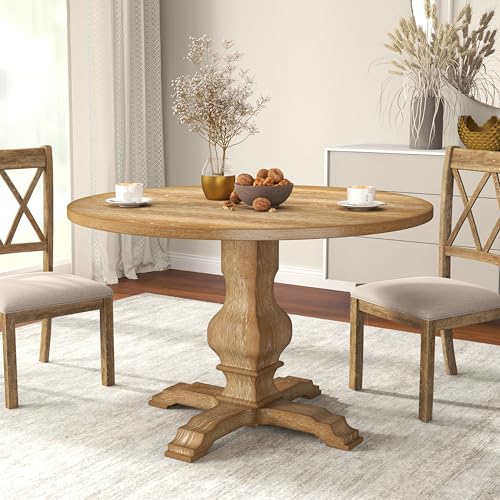
Roundhill Furniture Havre Pedestal Base Round Dining Table, Oak
Check price on Amazon
Merax Farmhouse Expandable Round Dining Table for 4-6, Natural | 42 to 56 Inch Vintage Solid Wood Kitchen Table with Removable Oval Leaf, Retro Distressed Finish for Dining Room
Check price on Amazon
HULALA HOME 42"-60" Oval Round Extendable Dining Table, Vintage Oak Wood Expandable Dining Room Kitchen Table with Butterfly Leaf Space Saving, Turned Legs,Circle Desk for Living Room, Grey
Check price on Amazon
VilroCaz 5-Piece Retro Functional Dining Set, Solid Wood Extendable Dining Table and 4 Upholstered Chairs, Round Dining Table Set for Dining Room Kitchen (Natural-7.16)
Check price on Amazon
ERYE Retro Style Round Dining Table Functional Wooden Extendable Oval Dining Table with 12" Leaf and Natural Wood Grain Variation Tabletop
Check price on Amazon
HIPIHOM 5-Piece Dining Set for Small Spaces 43.3" Round Table & 4 PU Leather Chairs, Modern Farmhouse with Storage Shelf, Apartment Kitchen Easy Assembly (Oak, Only Table)
Check price on Amazon
YESWOOD 43.3’’ Solid Wood Round Dining Table for 4, Oak Rustic Kitchen Table with Intersecting Pedestal Base, Farmhouse Circle Dinner Table for Dining Room, Living Room, Office, Natural
Check price on Amazon
MECHYIN 42'' Round Dining Table for 2–4, Farmhouse Round Kitchen Table with Storage Shelf, Pedestal Dinner Table, Wood Top & Metal Base, Small Space Table for Apartment, Dining Room, Light Oak
Check price on AmazonA final note on buying with confidence: A vintage round oak dining table is more than a piece of furniture; it is a record of craftsmanship, a warm anchor for daily meals, and a long-term investment in natural materials. Take your time, inspect carefully, and choose a piece that suits both your room dimensions and your daily routines. Whether you prefer the clean lines of mid-century design or the robust character of an Arts & Crafts piece, oak rewards thoughtful ownership with decades of service.