
Desk That Turns Into a Dining Table: The Complete Guide
One surface, two functions. Learn how convertible desk-dining tables work, which mechanisms last, and how to choose the right design for compact living, studios, and dual-purpose rooms.
EXPLORE CONVERSION TYPESWhy consider a desk that turns into a dining table? In compact homes, studio apartments, and shared rooms, floor space is the most limited resource. A convertible desk-dining table lets you work, study, and eat on the same footprint without dedicating an entire room to a formal dining setup. When the workday ends, the surface transforms into a comfortable place for two to four diners.
This guide breaks down the three main conversion mechanisms, the materials that hold up to daily switching, seating strategies for small spaces, and the exact measurements to check before you buy. If you are outfitting a compact rental or a multi-use room, you can also review our studio apartment dining table ideas for layout inspiration.
What Is a Desk That Turns Into a Dining Table?
A desk that turns into a dining table is a dual-purpose furniture piece engineered so that one work surface serves two roles. In its compact state, it functions as a workstation with a usable depth for a laptop, monitor, or writing space. In its expanded state, the surface grows or reorients to accommodate plates, serving dishes, and seating for two or more people.
These pieces fall into a broader family of transforming furniture that includes coffee tables that raise into dining tables and coffee tables that convert into dining surfaces. The desk-to-dining category is distinct because the starting height is already at seating height, which makes the transition shorter and often more stable than lifting mechanisms.
Typical buyers are remote workers in studios, students in dorm rooms, and households that want a dining surface without giving up a dedicated workspace. If you are weighing a convertible against a fixed small table, our guide to a narrow dining table for two is a useful baseline comparison.
Three Conversion Mechanisms Explained
Almost every convertible desk-dining table on the market uses one of three mechanisms. Each has a distinct trade-off between surface size, stability, and the amount of clear floor area required during conversion.
1. Hinged Fold-Out Top
A hinged leaf folds out from the back or side of the desk, doubling the surface area. This is the most common design because it is mechanically simple and keeps the compact footprint small. The hinge line runs along one edge, so the folded-out section is usually supported by a leg, bracket, or gateleg assembly.
- Best for: studio apartments and rooms where the desk sits against a wall.
- Watch for: hinge quality and whether the leaf has independent leg support. A leaf supported only by the hinge can sag under heavy dishes.
- Floor clearance: needs open space in front of the desk equal to the leaf depth, typically 24 to 30 inches.
2. Sliding Extension
A sliding extension pulls out horizontally from beneath the main worktop, lengthening the surface rather than widening it. This design keeps the desk depth constant, which is helpful in narrow rooms where a fold-out leaf would block a walkway.
- Best for: narrow rooms and wall-adjacent setups where depth is the constraint.
- Watch for: the extension rail quality. Cheaper rails can wobble at full extension; mid-range and premium models typically use metal ball-bearing slides.
- Floor clearance: needs lengthwise clearance equal to the extension travel, usually 20 to 36 inches.
3. Lift-and-Expand Mechanism
The worktop lifts to dining height and the surface expands, often through a combination of a gas strut and folding panels. This is the most complex mechanism and usually appears in premium and high-end tier models. It delivers the most comfortable dining height, but it also demands the most structural reinforcement.
- Best for: buyers who want a true dining-height experience and are willing to invest in a long-term piece.
- Watch for: weight ratings on the lift mechanism and the locking system. A surface that does not lock firmly at dining height is a safety concern.
- Floor clearance: needs open space on all working sides during the lift, so plan for at least 30 inches of clearance.
Editorial note: If you expect to convert the table daily, prioritize the mechanism over cosmetic finishes. A mid-range hinged model with a reinforced steel frame will usually outlast an entry-level lift mechanism with a decorative top.
Materials and Build Quality That Last
Convertible furniture experiences more mechanical stress than a fixed table because the same joints and hinges are exercised every time you switch modes. The materials and frame construction matter more here than in almost any other dining category.
Worktop Materials
- Solid hardwood (oak, teak, walnut): the most durable choice for daily conversion. Solid wood resists point loads from dishes and can be refinished if scratched. A white oak modern dining table style is a good reference for the look and durability profile.
- High-grade engineered wood with veneer: a balanced tier choice. The core is stable and less prone to warping, while the veneer provides a consistent finish. Check that edges are sealed, since exposed core material is vulnerable to moisture.
- Glass tops: visually light and easy to clean, but heavier than they look and less forgiving of impact. Glass works best on sliding-extension designs where the surface does not pivot.
- Laminate and compact laminates: common in entry-level and essential tier models. Durable enough for light use, but the hinge and rail hardware is usually the limiting factor rather than the surface.
Frame and Hardware
- Reinforced steel frames are the most reliable foundation for a convertible table. Look for welded joints rather than bolted brackets at load-bearing points.
- Hinges should be rated for the weight of the extended leaf plus tableware. Piano hinges distribute load better than two small butt hinges.
- Locking mechanisms matter on lift designs. A positive lock at both desk height and dining height prevents accidental collapse.
- Adjustable glides or leveling feet help compensate for uneven floors, which is common in older apartments.
For a broader comparison of surface options and their care requirements, see our dining table materials and finishes hub.
Sizing: How Much Surface Do You Actually Need?
The most common mistake buyers make is choosing a convertible desk based on its compact dimensions and ignoring the expanded dining footprint. Measure both states before you commit.
Compact (Desk) State
- Minimum desk depth: 20 inches for a laptop and notebook; 24 inches if you use an external monitor.
- Minimum desk width: 36 inches for a single worker; 48 inches if you spread out paperwork or use a second screen.
- Height: standard desk height is 28 to 30 inches, which also works as a casual dining height for most adults.
Expanded (Dining) State
- Two diners: a converted surface of roughly 36 to 48 inches wide and 30 inches deep gives each person about 24 inches of elbow room.
- Four diners: aim for at least 48 to 60 inches wide. If the conversion only extends lengthwise, confirm the depth is at least 30 inches so plates and serving dishes fit comfortably.
- Clearance: leave 30 to 36 inches between the table edge and the nearest wall or furniture so chairs can pull out and people can walk behind them.
Quick check: mark the expanded footprint on your floor with painter's tape. Sit in a chair at the marked edge and confirm you can pull out, stand, and walk around the table without moving other furniture.
If your room is tight in both directions, compare the convertible option against a dedicated small dining table set for two or a small two-chair dining table to see which layout uses your floor plan more efficiently.
Seating Strategies for Compact Spaces
A convertible table solves the surface problem, but seating is the other half of the equation. In a small room, chairs can consume as much floor area as the table itself. The right seating strategy keeps the room usable when the table is in desk mode.
Folding and Stackable Chairs
Foldable chairs are the most common pairing because they can be stored in a closet or behind a door when not in use. Look for chairs with a folded depth under 6 inches and a weight rating that matches your diners. Our guide to foldable chairs for dining tables covers hinge quality and comfort trade-offs.
Benches
A narrow bench can slide completely under the desk when not in use, freeing floor space. Benches work best on one side of the table, with chairs on the other. A teak dining table with bench setup illustrates how this pairing looks in practice.
Nesting and Stool Options
Backless stools or nesting stools tuck under the table with minimal clearance. They suit casual meals and short sittings but are less comfortable for long dinners. If comfort matters, prioritize chairs with a contoured seat and a backrest, even if they take slightly more space.
Chair Height Matching
Convertible desks typically sit at 28 to 30 inches, which pairs with standard dining chairs at 17 to 19 inches seat height. If you choose a lift-and-expand model that rises to 30 inches or higher, confirm the chair height still leaves 10 to 12 inches between the seat and the table apron. Our chairs for tall dining tables guide covers the height math in detail.
Comparison Table: Desk Mode vs Dining Mode
Use this table to compare the practical requirements of each mode before you buy. The columns focus on function and tier rather than numeric figures, so the guidance stays useful over time.
| Consideration | Desk Mode | Dining Mode | What to Check |
|---|---|---|---|
| Surface area | Compact footprint for a laptop or monitor | Expanded to fit plates and serving dishes | Measure both states; confirm expanded depth is at least 30 inches |
| Floor clearance | Minimal; usually against a wall | Needs 30–36 inches on working sides | Tape the expanded footprint on the floor |
| Stability demand | Low to moderate | High; dishes and elbows create point loads | Hinge rating, leg support, and frame material |
| Seating | One person, standard chair | Two to four diners | Chair height match and storage for extra chairs |
| Typical tier | Entry-level to mid-range | Mid-range to premium for reliable hardware | Prioritize mechanism quality over finish |
| Best for | Daily remote work and study | Casual meals, hosting two to four people | Consider how often you will convert it |
| Maintenance | Wipe-down surface care | Extra care at hinges and extension rails | Check whether the mechanism is user-serviceable |
Buying Checklist Before You Commit
Work through this checklist before placing an order. Each item addresses a failure mode that shows up repeatedly in convertible furniture reviews.
- Measure the expanded footprint, not just the compact one. Confirm the conversion clears walls, doorways, and adjacent furniture.
- Check the weight rating at full extension. The weakest point is almost always the extended leaf or rail, not the main frame.
- Confirm the locking mechanism. A positive lock at both heights prevents accidental collapse during meals.
- Inspect hinge and rail specs. Piano hinges, ball-bearing slides, and welded steel frames are the durable choices.
- Plan seating storage. Decide where folding chairs or a bench will live when the table is in desk mode.
- Check assembly requirements. Some convertible desks ship partially assembled; others require full assembly with tools.
- Review the care instructions. Hinges and rails benefit from periodic lubrication; surfaces may need specific cleaners.
- Consider the room's lighting. A dining surface needs overhead light; if the desk sits near a window, plan a lamp for evening meals. Our guide to dining room lighting offers placement principles that apply to compact setups too.
Tier guidance: An entry-level convertible desk is a reasonable starter choice for light, occasional use. If you will convert the table daily and seat two or more people, a mid-range model with a reinforced frame and better hardware is the more efficient long-term investment. Premium and luxury tiers add lift mechanisms, solid hardwood tops, and smoother conversion ergonomics.
If your space can accommodate a slightly larger footprint, compare this category against a space-saving folding dining table or a wall-mounted dining table for two to see which approach fits your room's traffic flow.
Recommended Convertible Desk & Dining Tables
⚠️ AFFILIATE DISCLOSURE: This website contains affiliate links. As an affiliate Associate, we earn from qualifying purchases. If you make a purchase through these links, we may receive a small commission at no additional cost to you. Read our full affiliate policy.

Transformer Table to Desk, Natural | Simple Modern, Home Office Desk with Storage, Folding Desk into Dining Table, Multiuse Dining Table and Gaming Desk
Check price on Amazon
DUMOS 39.4" Lift Top Coffee Table with Storage, 4 in 1 Convertible Table | Multifunctional Expandable Coffee Table to Dining Table with 2 Drawers for Small Living Room, Apartment, Board Game, Brown
Check price on Amazon
Facilehome 47.2" x 30.7" 2-in-1 Convertible Bookshelf & Dining Table,Brown | 2-in-1 Convertible Design|for Kitchen, Studio and Small Apartments|Space-Saving Design|Expand Easily|
Check price on Amazon
Extendable Dining Table with Charging Station, Convertible Folding Console Table for 6-8 People, Space-Saving Dining Table with LED Lights, Wood Rectangle Kitchen Table for Homes, Walnut (No Chairs)
Check price on Amazon
ModernMate 55" Convertible Computer Desk with Hidden Storage, Light Walnut | 2-in-1 Flip-Top Desk & Dining Table, Built-in Power Strip, Pegboard, Soft-Close Gas Spring, Space-Saving for Small Apartment
Check price on Amazon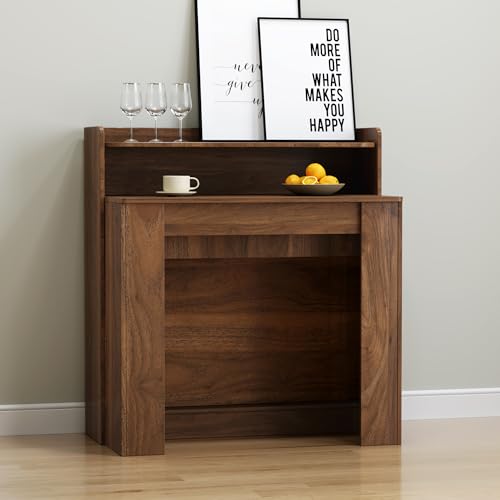
Varelynn 20"-98" Extendable Dining Table with Storage for 2-10, Walnut | Convertible Console Table with Storage, Extendable Design, Space Saving Solution, Ideal for Family Meals and Holiday Events
Check price on Amazon
2 in 1 Multifunction Convertible Dining Table for Small Spaces, 47.2" Long | Convertible Table to Shelf│Pre-Assembled Design for Easy Assembly│25mm Thickened E1-Grade MDF Board│250 lbs load Capacity
Check price on AmazonFrequently Asked Questions
How does a desk that turns into a dining table work?
Most convertible designs use one of three mechanisms: a hinged top that folds out to double the surface, a sliding extension that increases length, or a lift mechanism that raises and expands the worktop. The conversion is usually manual, requires a clear floor area, and takes seconds to a minute depending on the design.
Is a convertible desk dining table sturdy enough for daily meals?
Mid-range and premium convertible models built with reinforced steel frames and solid or high-grade engineered wood cores are generally sturdy enough for daily dining. Entry-level models may show wobble at full extension, so check weight ratings, hinge quality, and frame construction before choosing.
What size desk-to-dining table conversion do I need?
For two people, a converted surface of roughly 36 to 48 inches wide and 30 inches deep works well. For four diners, aim for at least 48 to 60 inches wide. Always check the extended depth and leave 30 to 36 inches of clearance around the table for chairs and walkways.
Can I use a convertible desk in a studio apartment?
Yes. These designs are especially suited to studio apartments, dorm rooms, and small dining nooks where a dedicated dining table is impractical. Pair the unit with foldable or stackable chairs to keep the footprint minimal when the table is in desk mode.
What is the difference between a desk that turns into a dining table and a coffee table that converts?
A desk-to-dining conversion starts at seating height and usually expands in surface area. A coffee table conversion typically involves lifting the surface from lounge height to dining height, sometimes with an expansion step. The desk category is generally simpler mechanically and better suited to daily work use; the coffee table category prioritizes living-room aesthetics.
Should I choose a hinged or sliding conversion?
Choose hinged if the desk sits against a wall and you have open floor space in front of it. Choose sliding if the room is narrow and depth is the constraint rather than length. Both designs can be durable; the deciding factor is usually which direction your room can spare.
Ready to Choose a Convertible Desk-Dining Table?
Compare recommended models above, check the expanded footprint against your floor plan, and confirm the hardware tier matches how often you plan to convert the table.
View Recommended Options