
Adjustable Dining Table for Small Spaces: The Complete Buying Guide
Small dining rooms and compact kitchens demand furniture that works harder. An adjustable dining table for small spaces lets you shrink your footprint for everyday life and expand it when guests arrive. This guide explains every mechanism, feature, and trade-off so you can choose with confidence.
Explore Recommended TablesWhy this guide matters: If you are researching an adjustable dining table for small spaces, you already know the product you want. What you likely need is clarity on which adjustment mechanism suits your room, how to verify build quality, and how to avoid the wobble and clearance mistakes that make compact tables frustrating. Everything below is organized to help you decide before you buy.
What Makes a Dining Table "Adjustable"?
An adjustable dining table for small spaces is any table that changes its footprint or working height to fit tight rooms. Unlike a fixed table, it gives you two or more configurations from a single piece of furniture. The most common adjustments fall into three families: surface extension, leaf removal, and height change.
Surface extension adds length by sliding panels outward or unfolding a section. Leaf removal shrinks the table by dropping or storing a panel, which is the classic drop-leaf approach. Height change raises or lowers the tabletop, which is useful for dual-purpose spaces where the same surface serves as a dining table and a work desk. Many modern compact tables combine two of these systems, such as an extendable table with a folding leaf.
The value of adjustability is not just space. It also changes how you use the room. A table that shrinks to a two-person size can sit against a wall during the week, then open into a four- or six-person surface for dinner. For a deeper look at how extendable systems work, see our two-person extendable dining table guide.
Adjustment Mechanisms Compared
Each mechanism solves a different problem. The right choice depends on how often you expect to change the table and how much floor space you can spare.
Extendable / Butterfly Leaf
The tabletop splits and slides apart, and a stored leaf folds out from the center. This is the most seamless option for a dining room because the table stays in place and the extension looks integrated. Mid-range and premium versions use smooth metal glide tracks, while entry-level models may use simpler wooden runners.
Drop-Leaf
One or two side panels hinge down to shrink the table against a wall. Drop-leaf tables are ideal for kitchen nooks and studio apartments because the folded position is genuinely compact. The trade-off is that a single leaf can feel less rigid than a center extension, so hinge quality matters a great deal.
Folding / Gateleg
The whole table folds flat or the legs swing out to support a leaf. Folding tables are the most space-efficient when stored, making them a strong pick for rooms that need to switch between dining and open floor. They tend to be lighter, so check the locking latches carefully.
Height-Adjustable
The tabletop raises or lowers on a frame or pedestal, letting the same surface serve as a dining table, a standing desk, or a low coffee-height table. Height-adjustable designs are less common in wood but appear in metal and mixed-material builds. Stability at the highest setting is the key thing to verify.
| Mechanism | Best For | Tier Where It Shines | Watch Out For |
|---|---|---|---|
| Butterfly / center extension | Dining rooms that host guests regularly | Mid-range and premium | Leaf storage space and glide track quality |
| Drop-leaf | Kitchen nooks, studios, narrow rooms | Entry-level to mid-range | Hinge rigidity and support leg placement |
| Folding / gateleg | Rooms that switch between uses | Entry-level to mid-range | Locking latches and overall weight |
| Height-adjustable | Dual-purpose dining and work spaces | Mid-range and premium | Wobble at the highest setting |
How to Choose the Right Adjustable Table
Start with the room, not the table. Measure the floor space you can dedicate to dining, then subtract the clearance you need around the edges. A table that fits the wall but leaves no room to pull out a chair is not actually usable. Once you know your maximum open size and your ideal closed size, you can filter mechanisms quickly.
Next, think about frequency of change. If you will extend the table only a few times a year, a butterfly leaf is efficient and looks best in a permanent dining room. If you need to fold the table daily to reclaim floor space, a drop-leaf or gateleg design is more practical. For rooms where the table doubles as a workspace, a height-adjustable model earns its place.
Seating is the other half of the equation. A compact adjustable table pairs best with chairs that tuck fully underneath. If you want a softer, more comfortable seat for long dinners, look at comfortable upholstered dining chairs and confirm the seat height matches your table. For a coordinated look, our guide to solid wood chairs for a dining table covers how to match chair materials to your tabletop.
Shape also matters in tight rooms. Round and square tops reduce corner collisions and let you walk around the table more easily. If your space is roughly square, a 55-inch square dining table can be a smart anchor for a compact dining area, especially when paired with an adjustable extension.
Quick rule of thumb: Choose the smallest closed size that still seats your household comfortably, then confirm the open size can host your typical guest count. Buying for the maximum crowd first usually leaves you with a table that feels oversized most of the year.
Quality Checklist Before You Buy
The difference between a satisfying adjustable table and a frustrating one almost always comes down to hardware. Use this checklist to evaluate any model you are considering.
- Locking mechanism: The table should lock firmly in both the closed and open positions. A latch or pin system that clicks into place is more reliable than friction alone.
- Hinge and glide quality: Look for reinforced hinge plates and metal glide tracks. Entry-level models sometimes use thin hardware that loosens over time, while mid-range and premium tables use heavier-duty components.
- Frame and leg structure: A sturdy apron and legs that are joined with proper brackets resist wobble. Check whether the legs are solid wood, engineered wood, or metal, and how they are attached.
- Surface finish: A matte or oiled finish hides everyday wear better than a high-gloss surface. For wood tables, a durable topcoat protects against spills and heat.
- Edge profile: Rounded or beveled edges are safer in tight rooms where you walk close to the table.
- Assembly and instructions: A clear manual and labeled hardware make a real difference. Complex mechanisms should come with a diagram showing every configuration.
- Weight and portability: If you plan to move the table often, lighter folding designs are easier to reposition, but they trade some rigidity for that convenience.
If you are also considering a fixed-height option, our guide to a dining counter-height table explains how taller surfaces change seating and clearance needs, which is useful when comparing height-adjustable models.
Space Planning and Clearance
Clearance is where most small-space dining setups succeed or fail. As a general guide, plan for about 30 to 36 inches of clear space on each side where chairs are pulled out, and roughly 36 inches along main walkways. These numbers let people sit down, stand up, and pass behind a seated diner without squeezing.
In very tight rooms, the adjustable mechanism becomes a planning tool. A table that folds to a narrow profile can sit against a wall during the week, freeing the walkway entirely. When guests arrive, you open it into the middle of the room and accept a temporary tighter layout. This trade-off is normal and is why adjustable tables are so effective in compact apartments.
Think about chair storage too. Stackable or lightweight chairs let you clear the room quickly. If your table is near a wall, a bench on one side can save depth, while chairs on the open side keep access easy. The goal is a setup where every configuration, closed and open, has a clear walking path.
Care and Longevity Tips
Adjustable tables have moving parts, and moving parts need attention. Keep hinges, glides, and latches free of grit, and tighten any screws that work loose over time. A dry cloth and a soft brush around the mechanism are usually enough. Avoid forcing a leaf or panel into place; if it resists, something is misaligned and should be checked before you apply more pressure.
Protect the surface with coasters and placemats, especially on wood and veneer tops. Wipe spills promptly and avoid leaving wet items on the table. For wood finishes, a periodic light polish keeps the surface conditioned. If you notice a wobble developing, address it early by checking leg fasteners and the locking mechanism rather than waiting for it to worsen.
Store any removable leaves flat and in a dry place. Moisture and heat are the main enemies of stored panels, so avoid damp basements or spots near radiators. With basic care, a well-built adjustable table can serve a small space for many years.
Ready to Compare Your Options?
The recommended tables below are selected for small-space flexibility. Review the specifications, check the adjustment mechanism, and match the closed and open sizes to your room before you decide.
Recommended Adjustable Dining Tables for Small Spaces
⚠️ AFFILIATE DISCLOSURE: This website contains affiliate links. As an affiliate Associate, we earn from qualifying purchases. If you make a purchase through these links, we may receive a small commission at no additional cost to you. Read our full affiliate policy.

Extendable Dining Table, Round Kitchen Dining Room Dinner Table with for 4 6 8 People, Space Saving Modern Oval Expandale Furniture with Storage and Pedestal for Kitchen Living Room (Black)
Check price on Amazon
DONGMUWUJEE Solid Wood Small Dining Table for 2-6, 23.6"L-47.2"L Expandable Kitchen Table, Designed for Small Spaces, Easy Assembly, Suitable for Kitchen, Dining Room, Living Room, Apartment (Walnut)
Check price on Amazon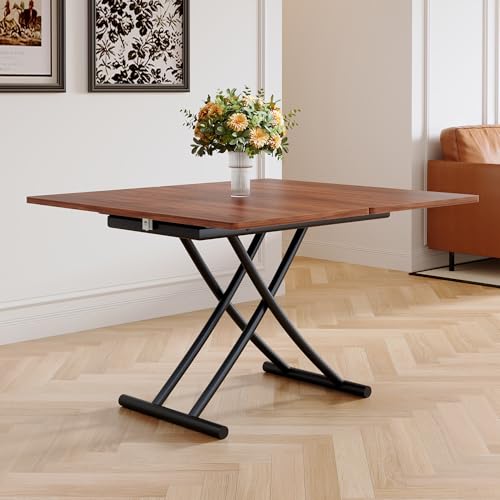
Vohward Adjustable Height Coffee Table, 4-in-1 Folding Dining Table, Walnut | Convertible lift top table for use as a coffee table, dining table, home office desk or vanity
Check price on Amazon
Extendable Dining Table with Charging Station, Convertible Folding Console Table for 6-8 People, Space-Saving Dining Table with LED Lights, Wood Rectangle Kitchen Table for Homes, Walnut (No Chairs)
Check price on Amazon
Amazon Basics Portable 4 Ft Rectangular Folding Dining Table, 4 Adjustable Height Settings, Space Saving Fold-in-Half Design and Carrying Handle, Indoor & Outdoor, Washed Black, 47.8 x 23.9 x 33.9 in
Check price on Amazon
86 in Extendable Dining Table for 6 8 10 People,59"-86" Farmhouse Rectangle Extending Dining Table w/Removable Leaves Space Saving,Wooden Adjustable Tables for Kitchen Office Living Room (Brown&Black)
Check price on Amazon
CRIPNAS Liftable Folding Dining Table for 4, Adjustable Drop Leaf Table, Folding Coffee Table for Small Spaces, Scratch-Resistant Wood Top with Metal Frame for Apartment Kitchen Living Room
Check price on AmazonFrequently Asked Questions
What is an adjustable dining table for small spaces?
It is a table that changes its footprint or height to suit compact rooms. It may extend, fold, drop a leaf, or raise and lower its surface, letting you shrink it for daily use and expand it for guests.
Are adjustable dining tables stable enough for daily use?
Yes, when the mechanism is well built. Mid-range and premium adjustable tables use reinforced hinge plates, locking latches, and solid frames. Entry-level models can wobble if the hardware is thin, so check the locking system and leg structure before buying.
How much clearance do I need around a small dining table?
Plan for roughly 30 to 36 inches of clear space on each side where chairs are pulled out, and about 36 inches along main walkways. If your room is tighter, a folding or drop-leaf adjustable table helps you reclaim floor space when it is not in use.
Can an adjustable table work in a kitchen nook?
Absolutely. Round and drop-leaf adjustable tables suit nooks because they have no sharp corners and can shrink against a wall. Pair them with stackable or lightweight chairs so the whole setup stays flexible.
Which material is best for a small adjustable table?
Solid wood and engineered wood with a durable topcoat are popular for warmth and longevity. Metal frames pair well with folding and height-adjustable mechanisms. If you want a bolder look, a metal-top dining table can be a practical and stylish choice for compact spaces.