
Travertine Dining Table Top: A Complete Buyer's Guide
Everything you need to know about travertine dining table tops — natural stone character, finish options, durability expectations, care routines, and how to choose a top that suits your dining room and lifestyle.
Start the GuideWhy This Guide Matters: A travertine dining table top is a natural stone surface with distinctive texture and warmth that few materials can match. But travertine is also a softer, more porous stone than granite or quartz, which means the finish, filling method, and edge profile you choose directly affect how the table performs over years of daily meals. This guide explains those trade-offs clearly so you can decide with confidence.
What Is a Travertine Dining Table Top?
Travertine is a form of limestone deposited by mineral springs, especially hot springs. Its characteristic appearance — soft beige, cream, tan, and sometimes grey or walnut tones with visible pits, veins, and banded layers — comes from the way calcium carbonate settles and hardens over time. When cut into slabs and finished for furniture, travertine becomes a dining table top with a distinctly earthy, architectural character.
Unlike uniform engineered surfaces, every travertine slab is visually unique. That natural variation is the main reason people choose it. It also means two tables built from the same specification can look noticeably different, so buyers should review actual slab photos or samples when possible.
Travertine in the Dining Room Context
A travertine top pairs naturally with solid wood bases, blackened steel frames, and pedestal designs. It works especially well in dining rooms aiming for organic modern, Mediterranean, rustic, or textured minimalist looks. If you are exploring broader stone options, our guide to oval stone dining tables covers how stone tops behave in different shapes and layouts, while stone-top rectangular dining tables explains why the rectangular format remains the most common for stone surfaces.
Travertine Material Traits: What to Expect
Understanding the physical behavior of travertine before you buy prevents most disappointment. The following traits are consistent across travertine tops, regardless of brand or tier.
Porosity and Pitting
Travertine forms with natural voids. Manufacturers either leave those voids open (unfilled travertine) or fill them with cementitious or epoxy filler (filled travertine). Unfilled tops show a more rustic, tactile surface but collect crumbs and liquids in the pits. Filled tops present a smoother, more uniform surface and are generally easier to live with in a dining setting.
Hardness and Scratch Resistance
Travertine sits in the mid-range of natural stone hardness — harder than soapstone, softer than granite and quartz. It resists everyday contact well but can scratch under grit, dragged ceramics, or direct knife use. A honed finish hides fine scratches far better than a polished finish.
Heat and Acid Sensitivity
Travertine handles warm plates reasonably well with trivets, but direct heat can dull a polished surface. More importantly, travertine is acid-sensitive: vinegar, citrus juice, wine, and many household cleaners can etch the surface if left to sit. Prompt wiping is the simplest protection.
Finish Options for a Travertine Table Top
The finish determines how a travertine top feels, reflects light, and ages. There are four common surface treatments for dining furniture.
| Finish | Best For | Character | Care Demand |
|---|---|---|---|
| Polished | Formal dining rooms and high-end tier settings | Glossy, reflective, deepens color | High — shows smudges and etching |
| Honed | Family dining and everyday use | Matte-smooth, softened color | Moderate — hides scratches well |
| Brushed | Textured, organic, or rustic interiors | Tactile, slightly aged appearance | Moderate — surface texture masks wear |
| Tumbled | Casual, Mediterranean, or outdoor-adjacent spaces | Softened edges, antique character | Moderate to high — more surface variation |
For most dining rooms, filled and honed is the balanced tier choice: it preserves travertine's natural movement while keeping the surface practical for plates, glasses, and daily cleanup. Polished travertine is the premium-tier aesthetic choice but demands more discipline with coasters and cleaning products.
Edge Profiles and Their Practical Impact
Travertine edges chip more easily than the face of the slab, so the edge profile is not a purely cosmetic decision. Common profiles include:
- Eased edge — a slight rounding that softens the corner and reduces chipping risk while keeping a clean line.
- Beveled edge — a small angled cut that adds visual lightness and protects the corner from direct impact.
- Bullnose edge — a fully rounded profile that is the most forgiving for family tables with children.
- Square edge — the sharpest and most modern look, but also the most vulnerable to chipping.
If the table will be used by children or in a busy open-plan space, a bullnose or eased edge is a practical, low-regret choice. The edge profile also affects how the top visually relates to the base — a thinner eased edge reads more contemporary, while a thicker bullnose reads warmer and more traditional.
Durability, Sealing, and Long-Term Care
A travertine dining table top is a long-term surface. With correct sealing and routine care, it can last for decades and develop a pleasant patina. Without care, it can stain, etch, and pit.
Sealing
Both filled and unfilled travertine should be sealed with a penetrating stone sealer. Sealing does not make the surface waterproof, but it buys time to wipe spills before they absorb. Reapply according to the sealer manufacturer's guidance, and sooner if water stops beading on the surface.
Daily Care
- Wipe spills promptly, especially wine, citrus, vinegar-based dressings, and sauces.
- Use coasters under glasses and trivets under hot dishes.
- Clean with a pH-neutral stone cleaner; avoid acidic or abrasive household cleaners.
- Place felt pads under decorative objects that could scratch the surface.
Repair and Restoration
Small chips and scratches can usually be repaired by a stone specialist using color-matched epoxy and polishing. If you are comparing surface resilience across materials, our overview of high-end marble dining tables explains how marble handles similar wear patterns, and our guide to dark stone dining tables covers how darker stone surfaces show or hide marks differently.
Matching the Top to Shape, Base, and Room
Travertine slabs are heavy, so the base and structural design matter as much as the surface. A well-built table pairs a substantial stone top with a base engineered to carry the load without flexing.
Rectangular and Oval Tops
Rectangular travertine tops are the most common configuration because they suit family dining and formal rooms. Oval tops soften the stone's visual weight and improve circulation in tighter rooms. For a closer look at stone-top formats, see our guide to oval stone dining tables.
Pedestal and Trestle Bases
A pedestal base keeps the stone visually floating and is a strong match for round or oval travertine tops. Trestle bases add a crafted, architectural feel and pair well with rectangular slabs. Our guides to pedestal bistro dining tables and solid oak trestle dining tables show how base style changes the character of a stone top.
Round and Compact Configurations
Round travertine tops work well in smaller dining rooms and breakfast nooks because the shape reduces corner conflicts. For compact layouts, a 60-inch round dining table and chairs set demonstrates how stone tops scale for four to six diners. If the room is narrow, our guide to 3ft x 4ft dining tables covers dimensions that keep stone tables comfortable in tighter footprints.
Travertine vs Other Stone and Wood Tops
Travertine is one option among several. The comparison below focuses on behavior and use case rather than any numeric measure.
| Surface | Character | Best For | Watch-Outs |
|---|---|---|---|
| Travertine | Warm, textured, natural movement | Organic modern, Mediterranean, rustic dining rooms | Porosity, acid sensitivity, edge chipping |
| Marble | Elegant, veined, cool-toned | Formal and luxury dining rooms | Etching, staining, heavier visual weight |
| Terrazzo | Graphic, speckled, contemporary | Modern and playful interiors | Busier pattern can dominate small rooms |
| Solid wood | Warm, repairable, tactile | Family dining and flexible styling | Movement, heat marks, routine refinishing |
If you want to see how another stone surface behaves in practice, our guide to the terrazzo-top dining table covers a different but equally distinctive stone-top approach. If you are weighing stone against wood, our overview of the elegant wood dining table explains the maintenance rhythm of wood surfaces.
Buying Checklist for a Travertine Table Top
Before committing to a travertine dining table top, run through this practical checklist. It is written for buyers who already know they want stone and need to verify the details before ordering.
- Filled or unfilled? Confirm which version the listing or showroom offers. Filled is more practical for everyday dining.
- Finish? Honed and brushed are the most forgiving; polished is the most formal.
- Edge profile? Choose eased, beveled, or bullnose for family use; square for a sharper modern look.
- Thickness and backing? Stone tops usually sit on a reinforcing substrate. Ask how the top is supported.
- Base capacity? Confirm the base is rated for stone weight and will not flex or wobble.
- Sealing guidance? Ask whether the top arrives pre-sealed and what maintenance the maker recommends.
- Delivery and placement? Stone tops are heavy and awkward to move. Check access routes and whether delivery includes placement.
- Sample review? Because travertine varies, request a slab photo or sample if buying remotely.
For a broader view of premium stone options before finalizing, see our guide to premium dining tables and the high-end marble dining table overview for a contrast in stone character and care.
Recommended Travertine Dining Table Tops
⚠️ AFFILIATE DISCLOSURE: This website contains affiliate links. As an affiliate Associate, we earn from qualifying purchases. If you make a purchase through these links, we may receive a small commission at no additional cost to you. Read our full affiliate policy.

ELDIBRO 47" Round Dining Table for 4, Travertine Stone Dining Tabletop with Classic Walnut Strip Base,Modern Circle Kitchen Table for Dining Room (Table Only)
Check price on Amazon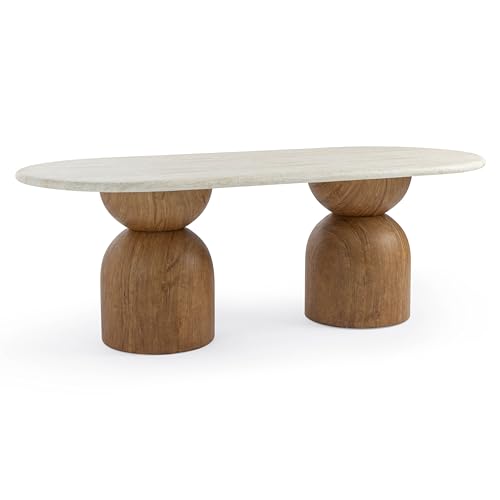
TOV Furniture Cynthia Travertine Concrete Indoor/Outdoor 87" Long Dining Table
Check price on Amazon
Honyee Sintered Stone Dining Table for 6–8, 78.7" Rectangular Kitchen Table, Real Travertine Top, Rounded Corners, Walnut Pedestal Base, Large Modern Dining Room Table
Check price on Amazon
homary 71" Oval Dining Table for 6, Modern Dining Room Table with Storage | Faux Travertine-Look Sintered Stone Top, Walnut Fluted Double Pedestal Base
Check price on Amazon
Tribesigns 78.74" Sintered Stone Dining Table for 8-10, Luxury Rectangular Dining Room Table with Solid Wood Legs, Mid-Century Kitchen Table with Travertine Slab Tabletop & Semi-Circular Stripe Base
Check price on Amazon
GDFStudio Oval Extendable Dining Table for 4-8, Travertine Inspired Kitchen Table, Wooden Strip Base, 63" to 79" Modern Kitchen Furniture with Rounded Corners, Simple Elegant Design, Beige
Check price on Amazon
63" Travertine Rectangular Dining Table for 6, Modern Kitchen Table | Sintered Stone Top Dining Room Table, Walnut Veneer Dual-Legs, Scratch & Heat Resistant, for Dinner (Table Only)
Check price on Amazon
71" Travertine Sintered Stone Dining Table, Seats 4-8, Luxury Dinner Table | Stone Top Dining Room Table with Premium Matte Tabletop & Heavy-Duty Base, Easy Assembly
Check price on AmazonFrequently Asked Questions
Is a travertine dining table top durable enough for daily use?
Yes. Travertine is a dense natural stone with good compressive strength. When properly sealed and installed on a solid frame, a travertine top handles daily dining, hot plates with trivets, and normal family use. It is softer than granite or quartz, so it benefits from coasters and prompt spill cleanup.
What finish is best for a travertine dining table top?
Honed and brushed finishes are the most practical for dining tables because they hide scratches and fingerprints while feeling smooth to the touch. Polished finishes look more formal but show smudges and etching more readily. Filled travertine with a honed surface is the most balanced choice for family dining rooms.
Does travertine need to be sealed?
Yes. Travertine is porous, especially in unfilled form, so a penetrating sealer is recommended to resist water rings, oil stains, and acidic spills. Filled travertine also benefits from sealing. Reapply sealer periodically based on water absorption and manufacturer guidance.
Can a travertine top be repaired if it chips?
Small chips at edges or corners can be repaired with color-matched stone epoxy and polishing. Larger damage may require a stone restoration specialist. Choosing a beveled or eased edge profile reduces the risk of chipping during everyday use.
How does travertine compare to marble for a dining table?
Travertine is warmer and more textured, with visible pits and banding, while marble is cooler and more veined. Both are acid-sensitive and benefit from sealing. Travertine generally shows scratches less on honed finishes, while marble's polished surfaces are more reflective and formal. For a side-by-side exploration, see our high-end marble dining table guide.