
Small Space Expandable Dining Table: The Complete Buyer's Guide
Discover how to choose a compact expandable dining table that adapts to your room, your household size, and your daily routine — without sacrificing comfort or style.
EXPLORE RECOMMENDED TABLESWhy expandable tables suit compact homes: A small space expandable dining table gives you two footprints in one piece of furniture. Closed, it handles everyday meals in tight kitchens and apartments. Extended, it seats guests for dinners, holidays, and gatherings. The key is matching the expansion mechanism, closed dimensions, and material build to your actual floor plan — which is exactly what this guide walks you through.
Who This Guide Is For
This page is written for buyers who already know they want a compact table that can grow. You are likely researching before a purchase: comparing mechanisms, checking whether a table will fit, and making sure the build quality holds up to frequent opening and closing. Rather than generic advice, the sections below focus on the decisions that actually change which table you should buy.
- Apartment and studio dwellers who need a table that disappears into a small floor plan.
- Small dining room owners who host occasionally but need everyday efficiency.
- Open-plan kitchen users who want a table that doubles as prep or workspace.
- First-time furniture buyers who want to avoid the most common sizing mistakes.
How Expandable Mechanisms Work
The mechanism is the single most important feature of a small space expandable dining table. It determines how much space the table needs to open, how easy it is to operate daily, and how the table looks when closed. There are five main types worth understanding before you shop.
1. Butterfly Leaf (Self-Storing)
A butterfly leaf folds in half and stores inside the table body, so you never need extra closet space for a loose leaf. When you need more seating, you lift the top, unfold the leaf, and lock it into place. This is the most space-efficient expandable design and a strong fit for apartments where storage is tight. If you want the convenience of a self-storing leaf in a narrow footprint, a narrow flip-top console dining table is worth comparing alongside butterfly-leaf models.
2. Drop-Leaf
Drop-leaf tables have hinged panels on one or both sides that fold down when not in use. A one-sided drop-leaf can sit flush against a wall, making it one of the most space-saving formats available. Two-sided drop-leaf models offer more flexibility but need clearance on both sides to open. If you want a wall-friendly format, see our guide to a small dining table with fold-down sides for layout considerations.
3. Flip-Top
Flip-top tables rotate the tabletop from a compact console position into a full dining surface. Many flip-top designs also convert from a console or coffee table into a dining table, which makes them ideal for multi-purpose rooms. A flip-top dining table is a practical choice when the table needs to serve two roles in the same room.
4. Extension Slide (Pull-Out Leaf)
Traditional extension tables separate in the middle and accept one or more loose leaves. The mechanism is smooth and the extended surface is stable, but you need storage space for the leaves. These are best suited to small dining rooms with a closet or under-bed storage nearby, rather than the tightest apartments.
5. Convertible / Multi-Function
Some tables convert between a coffee table and a dining table, or between a desk and a dining surface. These are the most space-flexible option for studio living, but the conversion mechanism adds complexity and usually a weight penalty. If you are comparing convertible formats, our breakdown of an expandable coffee table to dining table explains what to check before committing.
Mechanism Comparison at a Glance
| Mechanism | Best For | Storage Needed | Typical Tier |
|---|---|---|---|
| Butterfly leaf | Apartments, tight floor plans | None (self-storing) | Mid-range to premium |
| Drop-leaf | Wall placement, very narrow rooms | None | Entry-level to mid-range |
| Flip-top | Multi-purpose rooms, consoles | None | Mid-range |
| Extension slide | Small dining rooms with storage | Leaf storage required | Mid-range to high-end tier |
| Convertible | Studios, single-room living | None | Premium to flagship tier |
Sizing and Clearance: Getting the Numbers Right
Sizing mistakes are the most common reason buyers regret an expandable table. Two measurements matter most: the closed footprint and the fully extended footprint. A table that fits when closed can block a doorway or walkway once extended, so always plan for the larger dimension.
Clearance Rules of Thumb
- Walkway clearance: Aim for about 36 inches between the table edge and walls or furniture when chairs are occupied.
- Wall clearance: Allow roughly 30 inches between the table edge and a wall for comfortable seating.
- Chair pull-out: Leave at least 12 inches behind each chair for pulling it out and standing up.
- Extension zone: Confirm the room can absorb the extended depth or width without trapping a doorway.
Seating Capacity by Extended Size
Extended seating depends on the table shape. Rectangular tables generally seat two per side plus one at each end once extended. Round and oval tables use circumference rather than linear length. For reference points on seat counts, our guide to a small space dining table for 6 shows how compact tables reach six seats, and our overview of a 6-person dining table length covers the linear dimensions that make that possible.
Materials and Build Quality for Frequent Expansion
An expandable table endures repeated opening and closing, so the frame and hardware matter more than on a fixed table. Prioritize solid joinery and metal hardware over glued composite hinges.
- Solid hardwood frames (oak, walnut, teak, pine) resist racking and hold screws tightly through many cycles. Our guide to good wood for a dining table covers which species balance stability and weight.
- Engineered wood cores with durable laminate or veneer are lighter and stable, but check that hinges are anchored into solid blocking, not the veneer alone.
- Tempered glass tops are easy to wipe down and visually shrink a small room, but they show fingerprints. If you are considering glass, read our notes on tempered glass for a dining table.
- Metal frames and legs add rigidity and are common on flip-top and convertible designs. A metal indoor dining table can be a strong fit for frequent conversions.
- Hardware quality: Look for metal leaf-lock mechanisms and reinforced hinge plates. Mid-range and premium tiers typically operate more smoothly and last longer than entry-level mechanisms.
Layout Scenarios for Small Spaces
The right mechanism depends on the room shape as much as the table itself. Below are four common layouts and the expandable formats that work best in each.
Studio Apartment
In a single-room layout, the table must serve meals, work, and storage. A convertible or flip-top design is usually the best fit because it collapses into a console. Our guide to an apartment-size dining table and chairs covers the closed footprints that keep a studio functional.
Narrow Dining Room
Narrow rooms benefit from drop-leaf or flip-top tables that sit against a wall and open only when needed. A narrow flip-top console dining table keeps the walkway clear while still providing a full dining surface for guests.
Small Kitchen Corner
Corner placements work well with square drop-leaf or round expandable tables, which use vertical wall space rather than a full footprint. Our notes on a corner small dining table explain how to measure a corner alcove before buying.
Multi-Purpose Living Room
When the dining table shares space with a living area, a convertible coffee-to-dining design keeps the room flexible during the day. Our breakdown of a dining table that turns into a coffee table compares conversion mechanisms and weight considerations.
Buying Checklist for a Small Space Expandable Table
Before you order, confirm:
- Closed dimensions fit your everyday footprint, including chair pull-out space.
- Extended dimensions fit the room without blocking a doorway or walkway.
- The mechanism type matches your storage situation (self-storing vs. loose leaf).
- Seat count at full extension matches your typical guest list.
- Frame material and hardware are rated for frequent expansion cycles.
- Table height matches your existing chairs or the chairs you plan to buy.
- Assembly requirements are realistic for your space and tools.
- Return policy and warranty cover mechanism defects.
Common Mistakes to Avoid
- Measuring only the closed footprint. Always plan for the extended size and the space needed to operate the mechanism.
- Ignoring chair clearance. A table that fits the room can still be unusable if chairs cannot pull out.
- Choosing a loose-leaf extension without storage. If you have nowhere to store leaves, a self-storing butterfly leaf is more practical.
- Overlooking table height. Standard dining height is around 30 inches, but counter-height and bar-height tables differ. Check before pairing with chairs.
- Underestimating mechanism quality. Entry-level hinges on a frequently used table wear out faster; mid-range hardware is usually the better long-term investment.
- Skipping the weight check. Convertible and glass-top tables can be heavy; confirm one person can move the table if needed.
Recommended Small Space Expandable Dining Tables
⚠️ AFFILIATE DISCLOSURE: This website contains affiliate links. As an affiliate Associate, we earn from qualifying purchases. If you make a purchase through these links, we may receive a small commission at no additional cost to you. Read our full affiliate policy.
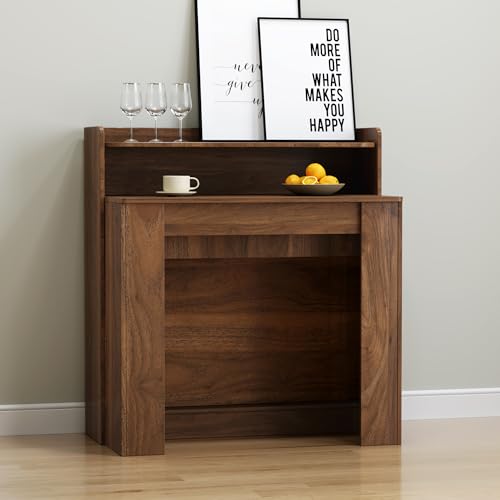
Varelynn 20"-98" Extendable Dining Table with Storage for 2-10, Walnut | Convertible Console Table with Storage, Extendable Design, Space Saving Solution, Ideal for Family Meals and Holiday Events
Check price on Amazon
DONGMUWUJEE Solid Wood Small Dining Table for 2-6, 23.6"L-47.2"L Expandable Kitchen Table, Designed for Small Spaces, Easy Assembly, Suitable for Kitchen, Dining Room, Living Room, Apartment (Walnut)
Check price on Amazon
Extendable Dining Table with Charging Station, Convertible Folding Console Table for 6-8 People, Space-Saving Dining Table with LED Lights, Wood Rectangle Kitchen Table for Homes, Walnut (No Chairs)
Check price on Amazon
20"-102" Extendable Dining Room Table with Storage for 1-9, Antique White | Expandable Console Table w/ Storage Cabinet,Space Saving Folding Dining Table, Modern Modular Multifunctional Extension Table
Check price on Amazon
HOMBIX Expandable Table, Extendable Dining Table for 2-12 People, Walnut | Expandable Design, Built-In Leaf Storage, Thanksgiving & Gatherings, Apartment Friendly
Check price on Amazon
Gemee 20"-118" Extendable Dining Table for 2-12 People | Built-In Leaf Storage Space, Space-Saving Expandable, For Apartments & Home
Check price on Amazon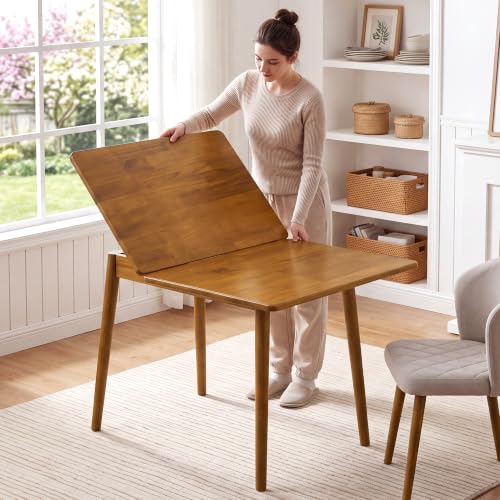
Extendable Dining Table Solid Wood , 23.6"-47.2" Expandable Dining Table | Small Spaces | Walnut Finish Foldable Dinner Table for 2-6 People, Easy Assembly for Apartment, Dining Room & Living Room
Check price on AmazonFrequently Asked Questions
How much clearance do I need around a small space expandable dining table?
Plan for at least 36 inches of walkway clearance around the table when chairs are occupied, and roughly 30 inches between the table edge and any wall for comfortable seating. For compact expandable tables, measure both the closed and fully extended footprint before you buy.
Which expandable mechanism is best for a small dining room?
Butterfly leaf mechanisms are the most space-efficient because the leaf stores inside the table. Drop-leaf and flip-top designs suit very narrow rooms, while self-storing extension slides offer the smoothest operation for mid-range and premium tiers.
Can an expandable dining table work in a studio apartment?
Yes. Wall-mounted drop-leaf tables, flip-top console tables, and coffee-to-dining convertible designs are purpose-built for studio apartments. Choose a compact closed footprint and confirm the extended size still fits your floor plan.
What materials hold up best on a small expandable table?
Solid hardwood frames and high-grade engineered wood cores with durable laminate or veneer finishes balance stability and weight. Tempered glass tops are easy to clean but show smudges, while metal frames add rigidity for frequent expansion and collapse.
How many people can a small expandable table seat?
Most compact expandable tables seat two to four people when closed and four to six when fully extended. Seating depends on table shape: rectangular tables add two seats per extension on the long side, while round tables add seats around the circumference. Confirm the extended length against your room clearance before choosing a seat count.
Do expandable tables wobble when extended?
Stability depends on the mechanism and frame. Extension slides with metal locking hardware and solid hardwood frames are the most stable when fully extended. Drop-leaf tables can feel less rigid if the hinges are low-grade. Check reviews for mentions of wobble at full extension, and confirm the table's weight rating if you plan to place heavy serving dishes on it.
Ready to Choose Your Expandable Table?
Browse the recommended models above, compare their closed and extended dimensions against your room, and confirm the mechanism matches how often you host. A well-chosen expandable table can serve a small home for years.
View Recommended Options