
Small Pine Dining Table: The Complete Buying Guide
Everything you need to know before choosing a compact pine dining table — wood quality, space planning, finishes, and long-term care for your home.
Why a small pine dining table? Pine is one of the most approachable solid woods for compact dining spaces. It offers a warm, natural grain, takes paint and stain beautifully, and is widely available in space-conscious sizes. This guide walks you through the material, construction, sizing, and care considerations so you can decide with confidence — whether you are furnishing a starter apartment, a breakfast nook, or a cozy kitchen corner.
Why Choose Pine for a Small Dining Table
Pine has a long history in furniture making for good reason. It is a softwood with an even grain, a warm tone that ranges from pale cream to honey amber, and a natural character that suits casual, cottage, Scandinavian, and farmhouse interiors alike. For a small dining table, pine brings several practical advantages:
- Warm, inviting appearance. Pine grain feels relaxed and homely, which helps compact dining areas feel cozy rather than cramped.
- Works with many design styles. From minimalist Scandinavian to rustic cottage, pine blends easily and can be stained, painted, or left natural.
- Solid wood character. Unlike veneered boards, solid pine shows genuine grain and develops a patina over time.
- Repairable and refinishable. Small dents and scratches can often be sanded out, and the surface can be refinished when you want a refresh.
- Widely available in compact sizes. Pine is commonly offered in two-seater and four-seater formats, making it a natural fit for smaller rooms.
If you are still deciding between wood and other surfaces, it helps to compare pine against other compact options. A small wooden dining table set covers similar ground, while a small light oak dining table offers a harder wood with a finer grain if durability is your priority. Pine sits comfortably between casual softwood charm and practical solid-wood construction.
Types of Pine Wood and What They Mean
Not all pine is the same. The species and grade affect grain appearance, hardness, and how the table will age. Here are the common categories you will encounter when shopping for a small pine dining table.
Solid Pine
Solid pine boards form the tabletop and often the frame. This is the most desirable construction for a table that will see daily use, because the wood can be sanded and refinished. Solid pine may be built from narrower boards glued together (edge-glued), which is normal and actually improves stability by distributing natural movement across multiple pieces.
Pine Veneer over Engineered Core
Some entry-level tables use a thin pine veneer over MDF or particleboard. These look convincing and stay flat, but they cannot be sanded heavily and are more vulnerable to moisture at the edges. For a small table that will be used daily, solid pine is generally the more serviceable choice.
Reclaimed and Recycled Pine
Reclaimed pine brings character — nail holes, aged grain, and a story. It suits rustic and cottage interiors. Because reclaimed wood varies, inspect for stability and any treated surfaces before refinishing.
Pine Grades
Pine is often graded by the number and size of knots. Clear or near-clear grades have fewer knots and a more uniform look; knotty grades embrace the natural character. Neither is inherently better — it is a style decision. For a small table where the surface is visible up close, decide whether you want a clean, calm grain or a character-rich, rustic look.
Quick Tip: Check the Edge Grain
On a solid pine tabletop, the edge grain should show continuous wood fibers consistent with the top surface. A repeating pattern or a visible seam line on the edge can indicate a veneer rather than solid wood.
Sizing a Small Pine Table to Your Space
A small pine dining table is only useful if it fits your room with comfortable clearance around it. Before choosing a size, measure your space and plan for circulation. The rule of thumb is to leave at least 30 to 36 inches (about 75 to 90 cm) of clearance between the table edge and walls or other furniture for chair pull-out and walkways. If you need a detailed breakdown, this guide on how much room you should have around a dining table walks through the numbers.
Common Small Pine Table Sizes
| Seating | Typical Footprint | Best For | Notes |
|---|---|---|---|
| 2-seater | Around 30 x 30 in to 36 x 36 in | Kitchen corners, breakfast nooks, apartments | Square or round shapes work well in tight corners |
| 4-seater | Around 36 x 48 in to 40 x 60 in | Small dining rooms, open kitchens | Rectangular tops suit narrow rooms; allow chair clearance on all sides |
| Drop-leaf or gateleg | Varies; often 30 in deep when folded | Multi-use rooms, tiny apartments | Flexible footprint for occasional hosting |
Shape matters as much as dimensions. A round or square table can fit into a corner more efficiently than a rectangle, while a rectangular top gives more usable surface per seat. If your room is especially tight, consider a dining table for tight spaces or a small apartment dining table idea that prioritizes clearance. For compact two-person setups, a small dining table and chairs for 2 is a natural pairing with a pine top.
Height and Chair Fit
Standard dining height is about 28 to 30 inches (71 to 76 cm) at the tabletop. Chairs should allow roughly 10 to 12 inches of clearance between the seat and the underside of the table for comfortable legroom. If you are mixing and matching, verify the apron depth — a deep apron on a small table can limit knee space.
Construction and Quality Signals to Check
When evaluating a small pine dining table, look beyond the surface. These are the details that separate a durable piece from one that wobbles or cracks within a year.
Joinery and Frame
- Corner blocks and braces. Reinforced corners resist racking, which matters more on narrow tables.
- Apron attachment. Screws or brackets should be snug, with room for wood movement. Overtightened screws can split pine.
- Leg attachment. Look for bolted or through-bolted legs rather than glue-only joints on larger tables.
Tabletop Construction
- Edge-glued boards. A common and stable construction for solid pine. Check that seams are tight and flush.
- Breadboard ends. Some tables use breadboard ends to stabilize wide tops; these should allow seasonal movement.
- Thickness. A thicker top (around 1 to 1.25 inches or more) tends to feel more substantial and resists warping better.
Stability and Finish
Set the table on a flat floor and check for wobble. On a small table, even a slight rock is noticeable. Also inspect the underside of the top and the inside of the legs — a consistent finish on hidden surfaces suggests better overall build quality.
Quality Signal: Wood Movement Allowance
Solid pine expands and contracts with humidity. Well-made tables allow for this in the frame and apron attachment. If a tabletop is rigidly screwed down with no allowance, it may develop cracks over time.
Finishes: Natural, Stained, Painted, and Oiled
The finish determines both the look and the maintenance routine of your pine table. Here is how the main options compare.
Natural and Clear-Sealed
Clear lacquer or polyurethane over natural pine keeps the pale-to-honey tone and protects the surface. This is a practical choice for a family table because it resists spills and wipes clean easily.
Stained Pine
Pine takes stain unevenly because of its grain density, so a pre-stain conditioner is often used. Stained pine can be pushed toward a walnut or oak look, though the grain remains distinctly pine. Expect some blotchiness — many people embrace it as character.
Painted Pine
Painted pine suits cottage, farmhouse, and coastal interiors, and it hides knots and minor imperfections. A painted finish is easy to touch up but will show chips over time; a topcoat of water-based polyurethane improves durability.
Oiled Pine
Oiled finishes (such as linseed or hardwax oil) penetrate the wood and leave a matte, natural feel. They are repairable spot-by-spot but require periodic re-oiling. Oiled pine is a good fit for a table you want to age gracefully.
If you are comparing finishes across wood types, the same principles apply to a small cottage dining table and other compact solid-wood pieces.
Market Tiers: Entry-Level to Premium
Small pine dining tables occupy several positions in the market. Rather than thinking in terms of numbers, it helps to understand what each tier typically delivers. The classification below is relative and consistent across this guide.
| Tier | Typical Construction | Best For | What to Expect |
|---|---|---|---|
| Entry-level | Pine veneer or thinner solid boards; basic hardware | Occasional use, starter spaces, light daily duty | Simpler joinery, fewer finish coats, more care needed with moisture |
| Mid-range | Solid pine top and frame; reinforced corners | Everyday family dining, small households | Better stability, smoother finish, serviceable hardware |
| Premium | Thicker solid pine, refined joinery, quality finish | Long-term daily use, design-focused spaces | More consistent grain selection, durable topcoat, better resale longevity |
If you are weighing a pine table against other compact options, it can help to look at how a small dining table is generally specified, or compare with a small oak drop-leaf dining table if you need a harder wood with a folding footprint. For a broader look at compact solid-wood sets, this small wooden dining table set overview covers what to check. If your plan is a pine top paired with a bench, the guidance on a bench for a dining table with a back can help you match heights and style.
Care and Maintenance for Pine
Pine is forgiving but not indestructible. A few habits keep a small pine dining table looking good for years.
Everyday Protection
- Use coasters under hot drinks and trivets under hot dishes — pine marks from heat more readily than harder woods.
- Wipe spills promptly. Pine is porous, and standing moisture can raise the grain or stain the finish.
- Use a soft, slightly damp cloth for daily cleaning; avoid abrasive cleaners that dull the topcoat.
Seasonal and Long-Term Care
- Humidity control. Keep indoor humidity reasonably stable. Pine moves with moisture, and dry winter air can open seams.
- Sunlight. Avoid long, direct sun exposure, which can fade or unevenly amber the finish.
- Refinishing. Solid pine can be sanded and refinished when the surface wears. If you plan to refinish, avoid heavy polyurethane that is difficult to strip; oil or lacquer are easier to renew.
- Dents and scratches. Small dents can often be raised with a damp cloth and gentle heat. Deeper scratches can be touched up with a matching wax or stain pen.
If your table has a painted or sealed finish, the same care principles apply to other compact wooden pieces, including a small white dining table for 2 or a small round dining table for 4.
Frequently Asked Questions
Is pine a good wood for a dining table?
Yes. Pine is a solid softwood with warm character and good workability. It is softer than oak or walnut, so it dents more easily, but it is also easier to sand and refinish. For a small dining table used daily, solid pine with a protective finish is a practical choice.
How do I know if a pine table is solid wood or veneer?
Check the edge grain — solid pine shows continuous fibers consistent with the top surface, while veneer often shows a repeating pattern or a visible seam on the edge. Also look at the underside: solid wood usually shows matching grain and construction details.
What size small pine dining table fits a compact kitchen?
For a compact kitchen, a 2-seater square or round top of roughly 30 to 36 inches per side is a common fit, provided you can keep about 30 to 36 inches of clearance for chair pull-out. Drop-leaf and gateleg designs are useful when the table doubles as a workspace.
Can a pine dining table be painted or stained later?
Yes. Solid pine is one of the easiest woods to repaint or stain. If the existing finish is a clear film, it must be sanded or stripped first. Oiled pine can be cleaned and re-oiled, or sanded back for a new finish.
How do I prevent a pine table from warping?
Keep humidity stable, avoid placing the table over a direct heat source or in prolonged direct sun, and choose a table with a stable construction such as edge-glued boards and a frame that allows for wood movement. A protective finish on all surfaces, including the underside, helps balance moisture absorption.
Recommended Small Pine Dining Tables
⚠️ AFFILIATE DISCLOSURE: This website contains affiliate links. As an affiliate Associate, we earn from qualifying purchases. If you make a purchase through these links, we may receive a small commission at no additional cost to you. Read our full affiliate policy.

Furniture Dash Wood Dining Table Corona
Check price on Amazon
Plank+Beam Classic 72 Inch Dining Table, Rectangular, Blonde Wirebrush | Non-Toxic Finishes, Versatile Design, Farmhouse Design, Elegant Details, Easy Assembly, Quick Setup, Solid Wood
Check price on Amazon
DM Furniture 47" Round Dining Table with Wooden Pedestal Base, Reclaimed Pine Wood Dinner Table for 4, Heavy Duty Pedestal Table for Kitchen/Dining Room/Living Room/Restaurant, Walnut
Check price on Amazon
Kitchen Breakfast Nook Table Set - Corner Dining Table Set with Cushion | 100% Solid Pine Wood, Dining Table Set with L-Shaped Bench, Space Saving for Kitchen Dining Room, Soft Cushion, Jet Black
Check price on Amazon
BizChair 46" x 30" Rectangular Antique Rustic Solid Pine Farm Dining Table
Check price on Amazon
Grain Wood Furniture Valerie Original Solid Wood 63" Dining Table, Rustic Walnut
Check price on Amazon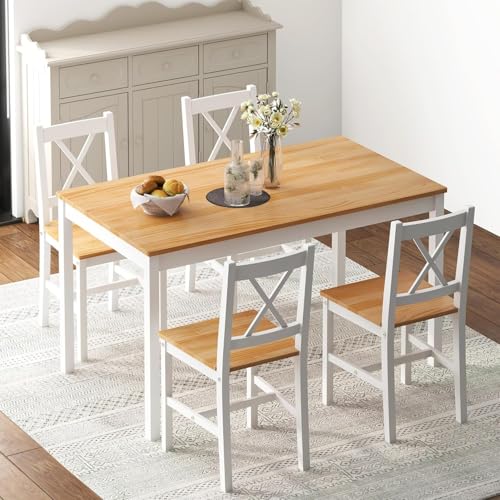
sogesfurniture 5 Pieces Small Dining Table Set with Chairs for 4 People | 42.5 Inch Rectangular Space Saving Kitchen Table, Modern Farmhouse Kitchen Dining Room Furniture, Pine Wood Frame, Oak&White
Check price on AmazonReady to Choose Your Small Pine Dining Table?
Use this guide to compare construction, sizing, and finishes — then explore the recommended options above to find the right fit for your space.
Explore Table OptionsRelated reading: if you are furnishing a compact dining area, you may also want to review ideas for a small kitchen dining table, a small convertible dining table, or a hideaway dining table and chairs setup. For a corner layout, a small corner booth dining table can maximize seating in a tight footprint.