
Small Dining Room Table and Two Chairs: The Complete Buyer's Guide
Everything you need to choose a compact two-person dining set that fits your space, matches your style, and lasts for years. Compare shapes, materials, tiers, and practical sizing rules before you decide.
Start ExploringWhy a two-person dining set deserves careful thought: A small dining room table and two chairs is one of the most space-efficient furniture investments you can make. Yet compact does not mean compromised. With the right shape, material, and tier, a two-seat dining set can anchor a breakfast nook, apartment kitchen, studio corner, or narrow dining room without overwhelming the floor plan. This guide walks you through sizing, shapes, materials, tiers, and styling so you can buy with confidence.
Recommended Small Dining Room Tables and Two Chairs
⚠️ AFFILIATE DISCLOSURE: This website contains affiliate links. As an affiliate Associate, we earn from qualifying purchases. If you make a purchase through these links, we may receive a small commission at no additional cost to you. Read our full affiliate policy.

VECELO Kitchen Dining Room Table with 2 Chairs & Bench, Compact Space-Saving Design, Easy Assembly Steel Frame, Perfect for Small Apartments & Breakfast Nooks,Classic Black
Check price on Amazon
IRONCK Dining Table Set for 2, Rustic Brown | Small Kitchen Table with Upholstered Chairs, Compact Dining Set for Small Spaces, Kitchen & Dining Room
Check price on Amazon
Dining Table Set for 4,Kitchen Table and Chairs for 4, Round Dining Room Table with Upholstered Chairs, 5 Piece Space Saving Circle Wood Kitchen & Dining Room Dinner Dinette Table Set (Vintage, 42In)
Check price on Amazon
AWQM 3 Piece Dining Table, Small Kitchen Table Set for 2 with Chairs(Brown) | Wood Breakfast Nook Table and Chairs Set of 2,Dinette Set for Small Space,Dining Room,Office, Apartment
Check price on Amazon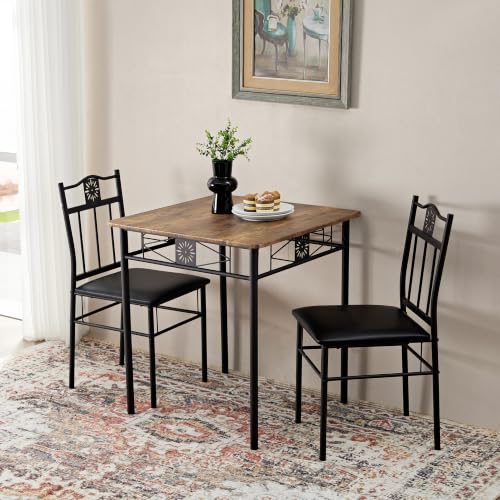
VECELO 3 Piece Small Dining Table Set for 2 with Upholstered Chairs, Brown | Wood Tabletop, Faux Leather Padded Seat, for Kitchen, Breakfast Nook, Small Space
Check price on Amazon
MALOL Upholstered Dining Chairs Set of 2 with High-Back, Beige | Dining Room Chair with Wood Legs, Padded Kitchen Chairs for Dining Room/Restaurant/Cafe
Check price on Amazon
DUMOS Dining Chairs Set of 2, Mid Century Modern Chair Round Upholstered Curved Backrest, Kitchen Vanity Living Room Chairs with Black Metal Legs, Green
Check price on Amazon
VINGLI 3 Piece Dining Set,Small Kitchen Table Set for 2,Breakfast Table Set,Kitchen Wooden Table and 2 Chairs for Small Space/Dining Room/Apartment,Metal Frame,Wine Rack,Black
Check price on AmazonWhy a Small Dining Table for Two Makes Sense
A dedicated two-seat dining arrangement solves several common household challenges at once. It gives you a place to eat that is not the sofa, it frees up square footage for other furniture, and it creates a natural focal point in small rooms. For couples, singles, students, and downsizers, a small dining room table and two chairs is often the most practical furniture purchase in the home.
Beyond the practical, a compact set improves daily routine. Meals become intentional, morning coffee gets its own spot, and the table can double as a work surface or a homework station. If you are still exploring broader style directions, our guide to dining room table styles can help you match a small set to your existing interior.
How Much Space Do You Really Need?
The most common mistake when buying a compact dining set is underestimating clearance. A table that fits the room is not the same as a table that fits the room comfortably. Use these practical sizing rules before you commit:
- Tabletop for two: roughly 30 inches square, 30–36 inches in diameter for round tops, or about 30 × 48 inches for rectangular models.
- Chair pull-out clearance: at least 30 inches behind each chair so someone can sit down and stand up without hitting a wall.
- Walkway clearance: 36 inches minimum behind seated chairs if the path is a main traffic route; 30 inches is workable for secondary paths.
- Wall gaps: leave 2–4 inches between the table edge and the wall when the table is pushed in, so chairs do not scuff paint.
For narrow rooms, a rectangular or oval top often slots into a wall niche more efficiently than a round top. If your room is tight on one dimension but generous on the other, our guide to a dining table for narrow space explains how to choose a footprint that respects both walls. For extremely compact apartments, a tiny apartment dining table may be the better starting point.
Round vs. Square vs. Rectangular: Choosing the Right Shape
Shape is the single biggest decision for a small dining room table and two chairs. Each geometry solves a different spatial problem:
| Shape | Best For | Trade-offs |
|---|---|---|
| Round | Compact rooms, apartments, corner nooks, improved traffic flow | Less usable surface against walls; chair backs may overlap on very small diameters |
| Square | Corner placements, small square rooms, maximizing surface against a wall | Sharp corners can feel tight in high-traffic paths; limited flexibility for extra guests |
| Rectangular | Narrow rooms, wall-anchored layouts, breakfast bars, galley kitchens | Longer footprint may block walkways; less sociable for face-to-face conversation |
| Oval | Softening a narrow rectangular footprint; small rooms that want a gentler look | Fewer compact models available; less efficient against straight walls |
If your room is roughly square and you want the most forgiving layout, start with a round top in the 30–36 inch diameter range. If you are placing the table against a wall in a narrow room, a rectangular top around 30 × 48 inches tends to be more efficient. Square tops sit nicely in corners and are a common choice for breakfast nooks.
Pedestal, Four-Leg, and Hairpin Bases
Under-table geometry matters as much as the tabletop. A pedestal base removes corner legs, which means chairs can be tucked in from any side without leg collisions. Four-leg bases are more traditional and stable but can crowd the space under a small top. Slim metal bases, such as hairpin dining table legs, open up visual space and suit modern compact rooms, while a metal leg dining table often brings a lighter visual weight than a solid wood apron.
For two-seat tables specifically, a central pedestal is often the most comfortable choice because both chairs can be positioned freely without knee obstructions.
Materials: Wood, Glass, Marble, and Metal
Material determines how the table looks, how it ages, and how much maintenance it demands. For a two-person set, the material also affects perceived bulk — glass and metal read lighter than solid wood in a small room.
- Solid wood: The most versatile and repairable option. Oak, walnut, teak, and rubberwood are common. Solid wood suits mid-range to premium tiers and can be refinished over time. A round rubberwood dining table is a practical entry into solid-wood construction.
- Glass: Visually expands small rooms and reflects light. A 42-inch round glass dining table set is a classic compact format. Glass needs regular cleaning but resists staining.
- Marble and stone: Brings a luxury feel and heavy visual presence. Suitable for premium tiers and formal nooks. Requires sealing and careful stain management. A marble granite dining table or a marble base dining table are common formats in this category.
- Metal: Durable, slim, and often weather-resistant. Metal frames pair well with wood or glass tops and suit industrial and modern styles.
If you want warmth without heavy maintenance, solid wood or wood-veneer tops in the mid-range tier are a strong default. If you want a bright, airy look in a dark apartment, glass or a light wood finish is usually the better pick.
Tiers and What They Typically Include
Compact dining sets span the full market from entry-level to luxury. The descriptors below describe relative market position, not any specific figure:
| Tier | Typical Construction | Best For |
|---|---|---|
| Entry-level / essential tier | Engineered wood or veneer tops, basic metal or wood legs, simple assembly | First apartments, temporary setups, low-traffic secondary dining areas |
| Mid-range / balanced tier | Solid wood or quality veneer, reinforced joinery, smoother mechanisms, better finishes | Everyday family use, long-term primary dining sets |
| Premium / high-end tier | Solid hardwoods, stone or tempered glass tops, refined edge detailing, premium hardware | Design-focused rooms, formal nooks, long-term investment pieces |
| Luxury / flagship tier | Rare hardwoods, book-matched stone, hand-finished surfaces, designer collaborations | Statement pieces in curated interiors and design-led homes |
Within each tier, look for construction details that predict longevity: corner blocks or aprons under the top, reinforced leg-to-apron joints, and a finish that is sealed rather than merely stained. A well-specified mid-range set often outlasts a poorly built premium one.
Choosing the Two Chairs
The chairs are half of the equation. For a compact set, chair dimensions determine whether the table can actually be tucked in and whether the room feels open or crowded.
- Seat height: for a standard 28–30 inch table height, choose chairs with a seat height of 17–19 inches.
- Seat depth and width: aim for at least 16 inches of seat depth and 16–18 inches of seat width for comfortable everyday use.
- Back height: low-back or backless chairs keep sightlines open in small rooms. High-back chairs add formality but visually shrink the space.
- Frame material: wood and metal frames are the most common; upholstered seats add comfort but require more cleaning.
If you are open to a specific chair style, a black chairs for dining table pairing grounds a light wood or glass top, while a wooden dining table chair keeps the set visually unified. For a mixed-material look, a black chair dining table combination works well in modern compact rooms. You can also consider a high back bench for dining table if you want a bench-plus-chair hybrid arrangement, though a traditional two-chair setup remains the most flexible.
Space-Saving Features Worth Considering
If floor space is tight, a few design features can make a two-seat set dramatically more livable:
- Drop-leaf: one or both sides fold down when not in use, shrinking the footprint to as little as a console. A drop leaf gate leg dining table is a classic example.
- Folding sides: similar to drop-leaf but often with hinged panels that tuck away. A dining table with folding sides is a practical apartment choice.
- Nesting and slim profiles: a slim dining table with bench or a tall narrow dining table can fit into corridors and galley kitchens.
- Console conversion: a console dining table doubles as an entryway piece when the table is not in active use.
- Small width formats: a small width dining table is designed specifically for narrow rooms where standard 36-inch tables are too deep.
For a two-person nook that also serves as a workspace, a 30 inch square dining table is a compact and versatile base. If you want the flexibility to add a guest occasionally, a small rectangular dining table set often leaves room for a third chair at the end.
Small Dining Set Types and Configurations
Two-person dining sets come in several configurations. Matching the configuration to your room and lifestyle prevents buyer's regret:
- Round two-seat sets: the most sociable layout; both diners face each other and the table reads as a single, soft object in the room. Explore a small round dining table set for a classic compact pairing.
- Square two-seat sets: efficient against walls and corners; often paired with low-back chairs to keep sightlines clear.
- Rectangular two-seat sets: best for narrow rooms and wall-anchored placements; allows a third chair at the end in some sizes.
- Glass-top sets: visually lighter and brighter; suit modern and minimalist interiors. A round glass dining table set is a common compact format.
- Drop-leaf and folding sets: the most space-flexible option; ideal for apartments and dual-purpose rooms.
If you are furnishing a breakfast nook rather than a full dining room, a small dining room table and two chairs is the anchor piece, but it should still be sized to leave room for a small sideboard or plant if the room allows. For wall-adjacent placements, a small dark brown dining table can create a grounded, cozy corner without dominating the room.
Placement, Lighting, and Styling Tips
A small dining set lives or dies on placement. The three most reliable layouts for a two-person table are:
- Wall-anchored: push one long side of the table against or near a wall and seat one person facing the room. This saves the most floor space and works well for rectangular tops.
- Corner nook: place a round or square top in a corner with two chairs at a 90-degree angle. This is the classic breakfast nook arrangement.
- Floating center: center the table under a pendant light for a deliberate, design-led look. This requires more clearance but delivers the strongest focal point.
Lighting does a lot of work in a small dining area. A single pendant centered over the tabletop defines the dining zone without adding furniture. A dining table light hung roughly 30–36 inches above the tabletop is a reliable starting point. If you want to soften a dark corner, a curved wood dining table paired with a warm pendant can make the zone feel intentional rather than squeezed in.
Styling a small table is about restraint. A single low centerpiece, two placemats, and a small plant or candle is usually enough. Avoid tall centerpieces that block sightlines; in a two-person setup, conversation across the table is the point.
Care and Longevity for Compact Sets
Compact sets often sit in high-use, high-traffic areas, so care matters. Wipe wood surfaces with a slightly damp cloth and dry immediately; avoid leaving standing water on any finish. Glass tops should be cleaned with a non-abrasive glass cleaner and a microfiber cloth. Stone tops need periodic sealing per the manufacturer's guidance. Chairs with upholstered seats benefit from a fabric protector and regular vacuuming.
If you plan to move the set between rooms or apartments, choose a table with removable legs or a folding mechanism. A table that disassembles cleanly survives moves far better than a fully glued unit.
Ready to Furnish Your Compact Dining Space?
Use the curated recommendations above to compare small dining room tables and two-chair sets across shapes, materials, and tiers. Every option is selected to fit tight footprints without sacrificing everyday comfort.
Explore Recommended SetsFrequently Asked Questions
What size should a small dining room table and two chairs be?
For two people, a tabletop measuring roughly 30 inches square, a round top of about 30–36 inches in diameter, or a rectangular top around 30 × 48 inches provides comfortable elbow room. Always allow at least 30 inches of clearance around the table for chair pull-out and walkways.
Is a round or square table better for a small dining room?
A round table softens sharp corners and improves traffic flow in tight spaces, making it ideal for compact rooms and apartments. A square table maximizes usable surface against walls and suits corner placements. Both work well for two chairs; choose based on room shape and walkway constraints.
Which material is best for a two-person dining table?
Solid wood offers warmth and long-term durability, making it a strong mid-range to premium choice. Glass tops create visual openness in small rooms, while metal frames provide a durable, slim footprint. Marble and stone tops bring a luxury feel but require sealing and careful maintenance.
Can a small dining table for two fit in an apartment?
Yes. Compact round or square tables, drop-leaf designs, and folding-side models are designed for apartments. Measure your floor space, account for chair clearance, and choose a table that leaves at least 30 inches of walkway behind seated chairs.
Should I choose a set with chairs included or buy them separately?
Included chairs guarantee matching finishes and compatible proportions, which matters in small rooms. Buying separately gives you more control over seat height and comfort. For a compact set, matching proportions are usually the higher priority, so a complete set is often the safer choice.