
Small Width Dining Table: The Complete Guide to Narrow Dining Tables
Learn how to choose a small width dining table that fits tight spaces without sacrificing comfort, style, or durability. Practical sizing rules, shape comparisons, and layout strategies for narrow dining rooms, apartments, and galley kitchens.
EXPLORE RECOMMENDED TABLESWhy a small width dining table matters: A narrow dining table is often the single most practical furniture decision for compact homes. When floor space is limited, the table's width — not its length — usually decides whether a dining area feels cramped or comfortable. Understanding how width interacts with chair placement, walkway clearance, and room proportions helps you buy with confidence.
This guide walks you through the exact measurements, shape trade-offs, material choices, and seating arrangements that make a small width dining table work in real rooms. If you are still comparing overall table styles, our dining room table styles overview is a useful companion read.
What Counts as a Small Width Dining Table?
There is no universal industry definition, but most furniture designers treat a dining table as "small width" when its short side measures roughly 30 to 36 inches (about 76 to 91 cm). Standard rectangular dining tables are commonly 36 to 42 inches wide, so a table under 36 inches gives you meaningful space savings while still accommodating place settings on both long sides.
Within this category, three practical bands appear most often in real homes:
- Ultra-narrow (about 30 inches / 76 cm): Best for galley kitchens, hallway dining, and studio apartments. Fits two place settings across comfortably.
- Standard narrow (about 32–34 inches / 81–86 cm): The most versatile band. Works well for two to four diners and leaves room for serving dishes in the middle.
- Compact standard (about 36 inches / 91 cm): The widest option still considered "small width." Ideal if you want a narrow footprint but regularly host four people.
A related consideration is the overall footprint. For truly tight rooms, a tall narrow dining table or a dining table for narrow space can solve layout problems that a conventional table cannot.
Table Width vs. Seating: How Many People Fit?
The practical rule is that each diner needs about 24 inches (61 cm) of table edge space, and each place setting needs roughly 12 to 15 inches of depth from the edge inward. On a narrow table, the depth constraint becomes the limiting factor — not the length.
| Table Width | Place Settings Across | Best Configuration | Typical Use Case |
|---|---|---|---|
| 30 inches (76 cm) | 1 per side, 2 facing | Two chairs, one on each long side | Couples, studio apartments, hallway dining |
| 32–34 inches (81–86 cm) | 2 facing, with center room | Two to four diners along the long edges | Small families, everyday meals |
| 36 inches (91 cm) | 2 facing plus serving space | Four diners, two per long side | Regular hosting for four |
| 30-inch round | 2–3 diners | Circular seating all around | Corners, breakfast nooks |
Measurement Tip
Always add 30 inches (76 cm) of clear floor space behind each chair for pull-out room and walkway clearance. A 30-inch wide table plus two chairs and back clearance effectively needs about 90 inches of room depth. Measure this first, then choose table length.
Best Table Shapes for Narrow Spaces
Width is only part of the story. The shape determines how the table feels in the room and how efficiently you can seat people.
Rectangular Narrow Tables
The most space-efficient option for long, thin rooms. A narrow rectangular table aligns naturally with walls and makes the room feel longer. Models such as a small rectangular dining table set and the tall narrow dining table are purpose-built for this scenario. For even tighter footprints, consider a slim dining table with bench, which eliminates chair push-back on one side.
Round and Square Narrow Tables
Round tables soften tight corners and allow flexible seating angles. A small round dining table set or a 30-inch square dining table can slot into a nook where a rectangle would block traffic. Square tables use floor space efficiently but demand more elbow room per diner than rectangles of the same width.
Drop-Leaf and Folding Tables
For rooms that must serve double duty, a drop-leaf gate leg dining table or a dining table with folding sides lets you shrink the table's footprint between meals. These are ideal when the dining area shares space with a kitchen or entryway.
Console and Skinny Tables
Wall-adjacent dining is a growing trend in compact homes. A console dining table or a skinny outdoor dining table (for patio versions) provides a slim dining surface that folds away visually. This is the narrowest practical solution when width is the primary constraint.
Materials and Finishes for Small Width Tables
In a narrow room, the table is visually dominant. Material choice affects both perceived lightness and long-term durability.
Wood
Solid wood remains the most popular choice for narrow dining tables. A wooden dining table and chairs set is durable and repairable, though heavy. Light wood tones and slim-profile legs reduce visual bulk. A light wood dining table for 4 is a strong everyday option in compact dining rooms.
Glass
Glass tops are visually light and make narrow rooms feel wider. A round glass dining table set or a glass dining table with bench can work well, but check that the frame is reinforced — narrow glass tables depend heavily on base stability. An amber glass dining table adds warmth where clear glass feels cold.
Marble and Stone
Stone tops feel premium and resist heat, but they are heavy and demand sturdy bases. A marble base dining table or a marble countertop dining table suits narrow spaces only if the floor can bear the load and the room has breathing space around the table.
Metal Frames
Metal legs and frames allow thinner profiles without sacrificing strength. A metal leg dining table or one with hairpin dining table legs reads as light and modern. For heavy-duty needs, cast iron dining table legs offer stability in a slim footprint.
Layout and Walkway Rules for Narrow Rooms
A small width dining table only works if the room supports it. These rules apply universally:
- Minimum walkway: 36 inches (91 cm) of clear space between the table edge and the nearest wall or furniture. This is non-negotiable for comfortable circulation.
- Chair pull-out: 30 inches (76 cm) behind each chair. If the wall is closer, choose a bench on that side.
- Table-to-wall gap: At least 18 inches if the table is pushed against a wall for occasional use, but 30+ inches for daily use.
- Leave the long axis clear: In narrow rooms, orient the table along the room's long dimension. A dining table for narrow space layout with the long side parallel to the longest wall maximizes circulation.
Benches are a strong solution in narrow dining rooms because they tuck fully under the table, freeing floor space between meals. A high back bench for dining table adds comfort without widening the footprint. For banquette-style seating, a round bench seat for dining table can anchor a nook corner.
Choosing Seating for a Narrow Table
Chair depth matters as much as table width. Dining chairs are typically 18 to 24 inches deep; armless chairs are the safest choice for narrow rooms. If you use benches, pick backless designs and store them under the table between meals.
For mixed setups, a slim dining table with bench on one side and two armless chairs on the other is one of the most space-efficient arrangements available. If you have the option of a dining table with bench 6 seater, the bench side reduces the total footprint significantly compared to six individual chairs.
Many buyers pair narrow tables with a small dining room table and two chairs for couples, or scale up to a light wood dining table for 4 when occasional hosting is required.
Quality Tiers: What Changes Across Narrow Dining Tables
To compare tables objectively, classify them by construction and material quality rather than by numeric figures. These universal tiers work across brands and regions:
| Tier | Typical Construction | Best For | Long-Term Notes |
|---|---|---|---|
| Entry-level | Engineered wood, MDF tops, basic metal legs | First home, temporary setup, low-traffic dining | Adequate for light use; check joint reinforcement |
| Mid-range | Veneer over solid core, reinforced steel frames | Everyday family dining, moderate hosting | Good balance of durability and flexibility |
| Premium | Solid hardwood, thick steel frames, precise joinery | Daily family use, frequent hosting | Repairable; strong long-term investment |
| Luxury / top-tier | Solid hardwood, stone tops, artisan hardware | Design-led spaces, long-term ownership | High durability; significant weight |
Within each tier, narrow tables are not inherently less stable than wider ones — but the slim proportions demand attention to leg placement. Tables with a central pedestal (like a marble base dining table) generally offer better stability at narrow widths than four thin corner legs.
Buying Checklist Before You Decide
- Measure the room's usable width and length, then subtract 36 inches for walkways.
- Confirm the table width is 30–36 inches if narrow footprint is essential.
- Verify chair depth and whether a bench would free more floor space.
- Check leg placement — pedestal or central bases are more stable at narrow widths.
- For glass tops, confirm frame reinforcement and tempered safety glass.
- For stone tops, confirm floor load and delivery requirements.
- Consider extendable or folding options if you occasionally host more than four.
- Check assembly requirements and whether the table can be moved through doorways.
If you are scaling up but keeping the narrow profile, a round dining table set for 4 with chairs or a small round dining table set can deliver extra seating without the footprint of a full rectangle.
Ready to Compare Small Width Dining Tables?
Browse our curated selection of narrow and compact dining tables chosen for space-saving layouts, stable construction, and practical seating configurations. Every recommendation is filtered for real-world narrow-room use.
VIEW RECOMMENDED TABLESRecommended Small Width Dining Tables
⚠️ AFFILIATE DISCLOSURE: This website contains affiliate links. As an affiliate Associate, we earn from qualifying purchases. If you make a purchase through these links, we may receive a small commission at no additional cost to you. Read our full affiliate policy.

Garvee 71" Wood Dining Table for 2/4/6/8, Large Rectangular Kitchen Table | Anti-Collision Curved Corner Dinner Table with Recessed Footrest for Dining Room, Study & Home Office, Walnut Brown & Black
Check price on Amazon
71-87 Inch Extendable Dining Room Table, Rustic Wooden Kitchen Table 6-10 | STHOUYN Expandable Dining Table, Farmhouse Rustic Style, Rectangular Wooden Top, Seats 6-10, Brown Kitchen or Dining Room
Check price on Amazon
DUMOS Dining Table Set for Kitchen, Apartment and Corner Grey 3 Pack | Space-Saving Ideal, Easy Clean, Scratch Resistant, Robust Iron Frame, Anti-slip Feet Pad, Living Room, Patio
Check price on Amazon
41 in-78 in Extendable Dining Room Table for 4-8, Round Expandable Kitchen Table with Fluted Base, Modern Farmhouse Oval Dinner Tables for Dining Room Kitchen Living Room (Walnut)
Check price on Amazon
Jocoevol Round Dining Table for 4,Kitchen Dining Room Circle Dinner Pedestal Table,Space Saving Wood Kitchen & Dining Room Furniture (Vintage, 46In)
Check price on Amazon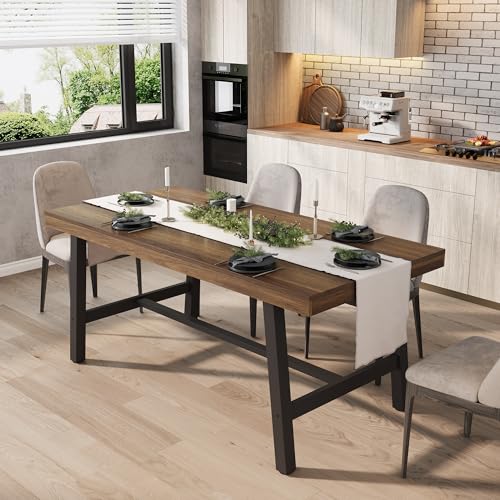
GarveeHome Industrial Dining Table for 4-6 People, 63" Long Large Kitchen Table with Sturdy Metal Frame, Rectangular Counter for Dinner, Kitchen, Dining Room (Brown, 63" Non-extendable)
Check price on Amazon
VASAGLE Folding Dining Table, Kitchen Table | Drop Leaf Extendable Table for Small Spaces, Seats 2-4 People, Industrial, Rustic Brown and Black UKDT077B01
Check price on Amazon
East West Furniture NFT-MAH-T Norfolk Dining Room Table - a Rectangle kitchen Table Top with Butterfly Leaf, 32x54 Inch, Mahogany
Check price on AmazonFrequently Asked Questions
How narrow can a dining table be for four people?
A 32-inch (81 cm) wide rectangular table is the practical minimum for four diners seated two per long side. At 30 inches, facing place settings become tight once serving dishes are placed in the center. A 34–36 inch width gives comfortable elbow room for four.
Is a round or rectangular table better for a narrow room?
Rectangular tables align with long, thin rooms and make circulation more predictable. Round tables soften tight corners and work better in nooks or near walkways. In narrow rooms with a long axis, rectangular usually wins on efficiency.
How much walkway space do I need around a small width dining table?
Plan for 36 inches (91 cm) of clear floor space between the table edge and any wall or furniture, plus 30 inches behind each chair for pull-out. If that is impossible, switch to a bench on the tight side to reduce clearance needs.
Do narrow dining tables wobble more easily?
Slim tables can wobble if the leg placement is poor, but width itself is not the cause. Tables with central pedestals or reinforced steel frames tend to be the most stable at narrow widths. Check assembly instructions for leveling hardware and cross-bracing.
What is the best material for a narrow dining table in a small room?
Glass and light wood reduce visual bulk and make narrow rooms feel wider. Solid hardwood offers the best long-term durability. Stone tops add visual weight and require sturdier bases, so they suit larger narrow rooms rather than the tightest spaces.
Can a small width dining table be extended?
Yes — extendable narrow tables exist, but verify that the extension mechanism does not add width. Most extend along the length, which preserves the narrow footprint. A dining table with folding sides is a good option when length flexibility is needed in a narrow room.
Final Thoughts
A small width dining table is not a compromise — it is a deliberate, space-aware choice that can make a compact dining area feel calm and functional. Focus on the three measurements that matter most: the table's short side (aim for 30–36 inches), the chair pull-out clearance behind each seat, and the 36-inch walkway around the table. Then choose shape and material based on how the room is used daily, not just on how it looks in photos.
If you are still narrowing down your options, pair this guide with our dining room table styles overview and explore configurations like a small dining room table and two chairs for couples, or a slim dining table with bench for families who need maximum floor clearance.