
Hideaway Dining Room Table: The Complete Space-Saving Buying Guide
When floor space is limited but hospitality is not, a hideaway dining room table becomes the smartest piece of furniture in your home. This guide explains how fold-away, drop-leaf, and convertible designs work, what to check before buying, and how to choose a table that disappears when you need the room back.
Recommended Hideaway Dining Room Tables
⚠️ AFFILIATE DISCLOSURE: This website contains affiliate links. As an affiliate Associate, we earn from qualifying purchases. If you make a purchase through these links, we may receive a small commission at no additional cost to you. Read our full affiliate policy.

HOMBIX Expandable Table, Extendable Dining Table for 2-12 People, Walnut | Expandable Design, Built-In Leaf Storage, Thanksgiving & Gatherings, Apartment Friendly
Check price on Amazon
20"-102" Extendable Dining Room Table with Storage for 1-9, Antique White | Expandable Console Table w/ Storage Cabinet,Space Saving Folding Dining Table, Modern Modular Multifunctional Extension Table
Check price on Amazon
Extendable Dining Table with Charging Station, Convertible Folding Console Table for 6-8 People, Space-Saving Dining Table with LED Lights, Wood Rectangle Kitchen Table for Homes, Walnut (No Chairs)
Check price on Amazon
5 PCS Farmhouse Dining Table Set for 4,60" Large Folding Dining Table Set w/ 4 Leather Chairs, Drop Leaf Foldable Kitchen Table for Small Spaces,Barn Door Design,6 Wheels,2-Layer Storage Shelf,Black
Check price on Amazon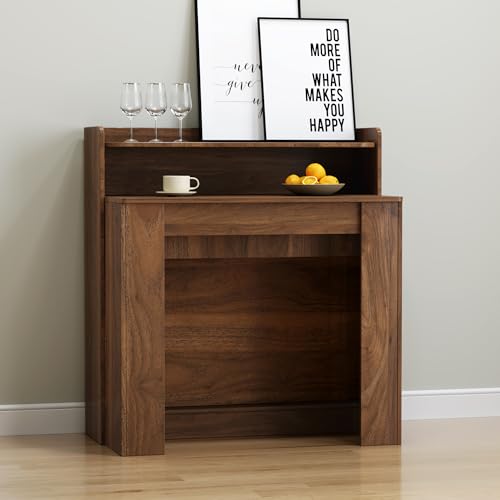
Varelynn 20"-98" Extendable Dining Table with Storage for 2-10, Walnut | Convertible Console Table with Storage, Extendable Design, Space Saving Solution, Ideal for Family Meals and Holiday Events
Check price on Amazon
Garvee Folding Dining Table with Storage, Folding Kitchen Table with 6 Wheels, Drawer & Shelves, Compact Dining Table for Small Spaces
Check price on Amazon
JNNXZZ Folding Dining Table Set with Chairs for 4, No Assembly - Walnut | Solid Bamboo, Drop Leaf Table and Hideaway Chairs with Lockable Wheels, Drawers, Leveling Feet for Small Spaces Kitchen
Check price on AmazonWhat Is a Hideaway Dining Room Table?
A hideaway dining room table is a dining table engineered to fold, flip, drop, or convert into a compact form so it can be stored out of the way or tucked against a wall. Unlike a fixed table that permanently claims floor space, a hideaway design lets the same room serve as a kitchen, workspace, and dining area on a rotating schedule. The category includes drop-leaf tables, flip-top consoles, gateleg designs, and tables that convert between coffee-table height and dining height.
The appeal is practical rather than decorative: you gain a full dining surface when guests arrive and reclaim the room when they leave. For apartment dwellers, studio owners, and anyone with an open-plan layout, this flexibility often matters more than the table's visual style. If you are exploring the broader category first, our guide to the hideaway dining table covers the compact variants that fold down to almost nothing.
Hideaway tables are not a single product type. They are a family of mechanisms, and each mechanism solves a slightly different problem. A drop-leaf table is ideal for a narrow wall. A flip-top console is ideal for an entryway that doubles as a dining spot. A coffee-to-dining converter is ideal for a studio where the living area is the only area. Choosing well means matching the mechanism to the way your room is actually used.
How Hideaway Mechanisms Work
Most hideaway tables rely on one of four mechanical ideas. Understanding them helps you predict how a table will behave after months of daily use.
Drop-leaf and gateleg
One or two hinged leaves fold down vertically along the table's sides. Gateleg tables add swinging legs that support each leaf when raised. The result is a table that can shrink from a full dining surface to a narrow console in seconds. The hinge quality is the single most important factor here: a reinforced hinge with a locking catch keeps the leaf rigid when raised and prevents sagging over time.
Flip-top and convertible
A flip-top table rotates its surface on a central pivot, turning a console into a dining table or changing the table from a low coffee height to a standard dining height. These designs are excellent for multi-purpose rooms but demand a sturdy pivot and a stable base, since the top must lock firmly in both positions. Our page on the flip top dining table explains the locking systems to look for.
Folding frame
The entire table folds flat, legs collapsing against the top. These are the most compact when stored, but they usually require assembly and disassembly each time. They suit occasional use and storage in a closet rather than daily dining.
Extendable and nesting
Some tables hide their extra length inside the frame, pulling out a leaf or nesting a smaller table beneath a larger one. These preserve a full dining surface while reducing the footprint when not in use. A narrow narrow flip top console dining table is a good example of a design that hides its dining function in plain sight.
Types of Hideaway Tables Compared
The table below summarizes the main hideaway formats so you can match a mechanism to your room and routine.
| Type | Best For | Footprint When Closed | Typical Tier |
|---|---|---|---|
| Drop-leaf | Narrow kitchens and dining nooks against a wall | Very compact, one side usable | Entry-level to mid-range |
| Gateleg | Rooms that need a full table only during meals | Folds to a slim console | Mid-range |
| Flip-top console | Entryways and open-plan rooms | Console-sized, wall-hugging | Mid-range to premium |
| Coffee-to-dining converter | Studios and living rooms with no dedicated dining zone | Low coffee-table profile | Mid-range to high-end tier |
| Folding frame | Occasional use, storage in a closet | Folds flat | Essential tier |
If your priority is a table that works as a desk during the day, look at a dining room table and desk hybrid. If you need to seat more people only occasionally, an expandable dining room table that seats 12 may be a better fit than a pure hideaway. And if the room is genuinely tiny, a small space dining table for 6 shows how far compact engineering has come.
Measuring Your Space Before You Buy
Hideaway tables fail in real homes for one reason: the room was measured in its empty state, not in its lived-in state. Follow a simple sequence.
- Measure the open footprint. Mark the table's fully extended outline on the floor with tape. Include the chairs pulled out, not tucked in.
- Measure the closed footprint. Confirm the folded table still leaves a clear walkway. A common rule is to keep at least 36 inches of clearance behind pulled-out chairs.
- Check the swing path. Drop leaves and flip tops need room to rotate. Measure the arc, not just the final position.
- Check ceiling and wall obstructions. A flip-top that raises the surface can collide with a low window sill or a wall-mounted shelf.
- Confirm the storage position. If the table folds flat, decide where it will live when closed. A table that must be carried to a closet every night will stop being used.
For rooms with awkward corners, a corner small dining table can be a more efficient answer than a folding design. For very tight floor plans, review our folding dining room table for small spaces guide, which walks through clearance math in detail.
Materials & Build Quality
A hideaway table endures more mechanical stress than a fixed table, because its joints move. Material choice should reflect that.
Solid wood and wood veneer
Solid hardwood tops handle hinge stress well and can be refinished if a leaf edge chips. Veneered tops are lighter and more stable in humidity changes, which matters for folding leaves that would otherwise warp. If you are comparing species, our guide to good wood for a dining table explains which woods hold up under repeated folding.
Metal frames and bases
Steel and aluminum frames are common in convertible tables because they keep the mechanism rigid while staying light. Look for a rust-proof finish and reinforced pivot points. Our overview of the metal indoor dining table covers frame construction in more depth.
Glass and stone tops
Glass tops are visually light and easy to clean, but they add weight that stresses hinges. Tempered glass is essential; our page on tempered glass for dining tables explains why. Stone tops are rarely used on hideaway designs for the same weight reason, though a small marble dining table for 4 can work if the mechanism is rated for it.
Hardware tier
Think of hardware in tiers. Entry-level tables use standard hinges and simple locking catches. Mid-range designs add soft-close hinges, metal-reinforced leaf supports, and adjustable feet. Premium and high-end tier tables use purpose-built pivot assemblies, often with a manufacturer-rated cycle count and spare parts availability. The hardware tier, not the top material, usually determines how long a hideaway table stays pleasant to use.
Seating & Comfort Considerations
Because hideaway tables are often narrower than fixed tables, seating choices matter more than usual. A deep upholstered chair can make a compact table feel cramped, while a slim bench can seat more people along one side.
Benches are particularly effective with drop-leaf and gateleg tables because they slide under the leaf when it is closed. Our guide to a seating bench for a dining table covers sizing and back support. If you prefer chairs, check seat height against the table's apron clearance; an adjustable dining chair gives you room to fine-tune. For households with children, a junior chair for the dining table keeps the little ones at the right height without adding a high chair.
Plan for the number of seats you need in the open position, not the closed position. A table that seats four comfortably is better than one that seats six in a squeeze.
What to Check Before Buying
- Mechanism rating. Ask for the rated number of fold cycles or at least a warranty covering the hinges and pivots.
- Locking security. The top must lock firmly in both the open and closed positions. Test for wobble at the leaf edge.
- Leaf support. On gateleg and drop-leaf tables, confirm the support legs lock and carry weight without flex.
- Weight and portability. If you plan to move the table between rooms, check the assembled weight and whether it has casters or glides.
- Assembly complexity. Folding-frame tables often need assembly each time. Confirm the process is tool-light and repeatable.
- Surface finish. A matte or oiled finish hides fingerprints better than a high gloss, which matters on a table that is handled frequently.
- Spare parts. Confirm replacement hinges, leaf supports, and feet are available before you commit.
For a broader checklist that applies to any table purchase, see our first dining table checklist. If you are working within a defined spending tier, our dining table set under 200 guide explains what the entry-level tier realistically includes.
Care & Maintenance for Hideaway Tables
Hideaway tables need two kinds of maintenance: surface care and mechanism care. Surface care follows the material; mechanism care is what keeps the table folding smoothly for years.
- Lubricate moving parts sparingly. A dry silicone lubricant on hinges and pivots prevents squeaks without attracting dust. Avoid oil-based lubricants on wood-adjacent hardware.
- Tighten hardware seasonally. Wood expands and contracts with humidity, so screws on leaf supports loosen over time. Check them twice a year.
- Keep leaves dry. Wipe spills promptly, especially along leaf seams where moisture can seep into the core.
- Store flat if removable. If a leaf can be removed, store it flat rather than leaning, which can warp it.
- Protect the open surface. Use a table pad or placemats on high-traffic tables; our guide to a clear dining table cover explains options that preserve the look.
For a deeper routine, our dining table routine upkeep guide covers cleaning schedules and seasonal checks.
Ready to Choose Your Hideaway Table?
Browse our recommended hideaway dining room tables above, or continue exploring the compact dining category to compare mechanisms side by side.
Explore Compact Dining TablesFrequently Asked Questions
Is a hideaway dining table sturdy enough for daily use?
Yes, if the mechanism is rated for regular folding. Mid-range and premium designs with reinforced hinges and locking leaf supports handle daily open-and-close cycles well. Entry-level folding frames are better suited to occasional use.
How much clearance do I need behind the chairs?
A common guideline is at least 36 inches of clearance from the table edge to the nearest wall or furniture so a chair can be pulled out and someone can walk behind it. Tight rooms can work with less, but the table will feel cramped during meals.
Drop-leaf or flip-top: which is better for a small kitchen?
Drop-leaf tables suit a narrow wall because one side can stay against it while the other leaf is raised. Flip-top consoles suit entryways and open-plan rooms where the table needs to look like a console when closed. Choose based on where the table will sit, not on the mechanism alone.
Can a hideaway table seat six people?
Some can. Gateleg and extendable hideaway designs in the mid-range and premium tiers can open to seat six, though the closed footprint will be larger than a two-person drop-leaf. Our guide to a small space dining table for 6 explains the trade-offs.
Do hideaway tables work outdoors?
Most indoor hideaway tables use hardware and finishes that are not weather-resistant. For patios, choose a purpose-built outdoor folding table with a weather-resistant coating and rust-proof frame.