
Coffee Table Turns Into Dining: The Complete Guide
Discover how a convertible coffee table transforms your living space into a dining area in seconds. Compare lift-top, expanding, and dual-function designs for compact homes.
Explore the GuideWhy convertible coffee tables matter: In small apartments, studio units, and open-plan homes, dedicating floor space to a separate dining table is often impractical. A coffee table that turns into a dining table solves this by giving you two essential furniture pieces in one footprint. This guide explains how these designs work, what to look for, and how to choose the right model for your space.
Recommended Convertible Coffee Tables
⚠️ AFFILIATE DISCLOSURE: This website contains affiliate links. As an affiliate Associate, we earn from qualifying purchases. If you make a purchase through these links, we may receive a small commission at no additional cost to you. Read our full affiliate policy.
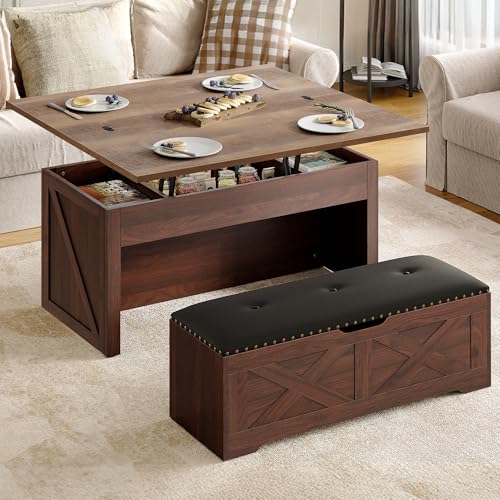
YITAHOME Lift Top Coffee Table Set with Storage Ottoman Bench & Wheels | 4 in 1 Convertible Dinning Center Tables with Hidden Compartment, Farmhouse Coffee Tables for Living Room Furniture, Walnut
Check price on Amazon
DUMOS 39.4" Lift Top Coffee Table with Storage, 4 in 1 Convertible Table | Multifunctional Expandable Coffee Table to Dining Table with 2 Drawers for Small Living Room, Apartment, Board Game, Brown
Check price on Amazon
Manora Lift Top Coffee Table,Convertible Dining Table,Hidden Storage,Brown | Dual Lift-Top Design · Expandable Dining Surface · 3 Hidden Storage Compartments · Space-Saving & Versatile
Check price on Amazon
Memobarco 40" Lift Top Coffee Table with Storage,Black | 4 in 1 Multi-Function Lifting top Coffee Tables with Storage Drawers and Hidden Compartmen,for Living Room
Check price on Amazon
Homiflex Dual Lift Top Coffee Table with Bench and Round Edge, 40'' Natural | Lifting Coffee Table with Hidden Compartment & Open Shelves for Living Room, 4 in 1 Convert Gaming/Reading/Dining Table
Check price on Amazon
YITAHOME Lift Top Coffee Table Set with Ottoman Bench & Wheels, Black | 4 in 1 Convertible Dinning Center Tables with Hidden Compartment, Storage Bench, Farmhouse Coffee Tables for Living Room
Check price on Amazon
Itaar Lift Top Coffee Table Set, 43'' Multi-Function Coffee Table with Storage Drawers and Hidden Compartment, Center Table with Ottoman Bench for Living Room, White
Check price on Amazon
Memobarco 40" Farmhouse Lift Top Coffee Table with Storage Drawers,Grey | 4 in 1 Multi-Function Coffee Tables with Sliding Barn Door & Hidden Compartment,Converts to Dining Table for Living Room
Check price on AmazonWhat Is a Coffee Table That Turns Into a Dining Table?
A coffee table that turns into a dining table is a multifunctional furniture piece designed to serve as a low living-room surface during everyday use and convert into a raised or expanded dining surface when you need to eat. These designs are especially popular in studio apartments, dorm rooms, RV interiors, and open-concept living spaces where floor area is limited.
The conversion is typically achieved through one of three mechanisms: a lift-top that raises the surface to dining height, an expanding top that unfolds or slides outward, or a combination of both. Some models also incorporate storage compartments beneath the tabletop, adding further utility. If you are exploring broader space-saving solutions, our guide on coffee and dining table combinations covers the full spectrum of dual-purpose furniture.
How Does the Conversion Mechanism Work?
Understanding the mechanism is essential before choosing a model, because each type suits different living situations and dining habits.
1. Lift-Top Mechanism
The most common design uses a hinged lifting mechanism that raises the tabletop from coffee-table height (typically 16 to 18 inches) to dining height (typically 26 to 30 inches). Premium and high-end tier models use gas-spring or reinforced steel hinges that lift smoothly and lock securely. Entry-level models may use simpler friction hinges, which are adequate for light use but may not hold a heavy surface as firmly.
Lift-top tables are ideal for people who eat while seated on a sofa or who want a raised surface for laptop work. The trade-off is that the raised surface is usually smaller than a full dining table, so seating is typically limited to two or three people.
2. Expanding Top Mechanism
Expanding designs unfold, slide, or butterfly open to create a larger surface area, often at a height closer to a standard dining table. Some models use a drop-leaf approach, while others slide the top outward and flip a secondary panel into place. These are better suited for households that regularly seat three or four people at mealtime.
3. Hybrid Dual-Function Designs
Hybrid models combine a lift-top with an expanding surface, offering the greatest flexibility. They tend to sit in the premium to luxury tiers because the mechanism is more complex and requires tighter engineering tolerances. For a closer look at related convertible furniture, see the guide on a coffee table that raises to a dining table.
Key Factors to Consider Before You Choose
Surface Height and Seating Comfort
The raised height determines how comfortable the table is for eating. Standard dining tables sit at roughly 28 to 30 inches, paired with chairs whose seats are about 18 inches from the floor. A lift-top that reaches 26 to 28 inches works well with standard dining chairs or a low bench. If the table only rises to 22 inches, it is better suited to casual snacking or floor-cushion dining. For more guidance on matching heights, see our article on chairs for tall dining tables.
Surface Area When Converted
Measure the converted surface carefully. A compact coffee table may expand to a surface that comfortably seats two, while larger models can accommodate four. If you regularly host meals, choose a model whose expanded dimensions are at least 36 by 48 inches. Our reference on standard dining table dimensions can help you understand proportional sizing, even though convertible models are smaller by design.
Materials and Durability
The tabletop material affects both durability and visual weight. Solid wood and wood veneer tops offer warmth and can be refinished; high-grade laminate and engineered wood are easier to clean and resist scratches well. For a comparison of wood options, see our guide on the white oak modern dining table as a benchmark for solid-wood construction quality.
Pay attention to the frame and hinge quality. Reinforced steel hinges and a solid wood or metal frame are hallmarks of mid-range and premium models. Entry-level models may use particle board frames with lighter hinges, which are fine for occasional use but less durable under daily conversion.
Storage and Footprint
Many convertible tables include hidden storage under the lift-top — useful for keeping remote controls, magazines, or table linens out of sight. When the table is in coffee-table mode, confirm that its footprint fits your seating arrangement with enough walkway clearance. A general rule is to leave at least 18 inches between the table edge and nearby furniture. For related compact layouts, see the studio apartment dining table ideas guide.
Weight and Mobility
Convertible tables can be heavy, especially solid-wood models. If you plan to move the table frequently, look for models with locking casters or a lighter engineered-wood construction. Models designed for small spaces often weigh less and are easier to reposition. The small folding dining table for 2 guide covers related portable options.
Advantages
- Saves floor space in compact homes
- Provides a dining surface without a dedicated dining room
- Often includes hidden storage
- Encourages flexible, multifunctional room layouts
- Available across entry-level to luxury tiers
Limitations
- Converted surface is usually smaller than a full dining table
- Mechanism quality varies significantly by tier
- Heavy models are harder to reposition
- Seating capacity is typically limited to two to four
- Entry-level hinges may loosen with heavy daily use
Comparison of Conversion Types by Tier
The table below compares the main conversion types using neutral tier descriptors rather than specific figures. Use it to match a design to your expected frequency of use and seating needs.
| Conversion Type | Typical Tier | Best For | Seating Capacity | Durability Notes |
|---|---|---|---|---|
| Basic lift-top | Entry-level | Occasional snacking, laptop work | 1–2 people | Friction hinges; light daily use |
| Reinforced lift-top | Mid-range | Daily meals for couples | 2–3 people | Steel hinges; solid frame |
| Expanding drop-leaf | Mid-range to premium | Small families, regular hosting | 3–4 people | Locking joints; sturdy legs |
| Hybrid lift-and-expand | Premium to luxury | Flexible open-plan living | 2–4 people | Gas springs; precision hardware |
| Commercial-grade convertible | Professional-grade | Rental units, hospitality | 2–4 people | Heavy-duty construction; long lifespan |
Design and Styling Considerations
A convertible coffee table should blend with your existing living-room decor. Neutral finishes such as white oak, walnut, and matte black are versatile and work across modern, Scandinavian, and industrial interiors. If your living room leans toward a specific aesthetic, review our guides on modern dining table styles and modern dining table styling for coordinating ideas.
Because the table doubles as a dining surface, consider easy-to-clean finishes. Matte lacquer and sealed wood resist spills better than unsealed porous surfaces. For care routines that apply to both coffee and dining surfaces, see the dining table care and maintenance hub.
Where a Convertible Table Works Best
- Studio apartments: One footprint serves as living-room table and dining area. Pair with small dining table centerpiece ideas for quick styling.
- Open-plan living rooms: A lift-top table lets you eat without carving out a separate dining zone.
- Dorm rooms and rentals: Lightweight convertible models are easy to move and store. See the dorm room dining table guide for related solutions.
- RV and tiny homes: Space-efficient designs match the constraints of mobile living. Our RV dining table and RV dining room table articles cover specialized options.
- Multi-use family rooms: A table that converts from coffee to dining to workspace handles homework, meals, and entertainment.
Maintenance Tips for Convertible Tables
Because the mechanism moves regularly, maintenance is slightly different from a fixed table. Follow these practices to keep the conversion smooth and the surface protected:
- Wipe spills promptly, especially on wood veneer and laminate surfaces.
- Check hinge screws every few months and tighten as needed.
- Apply a light lubricant to metal hinges annually if the manufacturer recommends it.
- Avoid placing hot cookware directly on the surface; use trivets.
- Keep the table in coffee-table position when not eating to reduce wear on the mechanism.
For broader surface-protection guidance, consult the dining table pad protection guide.
Frequently Asked Questions
How does a coffee table turn into a dining table?
Most convertible coffee tables use a lift-top mechanism that raises the surface to dining height, or an expanding design that unfolds or slides to create a larger eating area. Some models combine both features for maximum flexibility.
What size coffee table converts into a dining table?
Convertible coffee tables typically range from compact 36-inch models for two people to larger 48- to 55-inch designs that seat four. Measure your living space and consider how many diners you need to accommodate before choosing.
Is a lift-top coffee table sturdy enough for dining?
Premium and high-end tier lift-top tables use reinforced hinges and solid wood or high-grade metal frames that support regular dining use. Entry-level models may have weight limits, so check the manufacturer's specifications for the raised surface.
Can a coffee table dining combo work in a studio apartment?
Yes. A coffee table that turns into a dining table is one of the most efficient space-saving solutions for studio apartments. It eliminates the need for a separate dining area while providing a comfortable eating surface when needed.
What is the difference between a lift-top and an expanding coffee table?
A lift-top raises the surface vertically to dining height but keeps the same footprint. An expanding table increases the surface area horizontally, usually by unfolding or sliding panels. Lift-top designs suit single or couple dining; expanding designs accommodate more diners.
Final buying note: Choose a convertible coffee table based on how often you will dine at it and how many people you need to seat. Match the mechanism tier to your usage frequency, verify the raised height against your chairs, and confirm the expanded surface dimensions before committing. A well-chosen model delivers years of flexible living without compromising your floor space.