
Coffee Table Raises to Dining Height: The Complete Guide
One piece of furniture, two distinct functions. Learn how a raising coffee table converts your living room into a dining space — and how to choose the right mechanism, size, and build quality for your home.
Why this category matters: In compact apartments, studio layouts, and open-plan homes, floor area is the most valuable resource. A coffee table that raises to dining height eliminates the need for a separate dining table, freeing up square footage without sacrificing a proper seated meal. This guide explains how the lifting mechanisms work, what to check before buying, and how to pair the table with the right seating. If you are still comparing furniture strategies for a small footprint, our overview of small apartment dining table ideas is a useful companion read.
What Is a Coffee Table That Raises to Dining Height?
A coffee table that raises to dining height is a dual-position furniture piece. In the lowered state it sits at the conventional living room coffee table height of roughly 16 to 18 inches, serving as a surface for drinks, books, and remotes. When the lifting mechanism is engaged, the tabletop rises to approximately 28 to 30 inches — the same height as a standard dining table.
The concept is closely related to the broader family of coffee tables that turn into dining tables, but the defining feature here is vertical adjustment rather than folding leaves or flip-up panels. Some models use a single central column, others use dual scissor lifts or side-mounted gas struts. The result is the same: a living room surface that becomes a proper seated dining surface in seconds.
For buyers who want a broader comparison of convertible formats, our guide to the transforming coffee to dining table category covers folding, sliding, and pop-up variants side by side.
How the Lifting Mechanism Works
Understanding the lift system is the single most important factor in choosing a durable model. There are three main architectures on the market:
1. Gas Spring / Pneumatic Lift
A compressed gas cylinder assists the upward motion, making even large tabletops easy to raise with one hand. Entry-level models often use a single gas spring, which is adequate for light use but can lose pressure over time. Mid-range and premium models use paired gas springs for balanced lifting. Look for a locking latch that secures the table at the top position — without it, the surface may sink under load.
2. Scissor Lift
Crossed metal arms fold and unfold as the table rises. Scissor mechanisms are mechanically simple, very stable at full extension, and typically rated for heavier loads. They require a slightly firmer push to raise, and the pivot points benefit from periodic inspection for loose bolts. Heavy-duty scissor lifts are common on professional-grade and commercial-grade models.
3. Screw / Crank Lift
A threaded column raises the top as you rotate a crank or the tabletop itself. Screw lifts are the slowest to operate but offer the most precise height control and the highest load ratings. They are less common in living room furniture but appear on luxury and high-end tier pieces where stability is the priority.
Regardless of mechanism, check the stated load rating. A balanced mid-range model typically supports 30 to 50 pounds when raised; top-tier scissor and screw systems can exceed 80 pounds. Avoid placing concentrated weight near the edges of a raised top, and never use the raised surface as a step or seat.
Sizing: Matching the Table to Your Room and Seating
The appeal of this furniture category is space efficiency, but the dimensions still need to work with your seating and walkways. Use the following benchmarks as a starting point:
| Use Case | Recommended Top Size | Seats Comfortably | Best For |
|---|---|---|---|
| Compact studio / solo living | 36–42 in wide | 1–2 people | Entry-level and mid-range lift-top models |
| Couples in open-plan apartments | 42–48 in wide | 2–3 people | Balanced tier with paired gas springs |
| Small families / frequent hosting | 48–54 in wide | 4 people | Premium tier with scissor lift and locking latch |
| Dedicated dual-use living-dining room | 54 in+ wide | 4–6 people | High-end tier or professional-grade build |
Height matters as much as footprint. The raised surface should land between 28 and 30 inches from the floor. Pair it with chairs whose seat height is 17 to 19 inches — standard dining chairs, counter stools set to the lower rung, or dedicated benches for a dining table with back support that tuck neatly under the raised top. Leave at least 30 inches of clearance on the seating sides so chairs can slide out without hitting a sofa or wall; our guide on how much room you should have around a dining table applies equally to raised coffee tables.
Materials and Build Quality
The lifting hardware determines whether the table survives daily use; the tabletop material determines how it looks and how it ages.
- Solid wood tops — durable construction that can be sanded and refinished. Oak, walnut, and teak are the most resilient choices. Solid tops add weight, so confirm the lift mechanism is rated for the load.
- Engineered wood with veneer — lighter and more dimensionally stable, which suits gas-spring lifts. Check that the veneer is sealed against moisture rings from hot mugs.
- Glass tops — visually light and easy to wipe down. Tempered glass is mandatory; avoid any model without a visible safety mark. For a closer look at glass surfaces in dining settings, see the glass and chrome round dining table style notes.
- Metal frames and bases — reinforced steel frames with a rust-proof finish are the standard for premium and commercial-grade models. Welded joints outperform bolted joints under repeated lifting cycles.
At the hardware level, look for a locking latch, a broad weighted base, and non-marking feet. Felt pads protect hard floors during repositioning; the same principle as dining table leg protectors applies here.
Quality Tiers: What Changes as You Move Up
This category spans a wide range of build quality. Using a neutral tier system, here is what buyers can expect at each level:
Entry-Level Tier
Single gas spring, particleboard or thin veneer tops, and a narrower base. Adequate for occasional use — a laptop session, a weekend brunch — but expect some side-to-side wobble at full height and a shorter service life for the lift mechanism. Best for renters and very small footprints.
Mid-Range Tier
Paired gas springs or a light scissor lift, thicker veneer or solid wood edges, and a locking latch. Noticeably smoother operation and better stability than entry-level. This is the sweet spot for most households that raise the table several times a week.
Premium Tier
Heavy-duty scissor or screw mechanisms, solid wood or thick tempered glass tops, and reinforced steel frames. Stability at full height is excellent, and the hardware is rated for daily dining. Well-specified for the category and a long-term investment for dual-purpose living rooms.
Luxury and Professional-Grade
Precision-engineered mechanisms with soft-close or assisted lowering, premium hardwood tops, and finishes that match high-end dining furniture. Commercial-grade versions appear in hospitality and co-living spaces where the table is raised dozens of times per day.
Recommended Coffee Tables That Raise to Dining Height
⚠️ AFFILIATE DISCLOSURE: This website contains affiliate links. As an affiliate Associate, we earn from qualifying purchases. If you make a purchase through these links, we may receive a small commission at no additional cost to you. Read our full affiliate policy.

Conabaen Solid Wood Convertible Lift Top Coffee Table to Dining Table | 31.5" to 59" Expandable Folding Dining Table for 4-6, Adjustable Space-Saving Center Table, Walnut
Check price on Amazon
DUMOS 39.4" Convertible Lift Top Coffee Table, 4 in 1 Multifunctional Table | Expandable Coffee Table to Dining Table with 2 Drawers and Storage for Small Living Room, Apartment, Board Game, Brown
Check price on Amazon
HUAHUU 40" Lift Top Coffee Table, 4 in 1 Square Coffee Table with Storage Shelf & 2 Drawers, Modern Coffee Tables with Lift Tabletop, Converts to Dining Table for Living Room, Home Office, Walnut
Check price on Amazon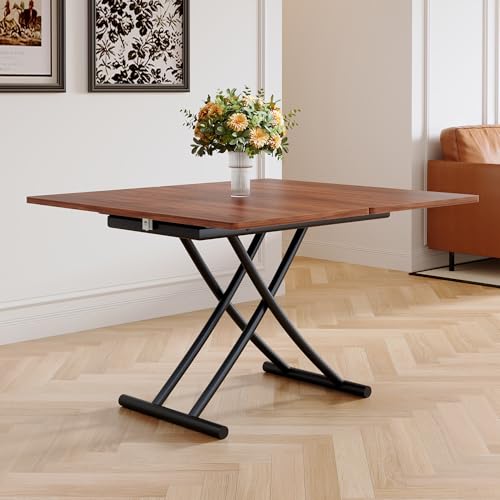
Vohward Adjustable Height Coffee Table, 4-in-1 Folding Dining Table, Walnut | Convertible lift top table for use as a coffee table, dining table, home office desk or vanity
Check price on Amazon
UNIQUITE 40" Lift Top Coffee Table, 4 in 1 Multi-Function Lift Coffee Tables with Storage and Hidden Compartment, Convertible Wood Coffee Tables to Dining Table for Living Room, Walnut
Check price on Amazon
YESWOOD 100% Solid Oak Lift Top Coffee Table, Multifunctional Wood Table | Foot-Pedal Height Adjustable from 18.5" to 28.3", Coffee Table with lifting Top for Living Room, Dining, Home Office, 47.2''
Check price on Amazon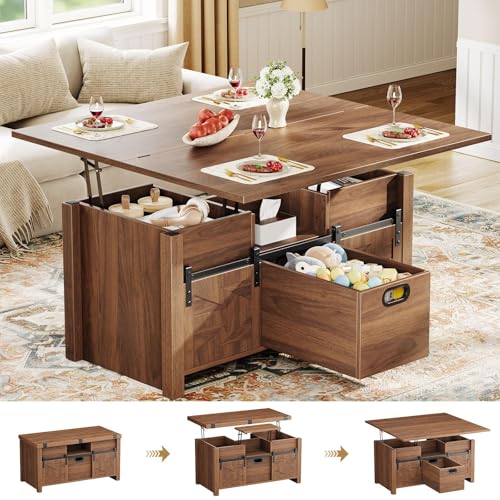
Memobarco 40" Farmhouse Lift Top Coffee Table with Storage Drawers,Walnut | 4 in 1 Multi-Function Coffee Tables with Sliding Barn Door & Hidden Compartment,Converts to Dining Table for Living Room
Check price on Amazon
Vohward Adjustable Height Coffee Table, Folding Dining Table, Light Wood | Convertible lift top table for use as a coffee table, dining table, home office desk or vanity
Check price on AmazonPairing the Raised Table with the Right Seating
Most lifting coffee tables are sold without chairs, so seating is where buyers need to plan ahead. Three approaches work well:
- Dedicated dining chairs stored nearby. Lightweight chairs in the 17–19 inch seat-height range slide under the raised top and can be stacked or pushed against a wall when not in use. If you prefer bench seating, choose a bench seat with back for a dining table that is narrow enough to tuck under the lifted surface.
- Convertible stool-and-chair hybrids. Backless stools take up minimal visual space and double as extra living room seating.
- Sofa-side dining. In the tightest layouts, one side of the raised table can face a low sofa, with a single chair on the opposite side — a common arrangement in studio apartments.
Whatever you choose, test the knee clearance before committing. The underside of a raised lift-top table is often deeper than a standard dining apron, which reduces legroom for taller diners.
Advantages and Trade-Offs
Advantages
- Replaces two pieces of furniture with one, freeing floor area in compact homes.
- Provides a proper seated dining height rather than forcing meals at sofa level.
- Doubles as a workspace for laptops, crafts, and board games.
- Useful in open-plan layouts where a permanent dining table would block sightlines.
Trade-Offs to Consider
- Lifting hardware adds complexity and a potential failure point over time.
- Raised tops are generally smaller than dedicated dining tables, limiting guest capacity.
- Entry-level mechanisms may wobble; stability depends on build tier.
- Heavier solid wood tops require stronger — and heavier — bases, reducing portability.
If you need a permanent dining surface for a family of four or more, a fixed table remains the more robust choice. The lifting coffee table shines in one- and two-person households and in rooms that must serve multiple functions. Buyers weighing a dedicated dining piece can compare formats in our guide to the small convertible dining table category.
Buying Checklist Before You Commit
- Measure the raised height. Confirm the top lands at 28–30 inches, and check knee clearance against your tallest chair.
- Confirm the load rating. Match it to your real use — light laptop work versus full dinner service.
- Test the lock. The raised position must lock securely and release smoothly.
- Inspect the base. A wide, weighted base is the best defense against wobble at full height.
- Check the finish. Heat-resistant and water-resistant surfaces matter if the table will host hot plates and drinks.
- Plan seating storage. Decide where chairs will live when the table is lowered.
- Review the warranty. Lift mechanisms are the first component to wear; a warranty that covers the hardware is a meaningful signal of build confidence.
Who Should Buy One?
This furniture format is the strongest fit for studio apartments, one-bedroom flats, open-plan living-dining rooms, and any home where a permanent dining table would consume the only available walking route. It also suits remote workers who want a living room that shifts from lounge to desk to dinner table without rearranging furniture.
It is a weaker fit for households that host large dinner parties regularly, for homes with very young children who may hang on the raised edge, and for buyers who prioritize a formal dining room aesthetic. If your priority is a fixed, generously sized dining surface, browse our dedicated guides on small dining table sets for four or small glass dining table sets for four instead.
Frequently Asked Questions
What is a coffee table that raises to dining height?
It is a dual-purpose furniture piece with an adjustable lifting mechanism. Lowered, it works as a standard coffee table at roughly 16–18 inches. Raised, it reaches a seated dining height of about 28–30 inches for meals, working, or entertaining.
How much weight can a lift-top coffee table support when raised?
Most mid-range and premium lifting mechanisms are rated to hold between 30 and 80 pounds safely when fully extended. Always check the manufacturer's stated load rating, and avoid leaning heavily on the raised surface or placing concentrated weight at the edges.
Is a raising coffee table stable enough for everyday dining?
High-end tier models with reinforced steel or pneumatic lift mechanisms and wide bases offer excellent stability for everyday dining. Entry-level gas-lift models may wobble slightly under heavy use, so choose a model with a locking mechanism and a broad, weighted base for frequent meals.
What height should a raised coffee table reach for dining?
A raised surface should reach approximately 28 to 30 inches from the floor, which matches standard dining table height. Pair it with dining chairs whose seat height is around 17 to 19 inches for comfortable ergonomics and proper knee clearance.
Can I use a lifting coffee table as a permanent desk?
Yes, many buyers use the raised position as a standing-desk alternative or a seated workspace. For desk use, prioritize a model with a stable scissor or screw lift, a flat and non-reflective top, and a height that places your forearms level with the surface when seated.
Ready to Compare Your Options?
Browse the recommended models above to compare lift mechanisms, top materials, and seating capacity. For a related space-saving format, explore the adjustable height coffee table to dining table selection.
Explore Recommendations