
Solid Oak Dining Table Top: The Complete Guide to Grain, Finish & Durability
Everything you need to know before choosing a solid oak dining table top — grain patterns, thickness, finishes, care requirements, and how to match the top to your table base and dining room style.
Why Solid Oak Is a Leading Choice for Dining Table Tops
Solid oak has earned its reputation as one of the most dependable natural surfaces for a dining table. Oak is a dense hardwood with tightly packed fibers, giving it strong resistance to daily wear, scratches, and dents compared with softer woods. That density is why oak tops hold up well in households with children, frequent entertaining, and long meals that stretch for hours.
Beyond durability, oak brings a warm, open grain that reads as timeless rather than trendy. The wood accepts stains, oils, waxes, and lacquers exceptionally well, so a single oak top can be finished to look modern, rustic, Scandinavian, farmhouse, or traditional depending on how it is treated. This versatility makes a solid oak top a sound long-term investment for a dining space that may be restyled over the years.
Oak is also widely available in consistent grades, which means buyers can compare tops from different makers with more confidence. Two oak tops of similar construction and grade will behave predictably, unlike exotic woods with greater natural variation. If you are building a complete dining set, an oak top pairs naturally with a wide range of bases, from modern pedestals to traditional trestle legs.
Key takeaway: Solid oak offers a rare combination of hardness, workability, and visual warmth. For a dining table top that must survive daily use while still looking refined, it is one of the safest and most satisfying choices in its tier.
Oak Grain Patterns Explained
The grain is the first thing most buyers notice about an oak top, and it is also the feature that most affects the final character of the table. Oak grain falls into a few broad categories:
Plain-sawn (flat-sawn) oak
This is the most common cut. It produces the broad, sweeping cathedral arches and gentle curves that most people associate with oak. Plain-sawn tops show a lively, varied surface with good contrast between earlywood and latewood. It is a balanced choice for farmhouse, rustic, and transitional interiors.
Quarter-sawn oak
Quarter-sawing produces straight, parallel grain lines with distinctive ray flecks — small, silvery ribbons that catch the light. Quarter-sawn oak is more dimensionally stable and is favored for traditional and Arts and Crafts styles. It tends to read as more formal and refined than plain-sawn oak.
Rift-sawn oak
Rift-sawing yields straight grain with minimal ray fleck. It is prized for its calm, uniform appearance and is often used in modern and minimalist designs where a quieter surface is desired.
Live-edge and natural-edge oak
Live-edge oak tops preserve the natural contour of the tree's edge. These tops are statement pieces that suit rustic, organic, and industrial interiors. They require more careful sealing along the natural edge and are best for buyers who want the top to be the focal point of the room.
Buying tip: Ask the maker which cut the top uses. A plain-sawn top and a quarter-sawn top of the same species can feel completely different in a room, so the cut is as important as the wood itself.
Choosing the Right Thickness for a Solid Oak Table Top
Thickness affects strength, weight, visual presence, and how the top pairs with a base. Most residential solid oak tops fall within a few practical ranges, and each suits a different type of table.
| Tier | Typical Thickness | Best For |
|---|---|---|
| Entry-level / starter tier | Around 1 inch (approx. 25 mm) | Compact and mid-size tables, modern minimal bases, apartment dining sets |
| Mid-range / balanced tier | 1.25–1.5 inches (approx. 32–38 mm) | Everyday family tables, pedestal bases, most six- to eight-seater setups |
| Premium / high-end tier | 1.5–2 inches (approx. 38–50 mm) | Large statement tables, trestle and slab bases, heavy-duty family use |
| Luxury / flagship tier | 2 inches and above (approx. 50 mm+) | Live-edge slabs, sculptural bases, designer and commercial-grade builds |
A thicker top is not automatically better. Very thick tops are heavy, require stronger bases and more careful handling, and can overpower a small dining room. A top in the mid-range is usually the sweet spot for a family table that needs to feel substantial without becoming difficult to move or pair with chairs. If the top will sit on a slender metal base or a pedestal, a mid-range thickness keeps the proportions balanced.
Finishes and Surface Treatments for Oak Tops
The finish determines how the oak top looks, how it feels, and how much maintenance it demands. The most common options are:
Hardwax oil
Hardwax oil penetrates the wood and leaves a matte or satin surface that feels close to raw timber. It is easy to spot-repair, which makes it a favorite for family tables. The trade-off is that oiled tops need periodic re-oiling, especially in high-use zones.
Lacquer
Lacquer forms a film on top of the wood and provides strong protection against spills and stains. It is available in matte, satin, and gloss sheens. Lacquered tops are low-maintenance day to day, but deep scratches can be harder to repair locally.
Soap finish
A soap finish gives a pale, soft, Scandinavian look. It is gentle and easy to refresh but offers less resistance to water and heat, so it suits lighter-use dining rooms or buyers who love the natural aesthetic and are comfortable with more frequent care.
Stain plus topcoat
Oak can be stained to shift its color — from pale and bleached to deep walnut tones — before a protective topcoat is applied. Stained tops offer flexibility for matching existing furniture, but the quality of the stain work matters; a poorly applied stain can look muddy or uneven.
Practical note: Matte and satin finishes hide everyday marks better than high-gloss finishes. If the table will be used daily by a busy household, a matte hardwax oil or a satin lacquer usually delivers the best balance of looks and resilience.
Construction: Planks, Staves, and Slabs
How the oak top is built affects its stability, appearance, and long-term behavior.
Solid plank tops
Plank tops are made from wide boards joined edge to edge. They show the most natural grain continuity and are a strong choice for traditional and farmhouse tables. Plank tops need proper allowance for seasonal movement, so quality construction matters.
Stave-constructed tops
Stave tops are built from narrower strips of oak glued together. This construction improves dimensional stability and allows makers to use the wood efficiently. It is common in mid-range and premium tables and can look very uniform when finished well.
Slab tops
A slab top is cut from a single section of the tree, often preserving the natural edge. Slabs are the most dramatic option and are typical of luxury and live-edge designs. They are heavy, unique, and require careful sealing and support.
Regardless of construction, a well-made oak top should have a stable core, a flat surface, and a finish that is evenly applied. Ask how the top handles humidity movement — this is one of the clearest indicators of build quality.
Matching the Oak Top to a Table Base
An oak top can sit on almost any base, but the pairing changes the personality of the table. Consider these common combinations:
- Pedestal base: A central pedestal keeps the look open and airy. It pairs especially well with round and oval oak tops and suits compact dining rooms where legroom matters.
- Trestle base: A trestle base gives a farmhouse or rustic feel and supports long rectangular oak tops well. It is a natural fit for plank and slab tops.
- Metal frame: Industrial and modern interiors benefit from a metal base paired with a warm oak top. The contrast between cool metal and warm timber is one of the most reliable design pairings.
- Slender legs: Straight or tapered wooden legs keep the table light and contemporary. They work best with mid-range thickness tops so the proportions stay balanced.
If you are still deciding on the overall table shape, our guide to the oval dining table top covers how curved surfaces change seating and flow, while the timber slab dining table guide explores the live-edge alternative in more depth.
Care and Maintenance Essentials for an Oak Top
Solid oak is forgiving, but it is not indestructible. A few consistent habits keep the top looking its best for decades.
- Wipe spills promptly. Water left standing on an oiled or soap-finished top can raise the grain or leave marks.
- Use coasters and placemats. Heat and moisture are the two most common causes of surface damage on dining tables.
- Avoid prolonged direct sunlight. Oak will mellow and shift color over time, but strong, uneven sun exposure can cause patchy fading.
- Maintain stable humidity. Oak responds to seasonal humidity changes. Keeping indoor humidity relatively stable reduces movement and the risk of splitting.
- Re-oil or re-wax as needed. Oiled tops benefit from periodic refreshment, especially in high-traffic zones. Follow the maker's schedule rather than guessing.
- Use a protective pad for heavy projects. Craft projects, hot dishes, and holiday entertaining are easier on the top with a simple table pad.
For deeper guidance, see our dining table surface care reference and the broader care and maintenance hub.
Solid Oak Dining Table Top Buyer's Checklist
Before you commit to a top, run through these checks. They are the questions that separate a top that ages gracefully from one that disappoints within a year.
- Confirm the wood is solid oak, not oak veneer. Veneer can look convincing but behaves differently over time. Solid oak can be sanded and refinished; veneer cannot.
- Ask which cut is used. Plain-sawn, quarter-sawn, and rift-sawn oak each create a different look and stability profile.
- Check the construction method. Plank, stave, and slab tops have different strengths. Match the construction to the size and use of the table.
- Verify the thickness suits your base. A very thin top on a heavy base looks unbalanced, and a very thick top on a slender base can feel top-heavy.
- Understand the finish and its upkeep. Oil, lacquer, and soap finishes each require different care. Choose one you are comfortable maintaining.
- Ask about humidity and movement allowance. A quality maker will explain how the top is built to handle seasonal change.
- Inspect the edge profile. Rounded, chamfered, and square edges all change the feel of the table and how it wears.
- Match the top to the overall style. A live-edge top and a quarter-sawn top will pull a room in different directions. Choose deliberately.
Remember: The top is the surface you touch every day. It deserves more scrutiny than any other part of the table. A slightly better top on a simpler base usually feels more rewarding than the reverse.
Recommended Solid Oak Dining Table Tops
⚠️ AFFILIATE DISCLOSURE: This website contains affiliate links. As an affiliate Associate, we earn from qualifying purchases. If you make a purchase through these links, we may receive a small commission at no additional cost to you. Read our full affiliate policy.
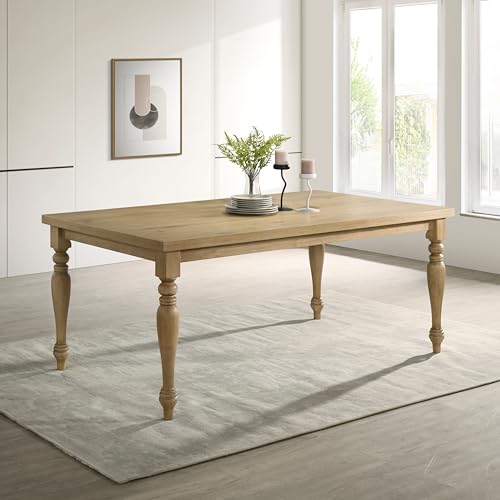
Roundhill Furniture Verta Solid Wood Leg Dining Table with Oak Veneer Top and Turned Legs
Check price on Amazon
East West Furniture NFT-OAK-T Norfolk Kitchen Dining Table - a Rectangle Solid Wood Table Top with Butterfly Leaf, 32x54 Inch, OAK
Check price on Amazon
Homsee 83.8" Solid Wood Dining Table for 6-8, Natural | Modern Kitchen Table with Thickened Tabletop in Oak Veneer, Fluted Deisgn Extra Long Dining Room Tables for Family Gatherings
Check price on Amazon
Danrelax 2-in-1 Board Game Table, 52"×29" Solid Oak Dining Table | Convertible Gaming Table with Removable Tabletop, Cup Holders, 6 Seats for Family Game Night
Check price on Amazon
VASAGLE 47-Inch Round Dining Table for 4-6 People, Pedestal Kitchen Table | Contemporary, with Wooden Pedestal Base and 3-Height Adjustable Storage Shelf, Thickened Tabletop, Oak Beige
Check price on Amazon
East West Furniture AVT-OAK-TP Avon Modern Kitchen Table - an Oval Dining Table Top with Butterfly Leaf & Pedestal Base, 42x60 Inch, Oak
Check price on Amazon
Oak Dining Table for 6, Solid Wood Dining Table with Square Legs | 63’’ Modern Rectangular Kitchen Table with Large Tabletop, Farmhouse Dinner Table for Kitchen, Living Room, Study, Walnut
Check price on AmazonFrequently Asked Questions
Is a solid oak dining table top durable for daily use?
Yes. Solid oak is a dense hardwood with strong resistance to wear, making it one of the most durable natural surfaces for a dining table top. With proper sealing and routine care, a solid oak top can last for decades.
What thickness should a solid oak dining table top be?
Most residential solid oak tops range from about 1 inch to 2 inches thick. Thinner tops of around 1 inch suit compact and mid-size tables, while 1.5 to 2 inch tops are typical for large, heavy-duty, or statement tables.
How do I protect a solid oak dining table top?
Use coasters and placemats, wipe spills promptly, avoid prolonged direct sunlight, and reapply an oil or wax finish periodically. A protective table pad helps during heavy use and craft projects.
Does solid oak expand and contract with humidity?
Yes. Solid oak is a natural material that responds to humidity changes. Quality tops are built with proper panel construction and allowance for movement. Keeping indoor humidity stable helps minimize seasonal movement.