
Round Mission Style Dining Table: Complete Buyer's Guide
Discover the structural honesty, warm wood tones, and sociable layout of round mission style dining tables — and learn how to choose one that fits your home, seating needs, and long-term care routine.
Why this guide matters: Mission style furniture carries a distinct architectural language — exposed joinery, square posts, and clean lines borrowed from the American Arts and Crafts movement. When applied to a round dining table, that language meets a sociable seating layout that works beautifully in both compact nooks and open-plan dining rooms. This guide walks you through the design traits, wood choices, sizing math, seating capacity, and care routines so you can make a confident, well-informed decision.
What Makes a Dining Table "Mission Style"?
Mission style emerged in the late 19th century as a response to ornate Victorian furniture. Its designers believed that structure itself could be decoration. The result is a furniture family defined by a handful of recognizable traits that you can spot at a glance.
Straight Lines & Square Posts
Legs are typically square or gently tapered, with no turned or carved profiles. The silhouette reads as clean, sturdy, and architectural.
Exposed Joinery
Through-tenons, pinned mortise-and-tenon joints, and visible key details are celebrated rather than hidden. This signals structural honesty.
Quarter-Sawn Oak
Traditional mission pieces favor quarter-sawn white oak, whose ray-fleck grain pattern is a signature of the movement.
Minimal Ornamentation
Decoration comes from proportion and material, not applied carvings. Any detail — corbels, stretchers, slats — serves a structural role.
Warm, Matte Finishes
Fumed or oil-rubbed finishes are common, giving the wood a soft, low-sheen warmth rather than a glossy lacquer look.
Honest Proportions
Thicker aprons, visible stretchers, and weighty bases are characteristic. Mission furniture is meant to look and feel substantial.
A round mission style dining table takes this vocabulary and applies it to a circular top. The result is a piece that feels rooted in tradition but visually softer than a rectangular mission table, especially in smaller rooms where sharp corners can create friction.
Why Choose a Round Top Over Rectangular?
The shape of a dining table affects how a room feels and how people interact around it. A round top offers several practical advantages that matter in real homes.
- Sociable seating: Everyone faces the center, which encourages conversation. There is no "head of the table" dynamic.
- Improved traffic flow: No sharp corners means smoother movement around the table, especially in narrow or open-plan rooms.
- Compact footprint: A round table with a 48-inch diameter can seat four comfortably while occupying less visual mass than a rectangular table of similar seating capacity.
- Flexible placement: Rounds work well in corners, bay windows, and dining nooks where rectangular tables feel awkward.
- Balanced visual weight: The circular form softens the structural heaviness of mission construction, making the table feel less imposing.
If you are working with a smaller dining footprint, a small 2-seater dining table in a round mission style can anchor a breakfast nook beautifully. For rooms that need more flexibility, consider whether an extendable design might suit your hosting habits better before committing to a fixed round top.
Wood Options for Round Mission Style Tables
The wood species you choose affects the table's appearance, durability, and long-term maintenance. Mission style is traditionally associated with oak, but several species work well.
| Wood Species | Character | Best For |
|---|---|---|
| Quarter-Sawn White Oak | Ray-fleck grain, dense, warm honey to amber tones | Traditional and authentic mission character |
| Cherry | Fine grain, deepens in color over time, smooth finish | Warmer, softer interpretation of mission style |
| Walnut | Rich chocolate tones, tight grain, premium feel | High-end tier pieces with a more refined look |
| Ash | Light, resilient, pronounced grain when quarter-sawn | Lighter interiors and Scandinavian-leaning spaces |
| Maple | Hard, pale, subtle grain, takes stain evenly | Contemporary or painted mission interpretations |
Look for solid wood construction with well-executed joinery. Entry-level pieces often use veneer over engineered wood, which can be perfectly serviceable but will not develop the same patina over time. Mid-range and premium tiers typically use solid stock with pinned mortise-and-tenon joints and hand-applied finishes.
Sizing a Round Mission Style Table Correctly
Round tables have a simple sizing rule: each diner needs roughly 24 inches of linear edge space. From there, you can match the diameter to your seating needs and room dimensions.
| Diameter | Comfortable Seating | Room Context |
|---|---|---|
| 36 inches | 2 to 3 | Breakfast nooks, small kitchens |
| 42 inches | 3 to 4 | Compact dining rooms, apartments |
| 48 inches | 4 | Standard dining rooms, open-plan corners |
| 54 inches | 4 to 5 | Mid-size dining rooms |
| 60 inches | 6 | Larger dining rooms, family homes |
| 66 to 72 inches | 6 to 8 | Formal dining rooms, large families |
Beyond the diameter, allow at least 36 inches of clearance between the table edge and walls or other furniture so chairs can pull out comfortably. If your dining space is tight, a smaller round such as a two-seater configuration can work well without crowding the room.
Base and Pedestal Designs
Mission style round tables typically use one of two base configurations, each with trade-offs.
Four-Leg Base
A four-leg base with square posts and visible stretchers is the most traditional mission arrangement. It offers generous legroom between legs and pairs naturally with mission-style chairs. The downside is that legs occupy the corners of the footprint, which can interfere with chair placement when seating more than four.
Pedestal Base
A central pedestal with a cross or X-shaped foot removes the leg interference entirely, making it easier to seat five or six around a round top. Pedestal bases are especially useful in smaller rooms because they reduce visual clutter beneath the table. Look for a pedestal with a wide, stable foot and a reinforced connection to the top — some entry-level pedestals can develop wobble over time.
If your space is narrow or you want to minimize the table's visual footprint, a pedestal design pairs well with compact layouts. You can read more about optimizing tight rooms in our guide to round dining tables around 55 inches.
Chair Pairing and Seating Comfort
Mission style tables pair most naturally with mission, craftsman, or slat-back chairs. Square legs and straight lines keep the visual language consistent. When pairing chairs, keep these considerations in mind:
- Seat height: Standard dining chairs have a seat height of 18 to 19 inches, which pairs with a table height of 30 inches. Stick to this ratio unless you are deliberately choosing a counter-height setup.
- Chair width: Wider chairs reduce the number of seats a round top can hold. Measure your chair width before finalizing the table diameter.
- Arm vs armless: Armless chairs tuck in more easily around a round table and allow more seats per circumference.
- Upholstery: Leather or woven seats bring warmth to the structural lines of mission furniture without competing with the wood grain.
For a coordinated look, choose chairs in the same wood species as the table. If you prefer contrast, a darker chair against a lighter oak top can add depth without breaking the mission aesthetic.
Finishes and Surface Protection
Mission style tables typically use oil-rubbed, waxed, or fumed finishes that emphasize the natural character of the wood. These finishes look warm and tactile but require more upkeep than a factory lacquer.
- Oil-rubbed finish: Penetrates the wood, feels natural, and can be refreshed with additional oil over time. Requires reapplication every few months in high-use homes.
- Wax finish: Adds a soft sheen and some surface protection. Reapply once or twice a year.
- Fumed oak: A traditional technique that darkens the wood through ammonia exposure, producing deep, even tones without heavy stain. Harder to touch up at home.
- Conversion varnish or lacquer: More durable and low-maintenance, common on premium and high-end tier pieces. Less authentic in feel but far more forgiving for busy households.
Regardless of finish, use coasters, trivets, and placemats to protect the surface from heat and moisture. A quality table pad is a worthwhile investment if the table sees daily use.
Care and Maintenance for a Mission Style Table
Solid wood mission tables are built to last generations, but they need basic care to stay in good condition.
- Daily: Dust with a soft, dry cloth. Wipe spills immediately with a slightly damp cloth, then dry.
- Monthly: Check joints and stretchers for looseness. Tighten any hardware as needed.
- Seasonally: Reapply furniture wax or oil according to the finish type. Address any small scratches with a matching touch-up product.
- Environment: Keep the table away from direct heat sources and prolonged sunlight. Aim for a stable indoor humidity level to prevent wood movement.
- Long-term: If the finish becomes worn, a professional refinish can restore the piece without compromising the joinery.
For a broader look at protecting wood surfaces, our guide to round dining table care and sizing covers related considerations.
Styling a Round Mission Style Table
Mission style is naturally understated, so styling should enhance rather than compete. A few principles work well:
- Keep centerpieces low and simple: A shallow bowl, a single silk flower centerpiece, or a pair of candles preserves sightlines across the table.
- Use natural textures: Linen runners, woven placemats, and ceramic tableware echo the movement's appreciation for honest materials.
- Limit color palettes: Warm neutrals, deep greens, and muted earth tones complement the wood without overwhelming it.
- Avoid heavy visual clutter: Mission design is about restraint. A few well-chosen objects read better than a crowded table.
If you are styling a larger round table for gatherings, a larger-format table layout can inform how to distribute decor across a wide surface.
Indoor vs Outdoor Mission Style Tables
Mission style has been adapted for outdoor use, particularly in teak and weather-resistant hardwood. Outdoor versions often use a slatted top and a more open base to allow water to drain. If you are considering an outdoor piece, look for teak or another naturally weather-resistant species, and confirm that the joinery uses stainless or coated hardware.
For covered patios and sunrooms, a teak outdoor extendable dining table can bring the mission aesthetic outdoors. Larger gatherings may call for a ten-person outdoor dining table or a white pedestal outdoor dining table for a lighter, more contemporary take.
Buying Checklist: What to Verify Before You Commit
Use this checklist to evaluate any round mission style dining table you are considering.
- Joinery: Look for mortise-and-tenon joints, through-tenons, or pinned joints. Avoid pieces held together primarily by screws and brackets.
- Wood: Confirm solid wood construction on the top and key structural components. Veneer is acceptable on secondary surfaces but should be disclosed.
- Finish: Ask what type of finish is used and how to maintain it. Oil and wax finishes need more care than lacquer.
- Stability: Check for wobble in the base, especially on pedestal designs. A well-built table should sit flat and stable.
- Dimensions: Measure your room, chair width, and clearance before ordering. Confirm the diameter and height match your seating needs.
- Assembly: Some tables ship flat-packed. Confirm whether assembly is required and what tools are needed.
- Warranty: A longer structural warranty is a good sign of build confidence.
Ready to Explore Round Mission Style Tables?
Browse our curated selection of round mission style dining tables below. Each option is chosen for structural integrity, authentic mission detailing, and long-term durability.
Recommended Round Mission Style Dining Tables
⚠️ AFFILIATE DISCLOSURE: This website contains affiliate links. As an affiliate Associate, we earn from qualifying purchases. If you make a purchase through these links, we may receive a small commission at no additional cost to you. Read our full affiliate policy.

Epecoya 59-Inch Extendable Dining Table, Kitchen Table for 4-6 People | Farmhouse Wood Space-Saving Expandable Dinner Table, Round to Oval Pedestal Dining Table, Dark Brown Walnut
Check price on Amazon
ERYE Retro Style Round Dining Table Functional Wooden Extendable Oval Dining Table with 12" Leaf and Natural Wood Grain Variation Tabletop
Check price on Amazon
Tribesigns 31.5-Inch Round Dining Room Table for 2-4, Farmhouse Small Kitchen Dinner Table with Square Base for Dining Room Living Room, Rustic Brown
Check price on Amazon
Round Dining Table Extendable with Storage Shelf, Brown | Extendable round dining table,seats 4-8,wood,farmhouse style,for small kitchen and apartment,43''-59''
Check price on Amazon
Tribesigns 47 inch Round Dining Table Wood Kitchen Table for Dining Room, 47" Dinner Room Tables for 4-6, Farmhouse Accent Furniture with Wooden Tabletop and Cross Base, Brown+Black
Check price on Amazon
MECHYIN Round Table for 2-4,31.5" Small Fluted Kitchen Table with Pedestal Base,Wood DinnerTable for Apartment,Restaurant,Kitchen
Check price on Amazon
47" Round Dining Table for 4-6 People, Modern Wood Kitchen Table with Sculptural Curved Pedestal Base, 1.57" Thick Tabletop, Storage Shelf, Dining Room Table for Apartment,Black Grey
Check price on Amazon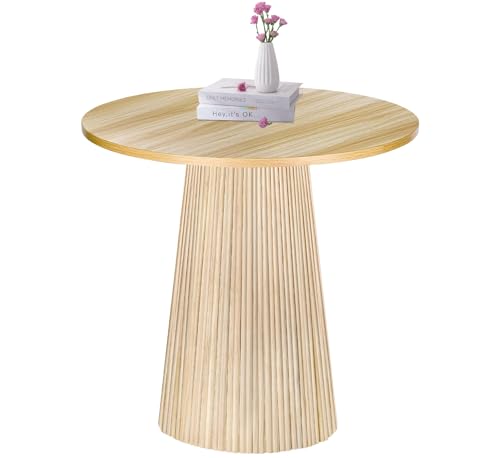
ZYBT Small Round Dining Table for 2, 27.5" Farmhouse Fluted Kitchen Table for Small Spaces, Wood Color Rattan Dining Tables with Circle Tabletop for Kitchen Dining Room
Check price on AmazonFrequently Asked Questions
What defines a round mission style dining table?
Mission style is defined by straight lines, exposed joinery, square posts, and minimal ornamentation rooted in the American Arts and Crafts movement. A round mission style dining table combines this structural honesty with a circular top, giving it a sociable layout and a softer visual footprint than a rectangular version.
How many people can sit at a round mission style dining table?
A round table with a 48-inch diameter comfortably seats four, while a 54 to 60-inch diameter accommodates six. Larger rounds in the 60-inch range can seat six to eight depending on chair width and clearance. Always leave roughly 24 inches of linear edge space per diner.
Which wood is best for a mission style round table?
Quarter-sawn white oak is the most authentic choice because its ray-fleck grain was central to the original mission aesthetic. Cherry, walnut, and ash also work well. Look for solid wood construction with visible, well-executed joinery rather than heavy veneer over particleboard.
Does a round mission style table work in a small dining room?
Yes. A round top removes sharp corners and allows chairs to tuck in evenly, which improves traffic flow in compact rooms. A 42 to 48-inch round is a strong fit for small dining nooks and open-plan corners.
How should I care for a mission style wood dining table?
Dust regularly with a soft cloth, wipe spills promptly, and reapply a quality furniture wax or oil finish once or twice a year depending on use. Keep the table away from direct heat and prolonged sunlight, and use coasters and trivets to prevent rings and heat marks.
Can I mix mission style chairs with other chair styles?
Yes, but keep the visual language coherent. Mission and craftsman chairs are the most natural pairing. If you mix styles, choose chairs with clean lines and square or gently tapered legs to avoid visual conflict.