
Rotating Expandable Round Dining Table: Complete Buying Guide
Everything you need to understand how rotating expandable round tables work, where they shine, and how to select a model that fits your dining room, your household, and your long-term needs.
Why this guide matters: A rotating expandable round dining table solves one of the most common dining room dilemmas — how to keep a compact footprint day to day while still hosting larger gatherings when needed. This guide walks you through the mechanism, materials, sizing, and practical trade-offs so you can decide with confidence before you buy.
What Is a Rotating Expandable Round Dining Table?
A rotating expandable round dining table is a round table built with a swivel mechanism beneath the tabletop. Instead of adding separate extension panels that need storage, the tabletop itself rotates to reveal or deploy hidden leaves. When the rotation completes, the table locks into its expanded form, typically converting the round shape into a larger oval or a wider round surface.
This design is closely related to the classic extendable dining table guide family, but the rotating variant removes the need to store loose leaves. It is also a natural evolution of the round dining table guide concept, keeping the sociable circular shape while adding flexibility for guests.
The appeal is straightforward: a single piece of furniture that behaves like two. In everyday use it stays compact and easy to walk around. During holidays, dinner parties, or family visits, a quick rotation adds seating capacity without moving the table to another room.
How the Rotating Mechanism Works
Understanding the mechanism helps you evaluate quality before you commit. Most rotating expandable round tables share a similar architecture:
- Central swivel ring: A reinforced ring beneath the top allows the tabletop to rotate smoothly. Premium models use sealed bearings or heavy-duty steel tracks; entry-level models may use simpler plastic or nylon glides.
- Hidden leaves: One or two leaves are folded or nested under the main top. Rotating the top exposes the leaf channel.
- Locking pins: Once the leaf is deployed, pins or latches lock the surface so the table behaves like a fixed top during meals.
- Alignment guides: Small guides ensure the leaf sits flush with the main top, preventing wobble or gaps.
The quality of the swivel and locking hardware is the single biggest factor in long-term satisfaction. A smooth, well-locking mechanism turns the table into a reliable daily piece; a loose or sticky one becomes a constant annoyance.
Quality Tiers: How Rotating Tables Differ
Because rotating expandable round tables vary widely in build quality, it helps to think in tiers rather than specific models. The table below uses a consistent tier system you can apply across the site.
| Tier | Typical Build | Best For |
|---|---|---|
| Entry-level | Simpler swivel glides, one leaf, lighter frame | Occasional expansion, small households |
| Mid-range | Reinforced steel swivel, locking pins, two leaves | Regular hosting, daily family use |
| Premium | Sealed bearing swivel, precision alignment, solid hardwood or stone top | Frequent entertaining, long-term investment |
| Luxury | Custom hardware, hand-finished surfaces, designer joinery | Statement dining rooms, collector-grade furniture |
Mid-range models usually offer the smoothest balance of mechanism quality and material durability. Entry-level tables are fine if you expand only a few times per year, while premium and luxury tiers are worthwhile investments if the table will be expanded weekly or if the room is a focal point of the home.
Space Planning: Compact vs. Expanded Footprint
The biggest practical question is whether the expanded size still fits your room. A rotating round table is compact in its base form, but the expanded footprint can grow significantly. Plan for the larger size, not the smaller one.
As a rule of thumb, leave at least 36 inches of clearance on all sides of the expanded table so chairs can pull out and people can walk behind them. In tight rooms, this is where a small round glass dining table set for 4 can serve as a useful reference point for compact footprints, even if your final choice is a rotating solid-top model.
For rooms with limited width, the round shape already helps because there are no sharp corners to navigate. Pair it with a small dining table with a marble top if you want a stone surface that reads as premium without dominating the room visually.
If your dining area opens onto a terrace or patio, consider how the table transitions between indoor and outdoor zones. A terrace dining table setup can complement a rotating indoor table by giving you a second hosting surface during warm months.
Materials and Surface Options
The rotating mechanism is only half the story — the surface you eat on matters just as much. Common options for rotating expandable round tables include:
Solid Wood
Solid wood tops are the most traditional choice and pair well with the mechanism because they can be reinforced with a sturdy sub-frame. Oak, walnut, and teak are common. For a deeper look at wood construction, the long solid wood dining table guide covers grain, joinery, and finishing in detail, and many of those principles apply here.
Reclaimed and Natural Wood
Reclaimed wood tops give a rotating table character and hide minor wear well. If you like the rustic direction, the reclaimed wood trestle dining table guide explains how reclaimed surfaces are stabilized — important because a rotating top needs a flat, stable leaf to align properly.
Stone and Composite Tops
Marble, quartz, and composite tops are heavier, so the swivel mechanism must be rated for the extra load. Premium tiers handle stone well; entry-level swivels may struggle. A marble-top small dining table is a good reference for how stone weight affects base design.
Glass
Glass tops keep the table visually light, which suits small rooms. Glass rotating tables are less common because the leaf mechanism must support the panel without flexing, so check build quality carefully.
Base and Pedestal Design
Rotating round tables usually sit on a pedestal or trestle base rather than four corner legs, because a central base leaves room for chairs on all sides and hides the swivel hardware. Pedestal bases also make the table easier to move when you need to reconfigure the room.
If you prefer a sculptural, organic look, a tree trunk dining table base can inspire a custom or semi-custom rotating build, though you should confirm the base can accommodate a swivel ring. For a more classic silhouette, the Duncan Phyfe dining table and chairs style shows how pedestal bases have historically supported expandable tops.
Seating Capacity and Expansion
Seating capacity depends on the base diameter and the number of leaves:
- Compact round (base form): typically seats 4 comfortably.
- One-leaf expansion: usually seats 6.
- Two-leaf expansion: can reach 8 in larger models.
Always measure the expanded dimensions and compare them with your chair width and room clearance. A table that seats eight but leaves no walkway is not a practical upgrade.
Practical Advantages and Trade-Offs
Advantages
- No separate leaves to store or lose.
- Compact footprint for everyday use.
- Round shape encourages conversation and eliminates corner bumps.
- Expansion is quick — usually a single rotation plus locking.
- Works well in open-plan and small dining rooms.
Trade-offs
- Mechanism quality varies; cheap swivels can loosen over time.
- Heavier tops (stone, thick wood) demand stronger hardware.
- Expanded size may not fit tight rooms — plan for the larger footprint.
- Repair of the swivel can be harder than replacing a simple leaf.
- Some designs limit chair styles because of the pedestal base.
Who Should Choose a Rotating Expandable Round Table?
This table type suits households that host occasionally but value a compact daily footprint. It is especially useful for:
- Apartments and small dining rooms where space is at a premium.
- Families who entertain during holidays but eat casually day to day.
- Open-plan homes where the dining table is visible from the living area.
- Buyers who dislike storing loose extension leaves.
If you host large groups every week, a fixed large table or a long solid wood dining table may be more practical. If you want a single flexible piece, the rotating expandable round table is one of the most elegant solutions available.
Buying Checklist
- Measure twice: note both compact and expanded dimensions and compare with room clearance.
- Check the swivel: look for steel or sealed-bearing hardware, not plastic glides.
- Confirm locking: the leaf must lock flush with no wobble.
- Match the top to the mechanism: stone and thick wood need heavier-duty swivels.
- Consider chair clearance: pedestal bases need enough radius for chairs on all sides.
- Review assembly: rotating tables are heavier and often require two people to set up.
- Plan maintenance: periodic cleaning and lubrication keep the rotation smooth.
Recommended Rotating Expandable Round Dining Tables
⚠️ AFFILIATE DISCLOSURE: This website contains affiliate links. As an affiliate Associate, we earn from qualifying purchases. If you make a purchase through these links, we may receive a small commission at no additional cost to you. Read our full affiliate policy.

41 in-78 in Extendable Dining Room Table for 4-8, Round Expandable Kitchen Table with Fluted Base, Modern Farmhouse Oval Dinner Tables for Dining Room Kitchen Living Room (Walnut)
Check price on Amazon
Epecoya 59-Inch Extendable Dining Table, Kitchen Table for 4-6 People | Farmhouse Wood Space-Saving Expandable Dinner Table, Round to Oval Pedestal Dining Table, Dark Brown Walnut
Check price on Amazon
Round Dining Table Extendable with Storage Shelf, Brown | Extendable round dining table,seats 4-8,wood,farmhouse style,for small kitchen and apartment,43''-59''
Check price on Amazon
Limirix 47.2"–63" Extendable Dining Room Table for 4-8, Round-to-Oval Expandable Dining Table with Dust-Proof 2-Tier Shelf, Space-Saving Wood Kitchen Table for Living Room, Walnut
Check price on Amazon
knoworld 39.4"-105" Extendable Dining Table for 4-12, Large Round to Oval Farmhouse Dining Table, Expandable Kitchen Table with Storage Pedestal Base, Space-Saving Design, Walnut
Check price on Amazon
weselon 43"-59" Extendable Round to Oval Dining Table with Hidden Storage, Modern Wooden Kitchen Table with Fluted Sliding Door Cabinet, Expandable Dinner Table for Dining Room Living Room (Black)
Check price on Amazon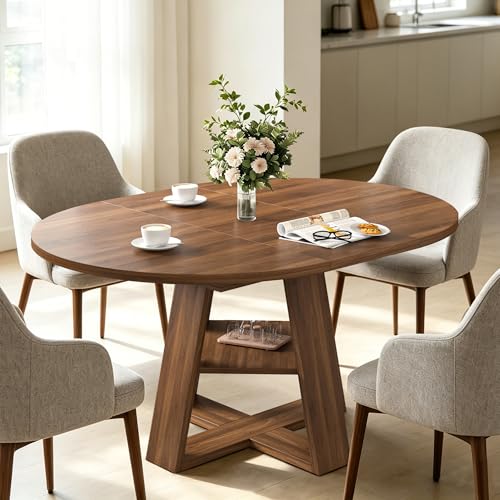
43.3"-59" Extendable Round Oval Dining Table for 4-8 with Storage Shelf | Modern Kitchen Oval Dining Table with Removable Leaves,Space Saving Extendable Table Wood Base for Kitchen Living Room Walnut
Check price on AmazonFrequently Asked Questions
How does a rotating expandable round dining table work?
A rotating expandable round dining table uses a central swivel mechanism beneath the top. When you rotate the tabletop, hidden leaves either fold out or slide into position, converting a compact round table into a larger oval or extended round surface without needing to store separate panels.
How many people can a rotating expandable round table seat?
In its compact round form, most models seat four people comfortably. After expansion, seating typically grows to six or eight depending on the diameter and the number of built-in leaves. Always check the expanded dimensions against your room clearance before choosing a model.
Is a rotating expandable round dining table durable?
Durability depends on the swivel mechanism and materials. Mid-range and premium models use reinforced steel or aluminum swivel rings with locking pins, which hold up well over years of daily use. Entry-level models with lighter hardware are best suited to occasional expansion.
Does the rotating mechanism require maintenance?
Yes, but maintenance is minimal. Periodically clean the swivel track, check that locking pins engage fully, and apply a light lubricant to metal components if the rotation becomes stiff. Avoid overloading the table during expansion to protect the mechanism.
Can a rotating expandable round table fit in a small dining room?
Yes, this is one of its main advantages. The compact round footprint works well in small rooms, and the table only grows when you need extra seating. Leave at least 36 inches of clearance around the expanded size for chairs and walkways.
Ready to Compare Rotating Expandable Round Tables?
Explore the recommended models above to compare mechanisms, materials, and seating capacity side by side, then choose the tier that matches your hosting habits.
View Recommended Models