
Mounted Dining Table Buying Guide: Space-Saving Wall Tables
Everything you need to choose a wall-mounted dining table that fits your room, your wall type, and your daily routine. Compare designs, materials, and installation essentials before you commit.
START WITH THE BASICSWhy a mounted dining table? A wall-mounted dining table attaches directly to your wall and typically folds down flat when not in use. For studio apartments, compact kitchens, and multipurpose rooms, it turns dead wall space into a functional eating area without permanently occupying the floor. This guide walks you through the decisions that matter most: bracket strength, wall compatibility, table size, material choice, and everyday usability.
Recommended Mounted Dining Tables & Wall Tables
⚠️ AFFILIATE DISCLOSURE: This website contains affiliate links. As an affiliate Associate, we earn from qualifying purchases. If you make a purchase through these links, we may receive a small commission at no additional cost to you. Read our full affiliate policy.

YHKJLYH Wall-Mounted Folding Dining Table & Floating Desk - Multi-Functional Space-Saving Home Office DeskModern Beige Design for Dining Room & Living Room (120x60cm)
Check price on Amazon
HZLCMPY Wall Mounted Folding Table, Flip-up Dining Table Wood Drop-Leaf Desk with Support Legs, L29 x W17.7 x H29.5 Inch, Kitchen Laundry Room Restaurant Office Wall Table (Black)
Check price on Amazon
PVUECHADEA Wall Mounted Folding Table,Flip-up Dining Table, Fold Down Wall Mount with Support Legs,wall-Mounted Kitchen Desk,Floating Drop Leaf Desk for Office Kitchen Living Room
Check price on Amazon
CYGJSYEA Wall Mounted Folding Table,White Floating Desk for Small Spaces,Stainless Steel Bracket Laundry Folding Table,Wall Folding Desk,Home Bars and Dining Establishments70x40cm /27.5" x 15.7"
Check price on Amazon
IAE Floating Wall Mounted Folding Table Desk with Pine Wood,72x22in, Teak | Foldable Workbench,Fold Down Wall Mounted Foldable Desk with Shelf Brackets,Laundry Folding Table for Home,Dining,Kitchen
Check price on Amazon
Mobili Fiver, Evolution High Table with Two Legs 70.9 x 15.7 in, Dark Walnut, Made in Italy
Check price on Amazon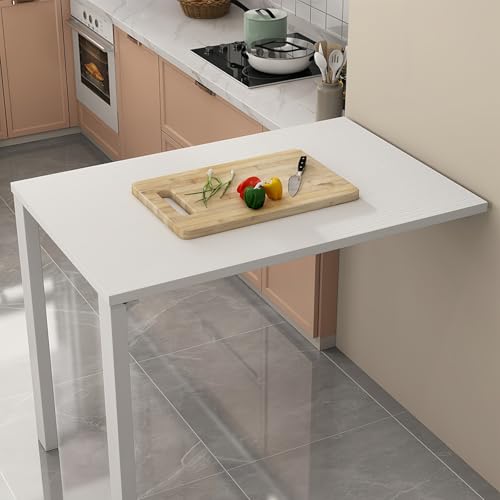
Wall Mounted Drop Leaf Table,Wall Mounted Folding Table,Heavy Duty Small Folding Wall Table, for Small Spaces,Home Office,Dining,Laundry,Kitchen,Bar,White,75×60cm(30×24in)
Check price on Amazon
YUASDUU Wall Mounted Folding Table with Legs, 29.52 * 15.75 * 29.13 inch Murphy Table Wall Mount Table Folding Dining Table for Small Spaces Wall Mounted Foldable Desk for Laundry Dining Room Bedroom
Check price on AmazonWhat Is a Mounted Dining Table?
A mounted dining table is a table that fastens to a wall rather than resting on a freestanding base. The most common type is a fold-down wall table: the tabletop hinges at the wall, flips up for mealtimes, and folds back down to sit nearly flush against the wall. Some designs use a fixed wall-mounted frame with a removable or sliding top, while others pair a wall bracket with a single folding leg for extra support.
Unlike a traditional dining table, a mounted table has no rear legs. That single design difference is what makes it so useful in tight rooms: chairs can tuck under on three sides, and the floor beneath the table stays clear when the top is folded away. It is closely related to the broader category of wall dining room tables and small wall dining tables, which prioritize footprint over seating capacity.
Because the wall carries part of the load, the quality of the bracket system matters far more than it does on a freestanding table. A well-engineered bracket assembly with reinforced steel arms, a secure locking mechanism, and proper anchoring will outlast a flimsy hinge-and-chain design by a wide margin. That is the single most important buying decision on this page.
Who Should Consider a Wall-Mounted Dining Table?
A mounted table is not the right answer for every home. It shines in specific situations and falls short in others. Use the list below to decide whether it fits your space before you shop.
- Studio and micro-apartments: When every square foot does double duty, a fold-down top lets you eat, work, and clear the floor in seconds. See our small apartment dining table guide for related layouts.
- Compact kitchens and breakfast nooks: A wall table can replace a bulky freestanding set in a narrow galley kitchen. Pair it with the ideas in our dining table and chairs for kitchen guide.
- Multipurpose rooms: If your dining area doubles as a home office or play space, folding the table away at the end of a meal is a real advantage.
- Rental units where drilling is permitted: Wall-mounted tables require solid anchoring. If your lease forbids wall modifications, a freestanding folding butterfly dining table is a better fit.
- Second dining spots: A wall table works well as an auxiliary eating area in a hallway, landing, or open-plan corner.
If you need seating for four or more on a daily basis, or if your walls are plaster-over-lath or lightweight drywall without accessible studs, a traditional compact table may serve you better. The very small dining table guide covers alternatives that do not depend on wall anchoring.
How Mounted Dining Tables Work: Bracket Systems Explained
The bracket is the heart of a mounted table. It determines how much weight the table holds, how smoothly the top folds, and how stable the surface feels when you lean on it. Bracket systems fall into three broad tiers.
| Tier | Typical Bracket Design | Best For | What to Expect |
|---|---|---|---|
| Entry-level tier | Single folding leg or simple hinge with chain support | Light use, occasional meals, one or two people | Basic stability; requires careful anchoring; may flex under heavy loads |
| Mid-range tier | Reinforced steel folding arms with locking hinge | Daily household dining for two to four | Solid build, smoother fold action, better weight distribution |
| Premium tier | Heavy-duty steel frame with dual locking arms and wall plate | Frequent use, heavier tabletops, larger seating | Commercial-grade feel, minimal flex, long service life |
Within each tier, look for a bracket that bolts to a continuous wall plate rather than relying on two isolated hinge points. A continuous plate spreads the load across more of the wall and reduces the chance of pull-out. Locking hinges that click into place when the table is raised are also worth prioritizing: they prevent the top from dropping if someone bumps the table.
If you are comparing a wall-mounted design against a freestanding pedestal, our pedestal leg dining table guide explains where each base style makes sense.
Wall Compatibility: What Your Wall Needs to Support
No bracket is stronger than the wall it is attached to. Before ordering a mounted table, identify your wall type and confirm that the bracket can be anchored into structural material.
| Wall Type | Anchoring Requirement | Suitability |
|---|---|---|
| Wood-stud framed wall | Lag bolts or structural screws into studs; locate studs with a detector | Excellent — the most reliable residential option |
| Solid brick or concrete | Masonry anchors or sleeve anchors rated for the load | Excellent with correct anchors |
| Drywall without stud access | Requires added blocking or a wall-mounted support board | Conditional — do not mount directly to drywall alone |
| Plaster over lath | Must reach framing; plaster is not structural | Conditional — professional assessment recommended |
| Metal stud walls | Toggle bolts or specialty metal-stud anchors rated for load | Possible — confirm rating with the bracket maker |
If your wall does not offer reliable anchoring, do not force it. A wall-mounted table that pulls out of drywall is a safety hazard, not just an inconvenience. In that case, consider a freestanding compact option such as a 2-seater dining table or a small dining table for 4.
Choosing the Right Size and Seating Capacity
Wall-mounted tables are sized by tabletop width, depth, and the number of people they comfortably seat. Depth is the variable most buyers underestimate: a deeper top gives more elbow room but eats into the floor space you were trying to save.
- One to two people: A top around 24 to 30 inches wide and 20 to 24 inches deep is workable for light meals and laptop use.
- Two to three people: Look for roughly 30 to 36 inches of width and at least 24 inches of depth so plates and glasses are not crowded.
- Three to four people: You will need a wider top, often 36 to 48 inches, and a bracket rated for the additional load.
Seating height matters too. A wall-mounted table intended for standard dining chairs should sit near standard dining height; if you plan to use counter stools, check the ideal height for a dining table before you buy. For very tight footprints, a 30-inch round dining table set offers a different space-saving approach.
Measure the folded depth as well. Some brackets leave several inches of hardware protruding from the wall even when the top is down. If your walkway is narrow, that protrusion can matter more than the tabletop size.
Materials and Finishes for Mounted Tables
Because a wall-mounted table folds, hinges, and takes repeated handling, material choice affects both durability and weight. Heavier tops are not automatically better: a solid hardwood top may be more durable but puts more load on the bracket and wall.
| Material | Weight Profile | Durability | Best For |
|---|---|---|---|
| Engineered wood with laminate finish | Light | Moderate; resistant to everyday spills | Entry-level and mid-range wall tables |
| Solid wood (oak, pine, birch) | Medium to heavy | High; refinishable over time | Premium tier with heavy-duty brackets |
| Tempered glass on metal frame | Medium | High surface durability; needs careful handling | Modern interiors, easy-clean surfaces |
| Powder-coated steel | Medium | Very high; rust-resistant when coated | Industrial and outdoor-rated designs |
| Bamboo | Light to medium | Good; moisture-sensitive | Eco-conscious buyers, indoor use |
For finish, a matte or satin surface hides fingerprints and everyday wear better than a high-gloss coat. If the table will sit near a window or in a humid kitchen, prioritize sealed edges and moisture-resistant coatings. Our materials and finishes hub covers surface options in more depth.
Installation Essentials: Getting the Mount Right
Installation quality determines whether a mounted table feels rock-solid or wobbly. Even a premium bracket will perform poorly if it is fastened with the wrong hardware.
- Locate structural framing first. Use a stud finder and mark stud edges with painter's tape before drilling.
- Match anchors to the wall. Lag bolts for wood studs, masonry anchors for brick and concrete, and rated toggle bolts only where the manufacturer approves them.
- Check level before final tightening. A table that is slightly out of level will feel unstable and may strain the hinge.
- Follow the weight rating. Never exceed the bracket's stated capacity, and account for the weight of the top plus everything placed on it.
- Test the fold mechanism empty first. Raise and lower the top several times before using it for meals.
If you are not comfortable drilling into structural framing, hire a handyman or installer. The cost of professional installation is small compared with repairing a failed wall mount. For adjacent setup topics, see our setup and accessories hub.
Everyday Use Cases for a Mounted Dining Table
Understanding how people actually use wall-mounted tables helps you pick the right model. The three most common scenarios are compact apartment dining, kitchen breakfast spots, and flexible work-and-eat setups.
In a studio apartment, a wall table often doubles as a desk during the day and a dining surface at night. Models with a slightly deeper top and a smooth locking hinge work best for this dual role. If your space is tighter still, compare with a small apartment dining room table or a round dining table for a small apartment.
In a kitchen, a wall-mounted top can replace a breakfast bar in narrow layouts. Pair it with stackable or folding chairs so the whole setup clears away at once. Our dining table set with 2 benches guide covers bench-based alternatives if you prefer that seating style.
For households that entertain occasionally, a wall table works as a secondary serving or seating surface rather than the primary dining table. Think of it as a flexible extension of your main dining area, not a replacement for a full-size table.
Mounted Dining Table vs. Other Space-Saving Options
A wall-mounted table is one of several ways to save floor space. The comparison below shows where it wins and where another design may suit you better.
| Option | Floor Footprint When Stored | Seating Flexibility | Installation Effort | Best For |
|---|---|---|---|---|
| Mounted dining table | None (folds flat to wall) | Moderate; usually 2 to 4 seats | High; requires wall anchoring | Tight rooms with solid walls |
| Folding butterfly table | Small | Moderate; expands when needed | None; freestanding | Rentals and flexible layouts |
| Drop-leaf table | Small | Moderate; leaves fold down | None; freestanding | Kitchens and breakfast nooks |
| Small round table | Small to moderate | Good; sociable seating | None; freestanding | Corners and compact dining areas |
If your priority is zero permanent floor use and your walls can take the load, a mounted table is hard to beat. If you rent or your walls are uncertain, a drop-leaf square dining table or a folding dining table set delivers similar flexibility without drilling.
Care, Maintenance, and Safety Checks
Mounted tables need periodic inspection because their hardware is load-bearing. A few minutes of maintenance a few times a year prevents most problems.
- Check fasteners every few months. Tighten any bolts that have worked loose, and replace damaged anchors immediately.
- Lubricate hinges sparingly. A dry silicone lubricant keeps folding arms moving smoothly without attracting dust.
- Watch for wall movement. Cracks, pulled anchors, or a gap between the wall plate and the wall are warning signs that require immediate attention.
- Clean according to the surface. Wood tops need a damp cloth and a suitable polish; glass tops need a non-abrasive cleaner; powder-coated metal wipes clean with mild soap.
- Respect the weight limit. Do not use the table as a step stool or lean heavy body weight on the unsupported edge.
For deeper cleaning routines, see our dining table care and maintenance hub. If the table will sit in a humid or sunny spot, review our humidity care guide before installing.
Mounted Dining Table Buying Checklist
Use this checklist as a final pass before you commit to a model. Each item corresponds to a decision that is difficult or impossible to fix after purchase.
- Confirm your wall type and whether structural anchoring is possible.
- Measure the available wall width and the folded depth of the bracket.
- Decide how many people the table must seat on a typical day.
- Check the bracket's stated weight rating against the tabletop weight.
- Choose a material that matches your cleaning routine and humidity levels.
- Verify that the fold mechanism locks securely in the raised position.
- Plan for installation help if you are not confident drilling into framing.
- Read the warranty terms for bracket and hinge components.
Frequently Asked Questions
What is a mounted dining table?
A mounted dining table attaches directly to a wall instead of standing on four legs. Most models fold down flat against the wall when not in use, freeing up floor space for small apartments, kitchens, and multipurpose rooms.
How much weight can a wall-mounted dining table hold?
Weight capacity depends on the bracket system, wall construction, and installation quality. Mid-range and premium models with reinforced steel brackets and proper anchoring into studs or masonry generally support everyday dining use. Always follow the manufacturer's weight rating and anchor into structural framing.
What type of wall is best for a mounted dining table?
Solid masonry walls and wood-stud framed walls are the most reliable surfaces. Drywall alone cannot support a mounted table unless the bracket is anchored into studs or reinforced with a proper blocking system. Brick and concrete walls require masonry anchors.
Can a mounted dining table be used outdoors?
Only models explicitly rated for outdoor use should be installed outside. Look for weather-resistant coatings, rust-proof hardware, and marine-grade or powder-coated finishes. Indoor wall-mounted tables can warp, rust, or fail if exposed to moisture and temperature swings.
Is a mounted dining table stable enough for daily use?
Yes, when the bracket is rated for the load and the wall anchoring is done correctly. Mid-range and premium brackets with locking hinges feel solid in daily use. Entry-level designs with simple chain supports are better suited to light, occasional use.
Can I install a mounted dining table in a rental?
Only if your lease permits wall modifications and you can anchor into structural framing. If drilling is not allowed, a freestanding folding or drop-leaf table is the safer choice.
Ready to Choose Your Mounted Dining Table?
Start with your wall type, then work through size, bracket tier, and material. Browse the recommended models above, compare the bracket designs, and confirm the weight rating before you order. A well-chosen wall-mounted table can turn an unused corner into a genuine dining spot.
For more space-saving ideas, explore our dining table types hub and the shopping and reviews section.