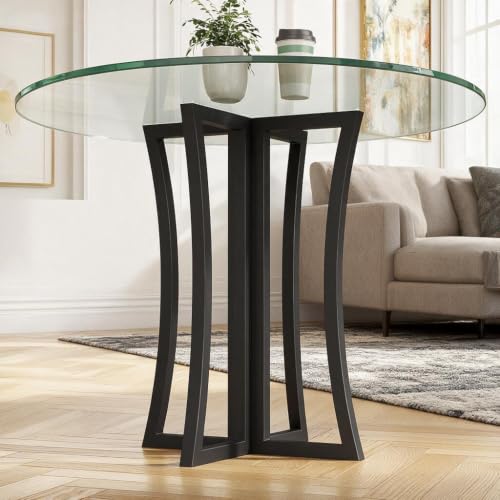
Pedestal Leg Dining Table: The Complete Guide
Everything you need to know about pedestal base dining tables — how they work, which base style suits your room, how many diners they seat, and what to check before you buy.
Jump to Buying FactorsWhy pedestal tables deserve a closer look: A pedestal leg dining table moves the support to the center of the table instead of the corners. That single design decision changes how chairs tuck in, how walkways flow, and how the table feels in a room. If you have ever banged a knee on a corner leg or struggled to squeeze a chair into a tight dining nook, a pedestal base is the fix. This guide explains the base styles, the stability questions, the seating math, and the practical details that separate a well-engineered pedestal table from a wobbly one.
What Is a Pedestal Leg Dining Table?
A pedestal leg dining table is a table supported by one or more central columns rather than four legs at the corners. The column (or columns) rise from a foot — often a cross-shaped base, a round disc, or a pair of trestle feet — and attach to the underside of the tabletop at its center. The result is an open perimeter where every chair position is free of obstructing legs.
This is not a niche design. Pedestal bases appear in traditional round tables, in modern oval dining tables, and in long extendable rectangular tables that use a double pedestal. If you are exploring shape options first, our guide to the round dining table pairs naturally with pedestal construction, and the oval dining table guide explains why oval tops often sit on twin pedestals.
The Main Pedestal Base Styles
Not all pedestals are built the same. The base style determines stability, seating flexibility, and how the table looks in the room. Here are the three core types you will encounter.
Single Pedestal
One central column on a cross or disc foot. Best for round and square tops up to roughly 4 diners. Compact, open underneath, and the most space-efficient option for tight rooms.
Double Pedestal
Two columns spaced along the length of a rectangular or oval top. Handles 6 to 8 diners reliably and distributes weight better than a single column on long tables.
Trestle & Architectural Base
Two A-frame or sculpted end supports connected by a stretcher. Heavy-duty construction, excellent for large tops, and often the most design-forward option.
If your tabletop is rectangular and long, a double pedestal or trestle base is the safer engineering choice. A single pedestal under a long top creates leverage at the ends, which is where wobble begins. For narrower footprints, a dining table base for a rectangle glass top is a common pairing because the open base keeps the glass top visually light.
Pedestal vs. Four-Leg Tables: An Honest Comparison
| Factor | Pedestal Base | Four-Leg Base |
|---|---|---|
| Chair placement | Unrestricted on all sides; chairs tuck in fully | Corner legs limit where chairs and knees fit |
| Small-room efficiency | Excellent — open perimeter saves walkway space | Moderate — legs consume usable clearance |
| Stability on long tops | Requires double pedestal or trestle for best results | Naturally stable at all four corners |
| Under-table storage | Limited by the central foot | Open corners, but legs interrupt storage |
| Style range | From traditional to sculptural modern | Universal; fits nearly every style |
| Best for | Round tops, compact rooms, bench seating, entertaining | Large rectangular family tables, heavy daily use |
Strengths of a Pedestal Base
- No corner legs means every seat is a "good seat"
- Chairs slide in closer, which saves floor space
- Bench seating works without leg interference
- Clean sightlines under the table make rooms feel larger
- Visually lighter, especially with glass or stone tops
Trade-Offs to Plan For
- A single pedestal can feel tippy if the foot is too small
- The central foot limits where feet and storage go
- Long tops need a double pedestal for proper support
- Cheaper builds may develop wobble at the column joint
- Some designs make adding a leaf more complex
How Many Diners Can a Pedestal Table Seat?
Seating capacity depends on the tabletop, not the base alone. Use these practical ranges as a starting point.
- Single pedestal, round top: 2 to 4 diners. A 30-inch round is a two-person table; a 36-inch round handles four.
- Single pedestal, square top: 4 diners comfortably, with a corner-oriented seating layout.
- Double pedestal, rectangular top: 6 diners reliably, 8 with a wider top. See our 6-seater dining table guide for spacing math.
- Trestle or double pedestal, long top: 8 to 10 diners. Our 8-seater dining table guide covers the clearance rules that apply.
A common mistake is buying a long top on a single pedestal to gain seats. The extra seats come at the cost of stability at the ends. If you need more than four seats, move up to a double pedestal or trestle.
What to Check Before You Buy
1. Footprint and Base Width
The foot should be wide enough that the table resists rocking when someone leans on an edge. A narrow disc under a wide top is the classic wobble recipe. For rectangular tops, check that the two pedestals sit far enough apart to support the overhang at each end.
2. Column Construction and Joint Quality
The column-to-tabletop joint is where pedestal tables fail first. Look for a metal mounting plate, a reinforced apron, or bolts that thread into a steel insert rather than directly into wood. A solid build here is what separates a long-term investment from a table that loosens within a year.
3. Tabletop Weight vs. Base Weight
Heavy tops — stone, thick solid wood, concrete — need a proportionally heavy or weighted base. Light glass tops can work with lighter bases but still need a wide foot for balance. Match the two, or the table will feel unstable in daily use.
4. Clearance for Chairs and Benches
Pedestal bases are the friendliest option for bench seating because there are no corner legs to straddle. Our dining bench seating guide explains how to pair benches with open bases. Also confirm that chair seats clear the table apron and that the central foot does not crowd the chair legs on the short sides.
5. Room Flow and Walkway Space
Because pedestal tables free up the perimeter, they often fit rooms that four-leg tables cannot. Measure the walkway behind pulled-out chairs before you commit. Our dining table space planning guide walks through the clearance numbers.
6. Material and Finish
Pedestal bases are made from wood, metal, or composite. Wood bases pair naturally with wood tops; metal bases are common under glass and stone. For care routines by material, see the materials and finishes hub and the care and maintenance hub.
Pedestal Tables for Small and Awkward Spaces
This is where pedestal bases earn their reputation. Without corner legs, chairs push in flush with the table edge, which can free up several inches of walkway on every side. In a compact apartment, that difference decides whether a table fits at all.
Single pedestal round tables are the classic small-space solution. Our small dining table guide and the small apartment dining table guide both lean on pedestal designs for exactly this reason. If your room is unusually narrow, the 2-foot-wide dining table guide shows how a slim pedestal table can work as a wall-adjacent dining spot, and the round dining table for small apartment guide covers the seating layout.
Pairing Pedestal Tables with Chairs and Benches
Pedestal bases open up seating combinations that four-leg tables make awkward. Benches slide underneath without hitting legs, and chairs can be placed at any point along the perimeter. A dining table set with two benches is a natural match for a trestle or double pedestal base.
When choosing chairs, match seat height to tabletop height. Our dining table chair height guide covers the standard ratios. If you want a mixed seating look, the dining chair selection guide explains how to combine chairs and benches without visual clutter.
Style Directions That Suit a Pedestal Base
The pedestal base is style-neutral, which means it adapts to nearly any dining room direction:
- Modern and sculptural: a tapered or faceted single column under a round stone top. See modern dining table styling.
- Farmhouse and cottage: a trestle base in painted or distressed wood. See farmhouse dining table styling.
- Rustic and industrial: a heavy timber trestle with metal strapping. See rustic dining table styling.
- Scandinavian: a slim round pedestal in pale wood. See Scandinavian dining table styling.
Common Pedestal Table Mistakes to Avoid
- Choosing a single pedestal for a long top. The ends will flex. Go double pedestal or trestle beyond roughly 4 seats.
- Ignoring the foot width. A narrow foot under a wide top is unstable no matter how thick the column looks.
- Skipping the mounting hardware check. Bolts into raw wood loosen over time. Metal plates and threaded inserts last.
- Forgetting the central foot when planning storage. Pedestal bases leave less open floor under the table for bins or stools.
- Not measuring the walkway. The open perimeter helps, but a pulled-out chair still needs clearance behind it.
Frequently Asked Questions
What is a pedestal leg dining table?
A pedestal leg dining table uses a central column or a pair of central columns instead of four corner legs. The base supports the tabletop from the middle, which frees up the perimeter so chairs and knees move freely without hitting corner legs.
Is a pedestal dining table stable enough for daily use?
Yes, when the base is properly engineered. A wide, weighted foot, a reinforced column, and a solid tabletop attachment are the key factors. Single pedestals are best for smaller and round tops, while double pedestals and trestle-style bases handle longer rectangular tops more reliably.
How many people can sit at a pedestal dining table?
A single pedestal works well for 2 to 4 diners, especially on round or square tops. A double pedestal comfortably seats 6 to 8, and larger double pedestal or trestle designs can accommodate 8 to 10 diners depending on tabletop length and width.
Are pedestal tables good for small dining rooms?
They are excellent for compact spaces. Because there are no corner legs, chairs tuck in further and walkways stay clearer. A single pedestal round table is one of the most space-efficient dining layouts for apartments and small dining nooks.
Can I use a bench with a pedestal dining table?
Yes. Benches pair especially well with pedestal and trestle bases because the open underside leaves room for legs and feet. Just check that the bench height matches your tabletop height so seating stays comfortable.
Final Checklist Before You Decide
- Confirm the base style matches the tabletop shape and size
- Check the foot width against the top overhang
- Inspect the column-to-top mounting hardware
- Verify seating capacity against your household and hosting needs
- Measure walkway clearance with chairs pulled out
- Plan for the central foot when thinking about under-table storage
- Match material and finish to your care routine and room style
If you are still weighing shapes, the round vs rectangular dining table comparison is the natural next read. For overall purchase planning, the first dining table checklist and the dining table buying mistakes guide will keep the decision on track.
Ready to Compare Pedestal Dining Tables?
Browse hand-picked pedestal base dining tables and check availability in your area.
View Recommended TablesRecommended Pedestal Leg Dining Tables
⚠️ AFFILIATE DISCLOSURE: This website contains affiliate links. As an affiliate Associate, we earn from qualifying purchases. If you make a purchase through these links, we may receive a small commission at no additional cost to you. Read our full affiliate policy.

Leinuosen 2 Pack Restaurant Table Base, 5" x 22" Cast Iron T-base, 28" Tall | 500 Lbs Capacity, Cast Iron, Table Pedestal Base Only, Fits 20-30" Tops, Anti-wobble, for Dining Cafe Bar Indoor & Outdoor
Check price on Amazon
TIEOU Metal Legs for Table V Shape 28" H Tall Metal Black Table Leg Heavy Duty Industrial Desk Legs Set of 2
Check price on Amazon
Metal Table Legs 28 Inch, Round Dining Table Base Fits Glass Marble Wood | 1000LBS Capacity, Golden Ratio Easy To Install with Suction Cups, 4 Adjustment Pads, Suitable for Indoor and Outdoor Use
Check price on Amazon
BOTAOYIYI 30 Inch Modern Table Base | Metal Dinning Table Legs with Suction Cups, Heavy Duty Desk Base for Marble,Glass,Wood Top, Set of 4 Furniture Legs for Home
Check price on Amazon
28 Inch Metal Dining Table Base, 1200 LBS Load Suitable for Glass Tops | Heavy Duty Industrial Table Legs with Height-Adjustable Foot Pads and Suction Cups for Fits Glass Marble Wood Top
Check price on Amazon
Leinuosen 2 Pack Restaurant Table Base, 22"x22" Cast Iron X-Base, 28" Tall | 500 Lbs Capacity, Cast Iron, Table Pedestal Base Only, Fits 20-30" Tops, Anti-wobble, for Dining Cafe Bar Indoor & Outdoor
Check price on Amazon