
Heavy Solid Wood Dining Table: The Complete Buying Guide
A heavy solid wood dining table is a statement piece built to outlast trends. This guide walks you through construction, wood species, joinery, stability, and everyday ownership so you can choose a table that anchors your dining room for decades.
Explore Recommended TablesWhy this guide matters: Buyers researching a heavy solid wood dining table already know they want mass, durability, and natural character. What they usually still need is clarity on what "heavy solid wood" actually means in construction terms, which wood species deliver the best balance of density and stability, and how to avoid a beautiful-looking table that cracks or wobbles within a few seasons. Everything below is written to answer those questions.
1. What Defines a Heavy Solid Wood Dining Table
The phrase "heavy solid wood" describes both mass and material integrity. A genuinely heavy solid wood dining table is constructed from thick, full-length timber, not a veneer skin over particleboard, MDF, or a hollow honeycomb core. Mass matters because it signals real material, but weight alone is not proof of quality, so the definition combines three signals: top thickness, wood density, and structural joinery.
Most tables marketed as heavy solid wood fall into a top thickness range of about 1.5 to 3 inches (roughly 4 to 7.5 cm). Thicker tops resist flexing across long spans and feel planted under hand pressure, but past a certain point extra thickness adds weight without meaningful functional benefit, so the sweet spot sits in the middle of that range for residential use.
Key markers to look for
- End-grain visibility: On a solid top, you should see grain continuing down the edge, not a thin decorative strip.
- Consistent grain continuity: Boards should run through the thickness rather than stop at a glued-on face.
- Reinforced joinery: Mortise-and-tenon, doweled breadboard ends, and corner blocks indicate a frame built to carry real load.
- Substantial legs or pedestal: Chunky legs, trestle bases, and wide pedestal columns distribute weight and resist racking.
- Reasonable per-person weight: A sturdy six-seat solid wood table typically feels noticeably heavier than a comparable veneered table, but total weight should still be movable by two to four adults.
If you are still weighing material families more broadly, our comparison of wood versus glass dining tables explains where solid timber sits against alternative surfaces in terms of feel and maintenance.
2. Why Buyers Choose Heavy Solid Wood
Heavy solid wood dining tables solve several problems at once. They resist wobble and racking during daily use, they absorb sound better than thin hollow tops, and they can be sanded and refinished repeatedly, which is why they often become family heirlooms. The mass also stabilizes the table during large gatherings when plates, serving dishes, and elbows all land on the surface at once.
Durability
Thick hardwood resists dents and surface wear far better than veneered or composite tops, and minor scratches can be sanded out rather than patched.
Stability
Heavy bases and thick tops reduce flexing, wobble, and shifting, which matters in busy households with children or frequent entertaining.
Restorability
Solid timber can be refinished multiple times over its life, so a premium or heirloom-tier table can be renewed instead of replaced.
Design Presence
Mass and visible grain give a dining room a grounded focal point, which is especially useful in open-plan layouts where the table anchors the space.
For buyers thinking about the overall room composition, our dining table style and design hub connects table choice to broader interior decisions.
3. Wood Species Compared
The species determines density, grain character, movement, and how the table ages. Density translates directly into perceived heft, while grain and pore structure affect how the finish reads in a room.
| Species | Density & Feel | Grain Character | Best For |
|---|---|---|---|
| Oak | High density, substantial and firm under hand | Pronounced open grain, rustic to modern depending on finish | Everyday family tables, farmhouse and modern interiors |
| Walnut | Medium-high density, dense and quiet | Rich chocolate tones, flowing grain, elegant | Mid-range to luxury dining rooms, statement pieces |
| Teak | High density, naturally oily and resilient | Warm golden-brown, subtle straight grain | Humidity-variable climates, long-term investment tables |
| Mango | Medium density, lighter feel | Bold, varied grain with natural color shifts | Entry-level and mid-tier rustic tables |
| Pine | Lower density, lighter and softer | Knotty, casual, farmhouse character | Starter-tier tables and relaxed country styles |
| Maple | High density, hard and uniform | Fine, closed grain, clean and contemporary | Minimalist and Scandinavian dining spaces |
Oak and walnut dominate the heavy solid wood category because both are dense and widely available in thick boards. Teak is the stand-out choice where indoor humidity swings are a concern, since its natural oils help it resist moisture variation. If you are leaning toward a natural wood look and want material context, the wooden dining table buying guide covers species selection in more depth.
4. Construction, Joinery, and Load Capacity
Weight is only useful when it is distributed well. Two tables can weigh the same and behave completely differently depending on how the top is attached, how the legs are joined, and whether the design allows for seasonal wood movement.
Top-to-base attachment
Better tables use floating tops, figure-eight fasteners, or button clips that allow the top to expand and contract while staying attached to the base. Screwing a thick top rigidly to a fixed frame is a common shortcut that can cause splitting as the wood moves. When reviewing construction details, look for language about "floating top," "movement allowance," or "expansion fasteners."
Joinery quality
- Mortise-and-tenon: The standard for heavy frames; strong, long-lasting, and resistant to racking.
- Dovetail or pinned joints: Often seen on trestle bases and drop-leaf mechanisms; strong and visually distinctive.
- Bolted metal plates: Acceptable on modular bases if the hardware is heavy-duty and properly recessed.
- Glue-and-dowel only: Adequate for lighter pieces, less convincing on heavy solid wood.
Leg and pedestal design
Four substantial legs at the corners provide the most predictable stability, especially on long rectangular tops. Trestle and pedestal bases reduce leg obstruction for seating, but they need a wide footprint and cross-bracing to resist side-to-side movement. Double-pedestal designs are common on eight-seat and larger tables because they distribute weight across a longer span.
If you are choosing between frame types, our dining table frame guide and pedestal guide go deeper into the trade-offs.
5. Quality Tiers Without the Guesswork
Heavy solid wood tables span a wide range of build quality. Rather than thinking in numbers, it helps to classify tables by tier, since the descriptor maps to construction decisions rather than to any specific market figure.
| Tier | Typical Construction | Best For |
|---|---|---|
| Entry-level | Solid wood top around 1.5 inches, simpler glued-and-doweled joinery, softer species | First heavy wood table, casual dining rooms, lighter-traffic homes |
| Mid-range | Thicker top around 1.75 to 2 inches, mortise-and-tenon base, reinforced aprons, oak or walnut | Busy family tables, frequent hosting, long-term daily use |
| Premium | Top around 2 to 2.5 inches, floating-top attachment, select-grade hardwood, refined finishing | Design-focused dining rooms, high-traffic homes, buyers planning to refinish later |
| Luxury / heirloom | Thick slabs or book-matched boards, hand-finished joinery, breadboard ends, premium hardware | Statement pieces intended to be passed down and restored across generations |
Mid-range models usually deliver the best balance for most households: they offer smoother joinery and better movement allowance than entry-level pieces, while remaining more practical to move and maintain than the heaviest luxury slabs. Buyers who want to see how specific heavy tables are rated in practice can browse highest-rated dining tables and editor's choice dining tables.
6. Sizing and Seating for Heavy Tables
Heavy solid wood tables tend to be wider and deeper than lightweight alternatives, which changes seating math. A thick top and chunky legs reduce usable knee space, so it pays to measure the clearance between legs rather than just the outer footprint.
| Seating Capacity | Typical Length | Typical Width | Notes |
|---|---|---|---|
| 4 seats | About 48–60 in | About 36–40 in | Compact heavy tables still need 24 in of clear chair pull-out per side |
| 6 seats | About 60–72 in | About 36–42 in | Most popular heavy solid wood size; avoid legs closer than 30 in to each other on the long side |
| 8 seats | About 72–96 in | About 40–44 in | Double-pedestal or trestle bases improve legroom for long tops |
| 10 seats | About 96–120 in | About 42–48 in | Confirm floor load and doorway widths before delivery |
Also plan walkway clearance: at least 36 inches of clear space between the table edge and walls or other furniture, and closer to 44 inches where chairs are frequently pulled out. Our dining table pathway width guide provides a room-by-room breakdown. For tighter rooms, a round versus rectangular comparison is useful because round heavy tables can improve circulation in compact spaces.
7. Stability, Humidity, and Seasonal Movement
Solid wood is hygroscopic, meaning it absorbs and releases moisture with the surrounding air. A heavy table built with proper movement allowance will expand and contract slightly across seasons without damage. A heavy table built rigidly will fight that movement, which is where cracks and lifted seams originate.
Design features that prevent problems
- Floating top or slotted fasteners: Allows the top to move independently of the base.
- Breadboard ends: Controls cupping across wide tops and accommodates lengthwise movement.
- Properly kiln-dried timber: Reduces internal stress before the table is even assembled.
- Sealed surfaces: Finish on all faces, including the underside, slows moisture exchange.
Home environment guidance
Indoor relative humidity between roughly 35 and 55 percent keeps solid wood in a comfortable range. Avoid placing the table directly over heating vents, against radiators, or in strong direct sunlight for long periods. In very dry winters, a room humidifier helps; in humid summers, air conditioning and good ventilation do the same job. If your climate swings sharply, teak or walnut tend to move less dramatically than softer species.
For detailed seasonal strategies, see our humidity care guide and sunlight fade prevention guide.
8. Flooring, Moving, and Placement
Heavy solid wood tables concentrate their weight at the feet. On hardwood, laminate, vinyl, or tile floors, unprotected heavy legs can dent the surface over time, especially when chairs are pushed in and the table shifts slightly.
Protecting the floor
- Use wide, dense felt pads under each foot, replaced annually.
- On soft flooring, consider load-spreading coasters or a rug with a firm backing.
- On upper floors, position the table across joists rather than along a single joist line when feasible.
Moving a heavy table safely
Whenever the design allows, detach the top from the base before moving. This reduces the single heaviest load, lowers the risk of dropped corners, and makes doorways and stairwells far easier to navigate. Two strong adults can usually manage a six-seat top; eight-seat and larger tops typically need three or four people or a furniture dolly.
Measure doorways, elevator interiors, and stairwell turns before delivery day. Our moving safely guide covers the step-by-step process, and rug placement guidance helps with the final positioning.
9. Care and Long-Term Ownership
A heavy solid wood table rewards simple, consistent care. Because the surface is thick enough to be sanded and refinished, even a table that sees years of daily use can be brought back to near-original condition.
Routine care
- Dust with a soft, slightly damp cloth; avoid soaking the surface.
- Wipe spills promptly, especially acidic or colored liquids.
- Use coasters and trivets for hot dishes and cold drinks.
- Apply a suitable wax or oil only as recommended for the specific finish.
Long-term maintenance
Oiled and waxed finishes typically benefit from periodic reapplication, while lacquered and polyurethane finishes generally need only cleaning until wear becomes visible. When scratches or heat marks accumulate, a light sanding and refinish restores the surface. Full guidance lives in our dining table surface care guide and scratch touch-up guide.
Recommended Heavy Solid Wood Dining Tables
⚠️ AFFILIATE DISCLOSURE: This website contains affiliate links. As an affiliate Associate, we earn from qualifying purchases. If you make a purchase through these links, we may receive a small commission at no additional cost to you. Read our full affiliate policy.

Christopher Knight Home Ace 70.28'L Solid Wood Dining Table for 6-8 People, Rubber Wood Dining Room Table, Minimalist Modern Rectangular Kitchen Table, Easy Assembly Dining Room Furniture, Natural
Check price on Amazon
Plank+Beam Classic 72 Inch Dining Table, Rectangular, Pecan Wirebrush | Non-Toxic Finishes, Versatile Design, Farmhouse Design, Elegant Details, Easy Assembly, Quick Setup, Solid Wood
Check price on Amazon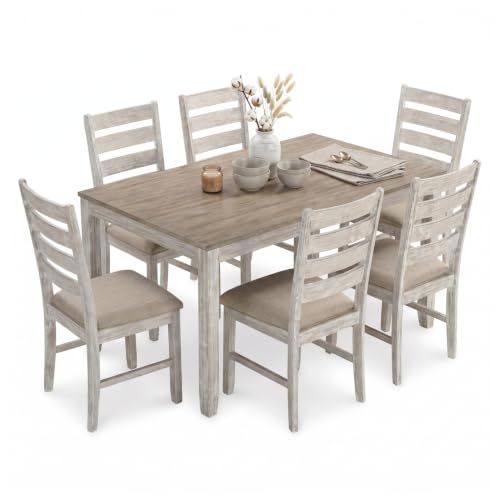
Signature Design by Ashley Skempton 7-Piece Dining Table Set for 6 | Solid Wood, Engineered Wood & Acacia Veneer Construction, 60-In Table, Cushioned Polyester Seating, Two-Tone Finish
Check price on Amazon
Furniture of America Nazaen III Modern Dining Table, Walnut | 82.5-inch Solid Wood Live Edge Table with X-Frame Base, Steel Support, Seats up to 8 for Dining Room
Check price on Amazon
Squireewo 71 Inch Solid Wood Dining Room Table, Walnut | Rustic Kitchen Table, Large Wooden Rectangular Dinner Table for Dining Room, Home Office, Living Room
Check price on Amazon
TRIBEWOOD 70.8-Inch Rectangle Solid Wood Dining Table for 8 People | Farmhouse Large Wood Kitchen Dinner Table for Dining Room
Check price on Amazon
TRIBEWOOD 63-Inch Solid Wood Rectangular Dining Table,Romantic Brown | Farmhouse Kitchen Table with Trestle Base, Dining Table Set for 6,Real Wood Finish for Dining Room,Easy Assembly
Check price on Amazon
TRIBEWOOD 63-Inch Rectangle Solid Wood Dining Table for 6 People | Farmhouse Wood Kitchen Dinner Table for Dining Room
Check price on Amazon10. Final Buying Checklist
Before committing to a heavy solid wood dining table, run through this checklist. It is designed for buyers who already know what they want and simply need confidence in the details.
- Verify solid construction: Confirm the top is solid timber, not veneer over a hollow or composite core.
- Check top thickness and species: Roughly 1.5 to 2.5 inches of dense hardwood covers most residential needs.
- Inspect joinery descriptions: Look for mortise-and-tenon, floating tops, breadboard ends, and reinforced aprons.
- Measure the room, not just the table: Include chair pull-out and walkway clearance on every side.
- Plan the delivery route: Measure doorways, stairs, and turns; confirm whether the top separates from the base.
- Match the base to your seating plan: Pedestal and trestle bases improve legroom but need wider footprints.
- Confirm finish and movement allowance: Sealed on all faces, with room for seasonal expansion.
- Review warranty and refinishing guidance: A good table should be supported for years, not just delivered.
Frequently Asked Questions
What qualifies a dining table as heavy solid wood?
A heavy solid wood dining table is built from thick, full-length timber rather than veneer over particleboard or hollow cores. Typical hallmarks include a top thickness of roughly 1.5 to 3 inches, dense hardwood species such as oak, walnut, or teak, and reinforced joinery like mortise-and-tenon or breadboard ends that add mass and structural rigidity.
Will a heavy solid wood table damage my floor?
The weight is concentrated at the legs or pedestal, so point loads matter more than total mass. Use felt pads or wide glides under each foot, and on soft wood or laminate flooring consider a protective rug or load-spreading coasters. On upper floors, position the table over load-bearing walls or joists when possible.
How many people does it take to move a heavy solid wood dining table?
Most heavy solid wood tables require at least two strong adults, and larger eight-seat models often need three or four people. Remove the top from the base whenever the design allows it, since the top is usually the heaviest single component and separating it reduces strain and the risk of dropped corners.
Do heavy solid wood tables warp or crack over time?
Solid timber moves with humidity, so some seasonal expansion and contraction is normal and expected. Properly kiln-dried wood combined with floating tops, breadboard ends, and button fasteners allows movement without splitting. Keeping indoor humidity stable between roughly 35 and 55 percent dramatically reduces the risk of warping or checking.
Is a heavy solid wood dining table a good long-term investment?
Yes. Solid hardwood tables can be sanded and refinished multiple times, repaired, and passed down across generations. While entry-level and mid-range models are already substantial, premium and heirloom-tier pieces with premium joinery and select-grade timber typically deliver the strongest long-term return because they can be restored rather than replaced.
Ready to Compare Heavy Solid Wood Dining Tables?
Use the curated options above to compare construction, species, and seating capacity, then check availability through the retailer listings.
View Recommended Tables