
Custom Dining Table and Chairs: The Complete Buyer's Guide
Commission a made-to-measure dining set that fits your room, your seating needs, and your taste. This guide walks through sizing, materials, chair pairing, maker vetting, and the design mistakes that trip up most first-time buyers.
Explore Custom OptionsWhy go custom? Ready-made dining sets follow standard dimensions and a small set of finish options. A custom dining table and chairs order lets you match the exact footprint of a tricky room, hit a specific seat count without squeezing, and combine a tabletop, base style, and chair design that no catalogue offers. The trade-off is a longer timeline and a more involved decision process — both of which this guide is designed to simplify.
What "Custom" Really Means for a Dining Set
The word custom covers a wide spectrum of service levels, and knowing where a maker sits on that spectrum helps you set realistic expectations. In practice, most workshops fall into one of four tiers:
- Entry-level made-to-order: you pick from a fixed catalogue of table shapes and chair models, then choose timber, stain, and upholstery from a standard swatch range. Dimensions may be adjustable within a set band.
- Mid-range bespoke: table dimensions, edge profile, base type, and chair frame can be adjusted. You typically get a wider finish palette and a choice of two or three joinery methods.
- Premium made-to-measure: the maker works from your room survey or detailed drawings. Expect custom radii on round and oval tops, matched grain book-matching, and hand-finished surfaces.
- High-end and flagship tier: full design collaboration, prototyping, rare or figured timber selection, hand-cut joinery, and bespoke upholstery on every chair.
Higher tiers are not automatically better for every buyer. An entry-level made-to-order set from a reputable workshop can be an excellent long-term investment if the sizing options cover your room. The mid-range tier is often the sweet spot for buyers who need a non-standard footprint but want predictable lead times.
Start With the Room, Not the Table
The single biggest advantage of going custom is fit, so the process should begin with measurements rather than a design sketch. Before you contact a maker, record the following:
- Clear floor footprint: the wall-to-wall dimensions of the dining zone, including any bay windows, radiators, or built-in storage that reduce usable area.
- Walkway clearances: aim for roughly 36 inches of clearance behind pulled-out chairs on main traffic routes, and a minimum of about 30 inches on secondary paths. Our guide to dining table width and clearance breaks down the math.
- Doorway and stair access: a large one-piece top that cannot pass through the delivery route is a common and avoidable problem. Ask the maker about split tops or removable legs.
- Ceiling height and lighting: a very long table under a low ceiling can feel oppressive; a pendant or chandelier position also constrains where the table centre can sit.
- Seat count and stretch goal: decide the everyday seat count and the maximum you might need for holidays. If the gap between them is large, a custom extendable design is usually the better investment.
If your room is on the smaller side, our notes on small solid wood dining tables show how custom sizing can recover space that standard sets waste. For larger rooms, the principles in our room sizing guide for a six-person table scale up cleanly.
Choosing the Table Shape and Base
Shape and base are the two decisions that most affect how a custom table lives in your room. Both are far more flexible in a bespoke order than in a catalogue set.
Shape
- Rectangular: the most space-efficient for long rooms and the easiest to extend. Rounded corners reduce the risk of hip-level knocks in tight layouts.
- Round: the most sociable shape and the best choice for square rooms or tight corners. Custom diameters let you hit an exact seat count — see our guide to a custom made round dining table for diameter-to-seat ratios.
- Oval: combines the convivial feel of a round table with the seating capacity of a rectangle. A custom oval dining table is often the best compromise for narrow rooms that still need to seat six or eight.
- Square: strong for four-seat arrangements and open-plan layouts where a centred table anchors the zone.
Base style
- Four legs with aprons: classic and stable, but the aprons limit how far chairs can tuck in and make later resizing harder.
- Pedestal: frees up legroom on all sides and suits round and oval tops. Our solid wood round pedestal table guide covers stability considerations.
- Trestle: visually striking and excellent for long tables. See our notes on a dining table with trestle base for clearance and seating implications.
- Metal and mixed-material bases: a custom order can pair a timber top with a steel or aluminium frame for a lighter visual footprint. Our guide to a metal-leg table with wood top explains the trade-offs.
If you expect to host larger groups occasionally, a custom extendable design is worth discussing early. The mechanics differ substantially between entry-level and premium tiers, and our overview of a custom extendable dining table covers leaf storage and mechanism options.
Material and Finish Selection
Custom orders let you choose the exact timber, grain pattern, and surface treatment, but that freedom also creates the most common source of regret. The table below summarises the practical differences between the most requested options.
| Material | Best For | Durability Notes | Maintenance Level |
|---|---|---|---|
| Solid oak | Everyday family dining, heavy use | Hard, dense, takes stain and oil well; develops character over time | Moderate — re-oil annually |
| Walnut | Formal dining rooms, rich dark tones | Strong but softer than oak; fine grain shows scratches more | Moderate — wax or oil finish |
| Teak | Humid climates, near-kitchen placements | Naturally moisture-resistant; excellent for semi-exposed spaces | Low to moderate |
| Maple | Clean contemporary looks, light interiors | Hard and uniform; less tolerant of prolonged moisture | Moderate |
| Live-edge slab | Statement pieces, rustic and organic styles | Varies by slab; requires stabilisation and careful sealing | Higher — needs sealing checks |
| Stone or quartz top | Low-maintenance surfaces, contemporary schemes | Scratch and heat resistant; heavy, needs a strong base | Low |
Finish choice matters as much as species. Matte oiled finishes feel warmer and are easier to spot-repair; lacquered finishes resist spills better but show scratches more readily. Ask the maker for a physical sample of the exact finish on the exact species — a swatch on a different timber tells you very little. If you are drawn to natural edges, our guides to a live-edge dining table and a raw edge wood table cover slab selection and stabilisation.
Specifying Custom Dining Chairs
Chairs are where custom sets most often go wrong, usually because seat height and frame dimensions are treated as an afterthought. Get these right and the set will feel designed as a whole.
- Seat height: for a standard-height table, aim for a seat height that leaves roughly 10 to 12 inches between the seat and the underside of the tabletop. Our average dining table height guide gives the full range.
- Seat depth and width: a seat depth of about 17 to 19 inches suits most adults; armchairs need extra clearance from the table edge.
- Tuck-in clearance: check that the chair back and arms clear the apron or trestle when pushed in. This is a simple test that many buyers skip until delivery day.
- Upholstery: performance fabrics and tightly woven textiles hold up better in busy households. Removable, washable covers are worth requesting on family sets.
- Frame joinery: ask how the chair legs and rails are joined. Reinforced corner blocks and proper mortise-and-tenon joints are the markers of a durable chair.
If you are mixing makers, order the chairs first or at least confirm their dimensions before finalising the table. A beautifully made table paired with chairs that sit too high or too low is the most common complaint in custom dining reviews. For a broader comparison of seating styles, see our guide to a beautiful dining table set.
How to Vet a Custom Maker
The quality gap between workshops is wider in custom furniture than in almost any other category. Use these checks before paying a deposit:
- Ask for drawings, not just photos: a serious maker will produce dimensioned drawings showing table height, overhang, apron depth, and chair clearance before you commit.
- Request finish samples on the actual species: and view them in your own room's lighting.
- Confirm the joinery method in writing: the quote should specify how the top is attached (buttons, clips, or figure-eight fasteners allow for seasonal wood movement) and how the base is joined.
- Check the warranty and the service terms: ask what happens if a leg arrives damaged or the finish fails in the first year.
- Review lead-time honesty: a maker who quotes an unrealistically short timeline for a complex set is a warning sign. Premium and high-end tier custom work routinely takes three to four months.
- Look for climate-appropriate construction: timber should be kiln-dried to a moisture content suited to your region. This matters most in humid climates.
It is also worth asking whether the maker handles delivery and in-home assembly, or whether that is subcontracted. White-glove delivery is a meaningful part of the experience at premium tiers and is often the difference between a smooth handover and a stressful one.
Design Mistakes to Avoid
- Oversizing the top: a table that fills the room leaves no room for chairs to pull out. Measure the pulled-out footprint, not just the closed table.
- Ignoring wood movement: solid timber expands and contracts across the grain. A top fixed rigidly to the base will crack or cup; confirm the attachment method allows movement.
- Choosing a finish that fights the use case: a delicate matte finish on a family table is a mismatch. Match the surface to the household.
- Buying chairs as an afterthought: chair dimensions should be locked in at the same time as the table drawing.
- Skipping the mock-up: mark the table footprint on the floor with tape and live with it for a few days. It is the cheapest design check available.
- Not planning for future extension: if you might add leaves later, request that the base and joinery allow for it now.
Putting It Together
A successful custom dining table and chairs order comes down to sequence: measure the room, decide shape and base, lock in the chair dimensions, choose species and finish with physical samples, then vet the maker against written drawings and joinery specifications. Buyers who follow that order rarely regret going custom. Buyers who start with a design sketch and work backwards usually end up compromising on fit. Take the measurement step seriously, choose a maker who communicates in drawings, and the result will be a set that fits your room and your household for years.
Recommended Custom Dining Table and Chairs
⚠️ AFFILIATE DISCLOSURE: This website contains affiliate links. As an affiliate Associate, we earn from qualifying purchases. If you make a purchase through these links, we may receive a small commission at no additional cost to you. Read our full affiliate policy.

IRONCK Dining Table Set for 4, Extendable Kitchen Table Chairs Set of 4 | Dining Room Table with 4 Upholstered Chairs, Folding for Small Space, Apartment, Walnut
Check price on Amazon
Stella Mia 5-Piece 47" Round Dining Table Set with Chairs, Natural | U-Shaped Pedestal Base, Round Tabletop Kitchen Table w/ 4 Upholstered Chairs, Space Saving Dinner Table for Dining Room
Check price on Amazon
Dining Table Set for 4,Kitchen Table and Chairs for 4, Round Dining Room Table with Upholstered Chairs, 5 Piece Space Saving Circle Wood Kitchen & Dining Room Dinner Dinette Table Set (Vintage, 42In)
Check price on Amazon
NicBex 6 Piece Farmhouse Dining Table Set, Wooden Dinner Table Set for 6, 58.5" Rectangular Table, 4 Upholstered Linen Dining Chairs & Bench, Dark Walnut
Check price on Amazon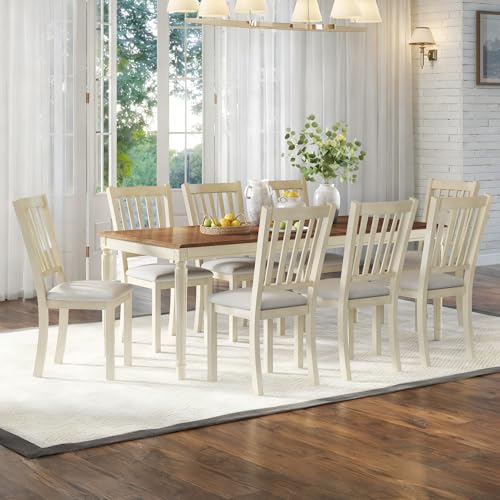
AMERLIFE 9 Piece Farmhouse Dining Table Set with 79" Table, Cream | Solid Rubberwood Frame, 8 Chairs Included, Farmhouse Design, Upholstered Seating, Rustic Cream Finish
Check price on Amazon
AMERLIFE 7-Piece Farmhouse Dining Table Set for 6, 60'' Table and 6 Chairs | Solid Wood Kitchen Table with 6 Upholstered Chairs, Space-Saving Dining Set for Dining Room, Kitchen, Small Apartment, Brown
Check price on Amazon
Sophia & William Solid Wood Kitchen Table and Chairs Set for 4, Walnut | Solid Wood, Farmhouse Charm, Handle Chairs, Space Saving, Easy Assembly, Small Dining Table Set for Kitchen
Check price on Amazon
Garvee Dining Table Set for 4 with 4 Upholstered Chairs, Wood Kitchen Table Chairs Set of 4 w/Beveled Edge Design, Dining Room Table Set for 4 for Dining, Small Space, Apartmen,Rustic Brown
Check price on AmazonFrequently Asked Questions
How long does a custom dining table and chairs order usually take?
Lead times vary by maker and complexity. Entry-level workshops often deliver in four to eight weeks, while premium and high-end tier makers typically quote ten to sixteen weeks or more, especially for hand-finished solid timber and bespoke upholstered chairs. Always get the lead time in writing and ask what happens if it slips.
Is a custom dining table worth it compared to a ready-made set?
A custom set makes sense when your room has awkward dimensions, you need a specific seating count, or you want a material and finish combination that standard ranges do not offer. It is a long-term investment, so it pays off most when you plan to keep the set for many years and want it to fit the room precisely from day one.
Which wood species is best for a custom dining table?
Oak and ash are durable and take stain well, walnut offers a rich dark tone and fine grain, teak resists moisture, and maple provides a clean uniform look. The best choice depends on your finish preference, climate, and how hard the table will be used. Request a finish sample on the actual species before committing.
Should the chairs be made by the same maker as the table?
Not always necessary, but matching from one maker simplifies seat height, timber tone, and finish consistency. If you pair different makers, confirm seat height and frame dimensions carefully so chairs tuck in properly and the visual balance holds. Order the chairs first, or at least finalise their dimensions before the table drawing is signed off.
Can a custom table be extended or resized later?
It depends on the base design. Pedestal and trestle bases are usually easier to modify than four-leg frames with aprons. Ask the maker at the design stage whether a future leaf addition or resize is feasible, and request that the joinery and attachment method allow for it.
What is the most common mistake in custom dining set orders?
Underestimating the pulled-out chair footprint. Buyers measure the closed table against the room but forget that chairs need space behind them. Tape out the full footprint on the floor, including chairs pulled out, before finalising dimensions with the maker.