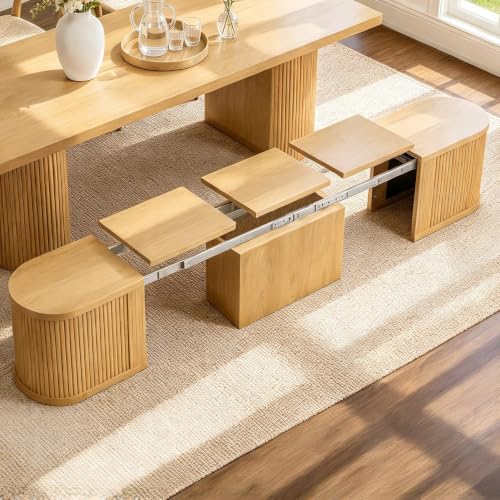
What Is a Curved Bench Seat for a Dining Table?
A curved bench seat is a crescent- or arc-shaped seating unit designed to follow the contour of a round or oval dining table. Unlike a straight dining bench, the curved form allows each seated guest to face the table naturally, improving conversation flow and ergonomic posture. Curved benches are typically available as standalone units or as part of a coordinated dining set that pairs a round table with matching seating.
These benches are especially popular in modern, Scandinavian, and farmhouse interiors because they soften angular room layouts and create a welcoming focal point. Many designs are upholstered for comfort, while others use solid wood or metal frames with slatted or padded tops. If you are still weighing up seating configurations, our guide to dining tables with chairs underneath offers useful context on how benches compare with traditional chairs.
Key Benefits of a Curved Dining Bench
- Space efficiency: A curved bench tucks neatly under the table, freeing up floor space and reducing visual clutter — ideal for small dining spaces for four.
- Sociable seating: Guests sit shoulder-to-shoulder along the curve, encouraging conversation and a relaxed, communal atmosphere.
- Ergonomic contour: The arc supports the natural curve of the back and legs, which is more comfortable than a flat straight bench over long meals.
- Design focal point: A sculpted bench adds architectural interest and a designer feel to a dining room.
- Versatile styling: Works beautifully with round tables, oval tables, and even as a standalone accent in open-plan layouts.
Matching Your Curved Bench to Your Dining Table
The single most important consideration is the table shape. Curved benches are designed to complement round and oval tables; the bench arc should mirror the table curve without overhanging awkwardly. For rectangular tables, a straight bench is usually the better fit — our guides on space-saving dining table and chair sets and slender dining tables cover those options in more detail.
Quick Sizing Checklist
- Table diameter: Measure your round or oval table diameter before buying; the bench arc should follow the same radius.
- Bench length: A typical curved bench seats 2–4 people and should be roughly 60–75% of the table's circumference.
- Seat height: Match the bench seat height to your table height — a standard dining table pairs best with a bench seat around 18 inches from the floor.
- Clearance: Leave at least 12–18 inches of knee clearance between the bench edge and the table apron.
- Walkway: Ensure 36 inches of clear space behind the bench for comfortable pull-out and movement.
Materials and Construction: What to Look For
Curved benches are built from three broad material families, each with distinct trade-offs:
| Tier | Material | Best For |
|---|---|---|
| Essential tier | Engineered wood with veneer, basic foam padding | Casual family dining, starter homes, entry-level curved benches |
| Mid-tier | Solid wood frame (oak, rubberwood, mango) with upholstered seat | Everyday use, balanced durability and comfort |
| Premium tier | Hardwood frame with high-density foam and performance fabric | Formal dining rooms, high-traffic households |
| Luxury tier | Solid hardwood, full-grain leather or designer fabric, handcrafted joinery | Statement dining spaces, long-term investment pieces |
When evaluating construction, check the joinery (dovetail or mortise-and-tenon joints signal durability), the density of the seat foam (higher density resists sagging), and the fabric's rub rating if upholstered. A solid wood frame with a reinforced apron is a hallmark of well-built benches. If you are pairing your bench with a wooden table, our guide to a solid oak dining table top will help you match tones and finishes.
Comfort and Upholstery Options
Comfort is where a curved bench truly shines — but only if it is properly specified. Look for contoured seats with a slight backrest or rolled edge, high-density foam of at least 2 inches, and breathable fabrics such as linen blends or performance weaves. Leather and faux leather are easier to wipe clean, making them a smart choice for households with children. For styling ideas that tie the bench into your overall scheme, browse our modern dining table centerpiece ideas and coastal dining table decor collections.
Curved Bench vs. Dining Chairs: Which Should You Choose?
Both seating types have merits. Chairs offer individual adjustability and easy reconfiguration, while a curved bench delivers a streamlined look and more seating per linear foot. Many designers combine the two — a curved bench on one side of a round table and two or three chairs on the other — to balance visual weight and functionality. If you are furnishing a compact round table, our guide to an elegant round dining table for six shows how bench-and-chair pairings work in practice. For larger gatherings, a round dining table for eight with a lazy Susan pairs beautifully with a long curved bench.
Styling Your Curved Dining Bench
A curved bench is a natural canvas for styling. Layer it with a fitted cushion or a folded throw, and coordinate the upholstery with your table linens. A bench also frees up the visual space beneath the table, so consider a low-profile centerpiece or a runner to keep sightlines open. Our dining table tablecloth guide and placement mats for dining table articles offer practical styling inspiration. For farmhouse-inspired rooms, the round dining room table farmhouse guide is a natural companion read.
Care and Maintenance for a Curved Dining Bench
Upkeep depends on the material. Upholstered benches benefit from regular vacuuming and prompt spot-cleaning with a fabric-appropriate cleaner. Wooden frames should be dusted and occasionally treated with a furniture wax or oil. Avoid placing a curved bench in direct sunlight for prolonged periods, as this can fade upholstery and dry out wood. For a deeper dive into protective routines, see our dining table care and maintenance hub.
Frequently Asked Questions
What is a curved bench seat for a dining table?
A curved bench seat is a crescent-shaped seating unit designed to follow the contour of a round or oval dining table. Its arc provides ergonomic support, improves conversation flow, and maximizes seating efficiency in a compact footprint.
Is a curved dining bench comfortable for long meals?
Yes, when properly upholstered and sized. Look for contoured seats with high-density foam, adequate seat depth, and a slight backrest or rolled edge for extended comfort during long dinners.
What dining table shapes work best with a curved bench?
Round and oval dining tables are the ideal partners. The bench arc follows the table curve naturally, creating a cohesive, sociable arrangement. Rectangular tables are better served by straight benches.
How many people can sit on a curved dining bench?
Most curved benches seat 2–4 people depending on length. A bench covering 60–75% of the table's circumference typically seats three comfortably, while longer arcs can accommodate four.
Can I use a curved bench with a rectangular table?
It is possible but not ideal — the arc will not sit flush against the straight table edge, creating an awkward gap. A straight bench is the better functional match for rectangular tables.
Ready to Find Your Curved Dining Bench?
Browse our curated selection of curved bench seats and dining benches to complete your dining space with comfort and style.
View Curved Bench OptionsWhether you are refreshing a compact breakfast nook or designing a formal dining room, a curved bench seat is a thoughtful investment that blends comfort, style, and space efficiency. Pair it with the right table shape, choose a construction tier that matches your household's needs, and you will enjoy a dining space that feels both beautiful and functional for years to come.