
Compactable Dining Table Guide: Space-Saving Tables That Work
Learn how folding, drop-leaf, and nesting dining tables shrink your footprint without sacrificing stability, style, or seating capacity.
START EXPLORINGDiningTablePicks Philosophy: A compactable dining table is not a compromise — it is a deliberate design choice for smaller homes, apartments, and multi-purpose rooms. This guide explains the mechanisms, materials, and layout math you need to pick a space-saving table that stays stable and looks intentional in your dining area.
Recommended Compactable Dining Tables
⚠️ AFFILIATE DISCLOSURE: This website contains affiliate links. As an affiliate Associate, we earn from qualifying purchases. If you make a purchase through these links, we may receive a small commission at no additional cost to you. Read our full affiliate policy.

IDEALHOUSE FoldingTable, Drop Leaf Dining Table with 6 Wheels and 2-Layer Storage Shelf, Space Saving Table for Small Spaces (Slate Oak, 50.1" D x 31.4" W x 29.5" H)
Check price on Amazon
IDEALHOUSE FoldingTable, Drop Leaf Dining Table with 6 Wheels and 2-Layer Storage Shelf, Space Saving Table for Small Spaces (Natural Wood, 47.2" D x 23.6" W x 29.5" H)
Check price on Amazon
IDEALHOUSE FoldingTable, Drop Leaf Dining Table with 6 Wheels and 2-Layer Storage Shelf, Space Saving Table for Small Spaces (Dark Walnut, 47.2" D x 23.6" W x 29.5" H)
Check price on Amazon
Extendable Dining Table with Charging Station, Convertible Folding Console Table for 6-8 People, Space-Saving Dining Table with LED Lights, Wood Rectangle Kitchen Table for Homes, Walnut (No Chairs)
Check price on Amazon
CHOEZON Folding Dining Table, Movable Dining Table, Expandable Kitchen Table, Versatile Table with 6 Wheels and 2-Tier Shelf, for Dining, Living Room, Apartment, Rustic Brown TCZ01BF
Check price on Amazon
IRONCK Dining Table Set for 4, Extendable Kitchen Table Chairs Set of 4 | Dining Room Table with 4 Upholstered Chairs, Folding for Small Space, Apartment, Walnut
Check price on Amazon
LotFun Folding Dining Table, White | Space-Saving Dining Table with 6 Rolling Wheels and 2-Tier Storage Shelf, Kitchen Table for Small Spaces
Check price on Amazon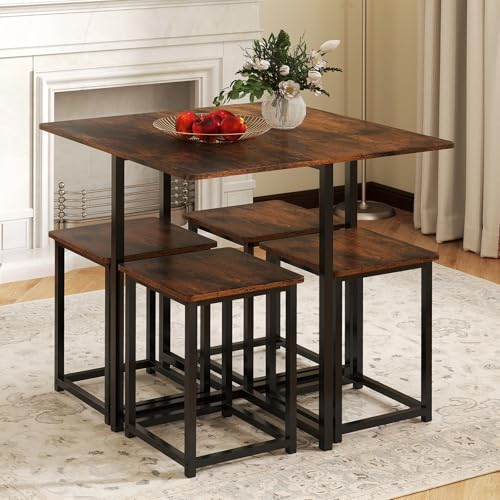
Tangkula Compact Dining Table Set for 4, Small Kitchen Table Set with Square Stools and Metal Frame, Perfect for Small Spaces, Home Kitchen Bar and Apartments
Check price on AmazonWhat Makes a Dining Table "Compactable"?
A compactable dining table is built around one idea: the table should take up less room when you are not using it. Unlike a fixed table that permanently claims floor space, a compactable design uses a mechanical system — folding legs, hinged leaves, or nesting frames — to reduce its footprint between meals. For anyone researching dining tables before buying, this category solves the most common small-space problem: hosting a proper sit-down meal without blocking a doorway, kitchen walkway, or living area for the rest of the day.
The term covers several distinct designs. Folding dining tables collapse entirely, often with legs that swing flat against the tabletop. Drop-leaf tables keep a fixed central base and fold down one or both side panels. Nesting tables are smaller tables that slide or stack together, so you can pull out extra surface only when guests arrive. Extendable tables add length through a leaf mechanism rather than folding, which is a related but different approach covered in our extendable six-to-eight seater guide.
The right choice depends on how often you fold the table, how many people you seat at peak, and how much visual stability you want in your dining room. A table that folds daily needs different hardware than one that folds twice a year for holidays.
The Main Types of Compactable Dining Tables
Each compactable mechanism trades off slightly differently between stowability, stability, and setup effort. The table below summarizes the four core types so you can match one to your routine.
| Type | How It Compacts | Best For | Stability Tier |
|---|---|---|---|
| Folding dining table | Legs fold flat against the top; table stores upright | Studios, temporary dining setups, rooms that need to revert to open floor | Entry-level to mid-range |
| Drop-leaf table | Side leaves hinge down along a fixed central frame | Daily compact dining with furniture-grade looks | Mid-range to premium |
| Nesting table set | Smaller tables slide under or stack with the main table | Flexible seating for two to four with occasional overflow | Mid-range |
| Gateleg / butterfly table | Leaves supported by swing-out gate legs | Narrow rooms where a full table only appears at mealtimes | Mid-range to high-end tier |
If you want a deeper look at folding-specific models, our wooden folding dining table guide covers frame construction and hinge quality. For drop-leaf layouts that include chair storage, see the drop-leaf table with chair storage guide. Round drop-leaf versions suit corner placements especially well, which we break down in the round drop-leaf dining table guide.
Folding Dining Tables: Maximum Stowability
Folding tables are the most compactable option on the market. The legs collapse against the underside of the top, and the whole unit can be carried to a closet or leaned against a wall. This makes them the strongest choice when the dining area must disappear completely — a studio apartment, a converted garage, or a room that doubles as a home office.
The trade-off is rigidity. Entry-level folding tables often use lighter frames and simpler locking joints, so they may flex slightly under heavy dishes or enthusiastic diners. Mid-range and premium folding tables add cross-bracing, thicker aprons, and locking leg mechanisms that bring stability much closer to a fixed table. When comparing models, check three things: the leg locking system, the apron depth, and whether the tabletop is solid wood or a veneered panel. A solid build with reinforced hardware is a long-term investment that will not need replacing after a few years of daily folding.
Folding tables pair naturally with bench seating, which stores flat underneath. Our dining table bench with storage guide shows how to combine a folding table with hidden storage for linens and small tableware. For narrow footprints, the narrow dining table guide explains how slim profiles still accommodate larger groups.
Drop-Leaf Tables: Furniture-Grade Compactability
Drop-leaf tables are the most popular compactable design for permanent dining rooms because they look like conventional furniture. A central fixed section stays in place, and one or two hinged leaves fold down to narrow the table by a third or more. When the leaves are up, the table often seats four to six comfortably; when folded, it can sit against a wall and function as a console or a two-person breakfast spot.
The key quality marker is the hinge and support system. Premium drop-leaf tables use heavy-duty hinges and support legs that lock into position, so the raised leaf feels as solid as the fixed center. Mid-range models are usually reliable for daily use. Entry-level drop-leaf tables may use lighter hinges that are fine for occasional meals but can loosen over time. If you plan to raise and lower the leaf every day, prioritize the hinge specification over decorative details.
Drop-leaf designs are especially useful in narrow rooms. A table with both leaves down can hug a wall, freeing walkway space, while still being ready for dinner in seconds. The walnut drop-leaf dining table guide covers how darker hardwoods hide wear and hold up to repeated folding. For very small dining rooms, the small dining room table for six guide explains how to seat a full family without a permanently large footprint.
Nesting Tables: Flexible Surface, Minimal Footprint
Nesting dining tables take a different approach. Instead of one table that shrinks, you get a main table plus one or more smaller tables that slide underneath or stack alongside it. In everyday use, the main table is the dining surface. When guests arrive, the nested tables pull out and join the arrangement, adding seating and surface area. When the meal is over, everything slides back together into a fraction of the expanded footprint.
Nesting sets are a strong fit for two-person households that occasionally host four to six people. They are also useful in open-plan spaces where the dining table doubles as a workspace during the day. The main table stays put, and the secondary tables appear only when needed. Our nesting dining table set guide covers stack height, matching finishes, and how to keep nested tables from scratching each other. For an even more space-conscious setup, the nesting dining table and chairs guide explains how chairs can nest alongside the tables.
One practical note: nesting tables work best when the main table is large enough for daily use and the nested tables are reserved for overflow. If you find yourself pulling out the nested tables at every meal, a drop-leaf or extendable design may be the better long-term choice.
Sizing and Layout: The Math Before You Buy
Compactable tables still need breathing room. The most common buying mistake is choosing a table that fits the room on paper but leaves no clearance for chairs and walkways. Before you commit to a model, work through these measurements.
- Seating clearance: allow at least 24 inches (about 60 cm) of table edge per seated person, and 30 inches (about 76 cm) of space behind each chair for pushing back.
- Walkway clearance: keep at least 36 inches (about 91 cm) between the table edge and any wall, cabinet, or doorway you need to pass through.
- Expanded footprint: measure the table with every leaf up and every nested section pulled out — not just in its compact position.
- Storage space: a folding table needs a closet, wall lean, or under-bed space when stored. Confirm that space exists before buying.
For two-person households, a two-person dining table is often enough, and our two-person dining table guide covers proportions that do not overwhelm a small room. If you need four seats in a tight footprint, the four-seater dining table for small space guide walks through compact configurations. Larger households can review the round pedestal dining table guide for a compact base that seats more people than its footprint suggests.
Materials and Hardware That Survive Repeated Folding
A compactable table is a mechanical object, so the materials matter more than on a fixed table. The folding or hinging action puts stress on joints, hinges, and leg locks every time you use the table. Prioritize construction over surface appearance.
- Solid hardwood frames — oak, walnut, and similar dense hardwoods resist loosening at hinge points better than softwoods or particleboard.
- Reinforced hinges — look for metal hinges with multiple screw points and, on drop-leaf tables, locking support arms.
- Locking leg mechanisms — on folding tables, a positive lock prevents the table from collapsing mid-meal.
- Durable finishes — a matte or oiled finish hides fingerprints and minor scuffs from frequent handling better than a high-gloss surface.
If you are comparing surface options, our materials and finishes resources explain how different coatings hold up to daily contact. For hardwood-specific guidance, the solid oak dining table guide covers grain, hardness, and finish compatibility. A compactable table in a premium material is a long-term investment: the mechanism and the wood age together rather than the hardware failing first.
Matching the Table to Your Room and Routine
The best compactable table is the one that matches how your room actually gets used. Consider these common scenarios:
- Studio apartment: a folding table that stores upright is the most flexible choice. Pair it with a bench or stackable chairs so the dining zone can disappear completely.
- Small dedicated dining room: a drop-leaf table keeps a furniture-grade look while freeing wall space. Raise one leaf for daily meals and both for guests.
- Open-plan living and dining: a nesting set lets the dining surface expand for dinner and contract for daily living, without moving furniture.
- Kitchen nook: a small round or square drop-leaf table fits corners and seats two to four without blocking cabinet doors.
If your dining area is a corner, the corner dining table set guide explains how L-shaped or corner-hugging layouts maximize seating. For a breakfast-bar feel, the high-top dining table with chairs guide covers taller compactable options that suit narrow kitchens.
Care and Maintenance for Folding and Hinged Tables
Compactable tables need slightly different care than fixed tables because moving parts accumulate dust and stress. A simple routine keeps the mechanism smooth and the surface protected.
- Wipe hinge areas monthly and apply a small amount of dry lubricant if the mechanism feels stiff.
- Tighten hinge and leg-lock screws every few months — loose hardware is the most common cause of wobble.
- Use felt pads under nested tables and chairs to prevent scratches during sliding and stacking.
- Avoid dragging the table when it is expanded; lift and reposition instead to protect the locking joints.
Our care and maintenance hub covers surface-specific routines for wood, laminate, and glass. If the table lives near a window, the sunlight fade prevention guide explains how to protect the finish from UV damage. For routine upkeep, the dining table routine upkeep guide is a practical checklist you can adapt to any compactable model.
Compactable Dining Table Buying Checklist
Use this checklist to compare models before you commit. It focuses on the details that separate a table that lasts from one that loosens after a season of use.
- Measure the expanded footprint — not just the compact size. Confirm chair clearance and walkway width.
- Choose the mechanism by frequency of use — folding for daily stowage, drop-leaf for daily compact dining, nesting for occasional overflow.
- Check the hardware specification — reinforced hinges, locking leg mechanisms, and solid mounting plates.
- Confirm the seating count — compare compact and expanded seating capacity against your typical and maximum guest count.
- Review the frame material — solid hardwood frames outperform particleboard at hinge and leg joints.
- Plan storage — folding tables need a storage spot; nesting tables need floor clearance for the nested sections.
- Match the finish to your routine — matte and oiled finishes hide handling marks better than high-gloss surfaces.
If you are still deciding between designs, our first dining table checklist covers the broader purchase process. For space planning, the dining table space planning guide explains how to map clearance zones before you order. And if you are weighing a folding table against a fixed small table, the small square dining table guide shows how fixed compact tables compare in stability and setup effort.
Frequently Asked Questions
What is a compactable dining table?
A compactable dining table is designed to reduce its footprint when not in use. It does this through folding legs, drop-leaf panels, or nesting sections that slide or stack together. The result is a table that can host a full meal and then free the floor space afterward.
Is a folding or drop-leaf table better for small spaces?
Folding tables store completely and are the best choice when the dining area must disappear. Drop-leaf tables stay in place but fold down their side panels, which usually gives a more stable, furniture-grade feel. Choose folding for stowability and drop-leaf for permanent placement with flexible width.
How many people can a compactable dining table seat?
Most compactable tables seat two to four people in their compact position and up to six when fully expanded, depending on the width and the number of leaves or nested sections. Always check the expanded seating capacity against your maximum guest count.
Do compactable dining tables wobble?
Entry-level folding tables can feel less rigid because of lighter frames and simpler joints. Mid-range and premium models use reinforced hinges, locking leg mechanisms, and solid hardwood frames to stay stable during daily use. Hardware quality is the biggest factor.
How do I choose the right compactable dining table?
Measure your room and walkway clearance first, decide your maximum seating count, then choose the mechanism that matches how often you will fold the table. Prioritize a solid frame, smooth hardware, and a finish that suits your care routine.
Can a compactable table be used outdoors?
Only if the table is explicitly rated for outdoor use. Folding tables made from weather-resistant materials and rust-proof hardware can work on patios, but most indoor compactable tables should stay inside to protect the hinges and finish.