
60-Inch Extendable Dining Table: The Complete Buying Guide
A 60-inch extendable dining table is the sweet spot for households that need comfortable everyday seating without giving up the ability to host. This guide explains sizing, extension mechanisms, materials, and room planning so you can choose with confidence.
Explore Recommended ModelsWhy a 60-Inch Extendable Dining Table Works So Well
Sixty inches is a practical middle ground in dining furniture. It is long enough to seat a family of four with generous elbow room, yet compact enough to fit comfortably in most dining rooms, eat-in kitchens, and open-plan layouts. The extendable feature adds a second layer of flexibility: the table stays compact for daily life and grows when guests arrive for holidays, dinners, or celebrations.
This dual-purpose design is why so many buyers researching an extendable dining table with folding chairs end up choosing a 60-inch footprint. The closed length fits standard rooms, while the extension adds meaningful seating without requiring a permanent second table.
Compared with fixed tables, an extendable model at this size rarely feels oversized. Compared with smaller 48-inch tables, it offers noticeably better comfort for four adults and a smoother path to six-seat hosting. For rooms where a larger footprint is possible, an extendable dining table with folding chairs bundle can further reduce storage pressure when the table is not in use.
Seating Capacity: What 60 Inches Really Means
Seating capacity depends on table length, table width, and chair style. A 60-inch extendable dining table is typically around 36 to 40 inches wide, which allows two people to sit opposite each other on the long sides without crowding. Short ends are best reserved for occasional seating or benches.
| Configuration | Typical Seating | Best For |
|---|---|---|
| Closed, 60 inches | 4 to 5 people | Daily family meals, work-from-home use |
| One leaf engaged | 6 people | Weekend dinners, small gatherings |
| Two leaves engaged | 6 to 8 people | Holidays, larger celebrations |
| With bench on one side | 6 to 7 people | Casual family setups, farmhouse interiors |
If your household regularly hosts eight or more diners, a 60-inch table with two leaves can work, but consider whether a dedicated larger table or a 10-seat farmhouse dining table better matches your hosting frequency. For most homes, however, the 60-inch extendable format covers the vast majority of occasions.
Chair choice matters as much as table length. Upholstered chairs with arms take more room than armless side chairs, so measure both chair width and pull-out clearance before finalizing your layout. A 6-seat round outdoor dining table offers a sociable alternative for covered patios, while a rectangular 60-inch extendable model remains the most efficient shape for indoor wall placement.
Extension Mechanisms Compared
The extension mechanism is the most important functional difference between models. It affects how often you will actually use the extension, how much storage you need, and how the table holds up over years of use.
Butterfly Leaf
A butterfly leaf folds in half and stores inside the table body. It is the most convenient option for frequent expansion because the leaf travels with the table and cannot be misplaced. Most butterfly-leaf models use a smooth sliding mechanism that one person can operate.
Self-Storing Leaf
A self-storing leaf slides underneath the tabletop when not in use. It is nearly as convenient as a butterfly leaf and often found on mid-range and premium models. The trade-off is slightly more complex hardware, which is worth inspecting for smoothness before purchase.
Separate Leaf
A separate leaf must be stored elsewhere, such as a closet or under a bed. This is common on entry-level models and on some traditional designs. It is perfectly workable if you only extend the table a few times a year, but it adds friction for frequent hosts.
Drop-Leaf Design
Drop-leaf tables fold down on hinged panels rather than using a central leaf. They are excellent for very compact spaces, but they are a different category from a true 60-inch extendable table and usually offer less seating at full extension.
Whichever mechanism you choose, test it in person if possible. A well-engineered extension should glide without binding, lock firmly into place, and leave no visible gap at the seam. For tables that will be used daily, a round pedestal extending dining table is worth considering as an alternative layout that keeps legroom unobstructed.
Materials and Finish Options
Material choice affects durability, repairability, weight, and how the table interacts with your interior. For an extendable table, weight distribution matters more than on a fixed table because the extension hardware must support the leaves and the diners seated on them.
Solid Hardwood
Oak, walnut, and maple are the most common solid hardwood options. They are durable, repairable, and age gracefully. A walnut wood dining table set brings a rich, warm tone that pairs well with both modern and traditional interiors, while oak offers a lighter, more versatile look.
Stone and Quartz Tops
Marble and quartz tops deliver a polished, contemporary appearance. A marble quartz dining table is resistant to staining and easy to wipe clean, but it is heavy, so confirm that the extension hardware is rated for the load. Stone tops rarely extend as smoothly as wood tops because of the added mass.
Pine and Softwood
Pine is a popular choice for farmhouse and cottage styles. A white pine dining table offers a bright, casual look that suits informal dining rooms. Softwoods dent more easily than hardwoods, so they suit households that prefer a lived-in patina over pristine surfaces.
Finishes
Matte and oiled finishes feel natural and hide minor scratches well. Lacquered and glossy finishes are easier to clean but show wear more readily. For extendable tables, pay attention to the finish on the leaf seam, since repeated opening and closing can wear that area faster than the rest of the surface.
Room Planning and Clearance
A 60-inch table needs breathing room to function well. The most common mistake is measuring only the table footprint and forgetting the space required for chairs, walkways, and the extension itself.
- Chair pull-out: Allow at least 30 inches between the table edge and the nearest wall or furniture so diners can pull chairs out comfortably.
- Walkway clearance: Keep at least 36 inches for primary traffic paths and 44 inches or more where people regularly pass behind seated diners.
- Extension space: Measure the fully extended length and confirm there is room for it, including chair clearance at the extended ends.
- Buffet and sideboard spacing: Leave enough room to open cabinet doors and serve food without squeezing past seated guests.
In narrow rooms, orient the table so the long side runs parallel to the longest wall. This preserves walkway width and keeps the extension pointing toward open floor space rather than a doorway. If your room is genuinely tight, a 48-inch dining table may be a better starting point, with the 60-inch extendable model reserved for rooms with a bit more depth.
For corner placements, a corner dining set with round table can solve awkward layouts, but a rectangular 60-inch extendable table remains the most space-efficient option for straight-wall dining areas.
Quality Tiers: What to Expect at Each Level
Extendable tables vary widely in build quality. The tiers below describe relative market positioning rather than any specific figure, and they help set realistic expectations about hardware, materials, and longevity.
| Tier | Typical Characteristics | Best For |
|---|---|---|
| Entry-level | Veneered tops, basic sliding hardware, separate leaf storage | Occasional use, first apartments, guest rooms |
| Mid-range | Solid wood or quality veneer, smoother self-storing leaf, reinforced aprons | Daily family use, regular hosting |
| Premium | Solid hardwood throughout, precision butterfly leaf, refined joinery | Long-term daily use, design-focused interiors |
| Luxury | Premium hardwoods or stone tops, artisan finishing, heavy-duty hardware | Statement dining rooms, frequent entertaining |
Mid-range models usually offer the best balance for most households. The hardware is smoother than entry-level options, the materials hold up better to daily use, and the extension mechanism is designed for regular operation rather than occasional use. Premium and luxury tiers add refinement and longevity, but the practical difference in everyday function is smaller than the jump from entry-level to mid-range.
Care and Long-Term Durability
An extendable table has moving parts, so maintenance goes beyond wiping the surface. A few simple habits keep the mechanism working smoothly for years.
- Keep the mechanism clean: Dust and crumbs work their way into tracks. Vacuum or brush the tracks periodically and avoid letting spills dry inside the hardware.
- Lubricate sparingly: Use a dry lubricant recommended by the manufacturer. Excess oil attracts dust and can stain wood.
- Protect the leaf seam: Place mats and coasters over the seam area to reduce wear and moisture exposure.
- Control humidity: Solid wood expands and contracts with humidity. Keep indoor humidity reasonably stable to prevent the leaf from fitting too tightly or too loosely.
- Lift, do not drag: When moving the table, lift it rather than dragging it, especially on hardwood floors.
For a deeper dive into surface protection, see our guide on dining table care and maintenance.
Frequently Asked Questions
How many people can sit at a 60-inch extendable dining table?
A 60-inch extendable dining table typically seats four to six people in its closed position, depending on the width and seating arrangement. When fully extended with one or two leaves, most models comfortably accommodate six to eight diners.
Is a 60-inch extendable dining table good for small dining rooms?
Yes. A 60-inch table is one of the most versatile sizes for compact and mid-size dining rooms because it works well for daily use with four seats and expands only when guests arrive, freeing floor space the rest of the time.
What is the difference between a butterfly leaf and a self-storing leaf?
A butterfly leaf folds in half and stores inside the table, making it convenient for frequent expansion. A self-storing leaf slides underneath the tabletop, while a separate leaf must be stored elsewhere when not in use.
Which material is best for a 60-inch extendable dining table?
Solid hardwood such as oak or walnut offers the best balance of durability and repairability for extension mechanisms. Stone and glass tops suit modern interiors but are heavier, so the extension hardware must be rated for the added load.
Can a 60-inch extendable table replace a larger fixed table?
For most households, yes. A 60-inch table with two leaves covers everyday dining and most hosting occasions. Only households that regularly seat eight or more diners should consider a permanently larger table.
Recommended 60-Inch Extendable Dining Tables
⚠️ AFFILIATE DISCLOSURE: This website contains affiliate links. As an affiliate Associate, we earn from qualifying purchases. If you make a purchase through these links, we may receive a small commission at no additional cost to you. Read our full affiliate policy.
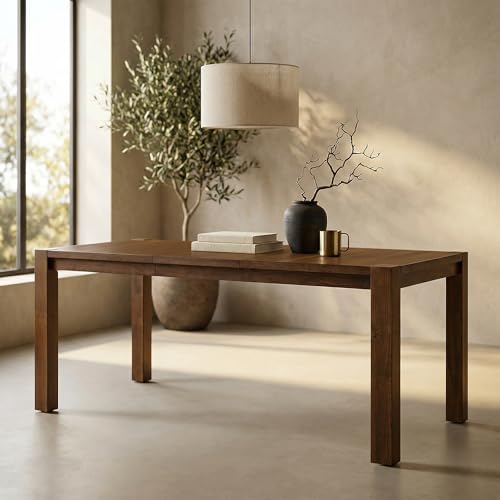
Farati 60"-80" Extendable Dining Table, Modern Rectangular Wood Kitchen Table, Farmhouse Expandable Dinner Table, Traditional Large Extension Meeting Desk for Dining Room, Living Room, Walnut
Check price on Amazon
Farati 60"-80" Extendable Dining Table, Modern Rectangular Wood Kitchen Table, Farmhouse Expandable Dinner Table, Traditional Large Extension Meeting Desk for Dining Room, Living Room, Black
Check price on Amazon
AllForWood 60" - 85"" Extending Dining Table Wood with Wood Base for 4 6 8 People Large
Check price on Amazon
Merax 7-Piece Extendable Wood Dining Table Set, 60"-78" Farmhouse Rustic Rectangular Table & 6 Linen Upholstered Chairs, Solid Rubberwood Legs, 350 lbs Capacity for Dining Kitchen Room, Walnut+Beige
Check price on Amazon
Garvee 63-83" Extendable Dining Table, Expandable Kitchen Table, Brown | 63-83" Extendable Dining Table, Expandable Kitchen Table For 10, Heavy Duty Metal Frame, Smooth Glide
Check price on Amazon
59"-86" Extendable Dining Table for 6-8 Person, Wooden Dining Room Table, Modern Extendable Table for Gatherings, Meeting for Small Kitchens, Dining Office Areas(Walnut)
Check price on Amazon
60" Extendable Drop Leaf Dining Table Set with 4 Leather Chairs,Storage,5 Pcs Rectangle Foldable Kitchen Table and Chairs Set for 4-8 People,6 Wheels,Folding Table Set for Small Space Saving,Brown
Check price on Amazon
Epecoya 59-Inch Extendable Dining Table, Kitchen Table for 4-6 People | Farmhouse Wood Space-Saving Expandable Dinner Table, Round to Oval Pedestal Dining Table, Dark Brown Walnut
Check price on AmazonReady to Choose Your 60-Inch Extendable Dining Table?
You now understand the sizing, mechanisms, materials, and room planning that matter most. Use the recommended models above as a starting point, then compare features against your household's daily needs and hosting habits.
Compare Available Options