
6 Foot Dining Table With Leaf: The Complete Buying Guide
A six-foot table seats six comfortably, but add a leaf and it becomes a true hosting table. Learn how leaf types, materials, and frame construction decide whether your table stays rock-solid when fully extended.
Explore Recommended TablesWhy this guide matters: A 6 foot dining table with leaf sits in a sweet spot — compact enough for everyday family meals, generous enough for holidays and guests. But not every extendable table is built to hold a firm, flat surface once opened. This guide breaks down the exact measurements, leaf mechanisms, and frame details that separate a table that lasts from one that wobbles.
What Is a 6 Foot Dining Table With Leaf?
A 6 foot dining table measures roughly 72 inches (about 183 cm) in length in its closed position. That length comfortably accommodates six place settings — three on each long side — with enough elbow room for plates, glasses, and serving dishes. When you add a leaf, the table surface extends, typically by 12 to 24 inches, pushing the length into the 84 to 96 inch range.
The leaf itself is a removable or folding panel that slots into the table's center gap. It is the mechanism that turns a standard family table into an event table without forcing you to buy a second piece of furniture. For households that host occasionally but do not want a permanent oversized table, this is one of the most practical formats available.
If you are still comparing shapes and formats, our broader guide to square tables with butterfly leaf explains how leaf systems adapt to different footprints, and the extendable dining table guide covers the full category of expandable designs.
Closed vs. Extended: The Real Seating Math
Understanding seating capacity at each stage helps you plan your room before you buy. The table below uses standard 24-inch-per-person placement, which is the accepted minimum for comfortable dining.
| Configuration | Typical Length | Comfortable Seating | Best For |
|---|---|---|---|
| Closed (no leaf) | 72 inches | 6 people | Daily family meals |
| Single leaf extended | 84–90 inches | 8 people | Weekend hosting, holidays |
| Dual leaf extended | 96–108 inches | 8–10 people | Large gatherings, events |
Notice that the jump from six to eight seats is the most meaningful in practice. Most families rarely need ten seats, which is why a single-leaf six-footer covers the majority of hosting scenarios. Dual-leaf designs exist for larger households, but they demand a longer room and a sturdier base.
Leaf Types: Butterfly, Drop Leaf, and Removable Panels
The leaf mechanism is the single most important detail on an extendable table. Each type behaves differently in daily use, and the right choice depends on how often you open the table and how much storage space you have.
Butterfly Leaf
A butterfly leaf is split into two halves that fold and store inside the table body. When you pull the table ends apart, the leaf unfolds and flattens into the gap. No separate storage is required, and there is no risk of losing the leaf. This is the most popular mechanism on mid-range and premium six-foot tables. The trade-off is that the internal storage cavity adds weight and slightly reduces the apron depth.
Removable Center Leaf
A single solid panel that you lift out of storage and slot into the table's center. These are common on traditional wood tables and entry-level to mid-range models. They are simple and reliable, but you must store the leaf somewhere — a closet, under a bed, or behind a sofa. The upside is that a well-made solid leaf is easy to align and creates a seamless surface when seated correctly.
Drop Leaf
Drop leaves hinge on the table edges and fold downward when not needed. They extend the table's width or partial length rather than adding a full center section. Drop leaves are common on small-space tables and are convenient for everyday use, but they typically do not extend a six-footer into a true eight-seat table. They work best as a secondary expansion option.
Buying tip: Ask whether the leaf is self-storing. Self-storing butterfly leaves are the most convenient for households that open and close the table frequently. If you only extend the table a few times per year, a removable solid leaf is perfectly adequate and often more stable.
Frame and Base Construction: Where Stability Is Won
An extended table is a lever arm. The longer the surface, the more stress is placed on the frame, apron, and legs. This is why construction quality matters more on an extendable table than on a fixed one.
- Reinforced aprons: Look for a steel or hardwood apron that runs the full length of the table. Thin aprons flex when the leaf is in place.
- Locking mechanisms: A quality table locks the two halves together when extended. Without a lock, the table can slide apart under weight.
- Leg placement: Legs set at the corners support the extended surface; pedestal bases need a wide enough footprint to prevent tipping when a leaf is added.
- Alignment hardware: Metal alignment pins or dowels keep the leaf flush with the main surface. Plastic alignment parts wear out faster.
For a deeper look at how legs and pedestals affect stability, our dining table leg guide and pedestal guide explain the structural differences in detail.
Materials: Matching the Leaf to the Table Body
The leaf should match the table body in material, finish, and grain direction. Mismatched leaves are a common complaint on lower-tier tables, where the leaf is sourced from a different batch of wood.
| Material | Leaf Suitability | Durability Tier | Best For |
|---|---|---|---|
| Solid oak | Excellent — stable grain, holds alignment well | Premium | Long-term family use |
| Solid pine | Good — lighter, may show dents | Entry-level to mid-range | Casual, rustic settings |
| Walnut | Excellent — dense, holds shape | High-end tier | Formal dining rooms |
| Engineered wood with veneer | Moderate — veneer edges can chip at the seam | Entry-level | Occasional hosting |
| Marble or stone top | Requires heavy-duty frame; leaf seam is visible | Luxury | Statement dining rooms |
Solid hardwood tables handle leaf seams best because the material expands and contracts predictably with humidity. Engineered tops are more prone to visible gaps at the leaf joint over time. If you want a natural wood finish, our solid pine wood dining table guide and solid oak dining table guide cover the care differences between these two popular woods.
Room Planning: How Much Space a Six-Footer Needs
A 72-inch table needs at least 36 inches of clearance on all sides for chairs to pull out comfortably. That means a minimum room dimension of roughly 12 feet by 10 feet for the closed configuration. When extended to 90 inches, you need closer to 13.5 feet of length.
Closed configuration
Plan for a 12 ft × 10 ft footprint with walkway space around the table.
Extended configuration
Plan for a 13.5 ft × 10 ft footprint to keep chair pull-out and walkways clear.
Walkway clearance
Keep at least 36 inches between the table edge and any wall or furniture for comfortable movement.
For a full breakdown of clearance rules, see our dining table space planning guide and walkway clearance guide.
Care and Maintenance for Leaf Tables
Leaf seams are the most common wear point on extendable tables. Dust and crumbs collect in the joint, and repeated opening and closing can wear the alignment hardware. A few habits keep the table working smoothly for years.
- Clean the leaf seam with a soft brush or vacuum attachment before closing the table.
- Store removable leaves flat, not on edge, to prevent warping.
- Apply a furniture wax or oil to the leaf edges to reduce friction at the seam.
- Check the locking mechanism every few months and tighten any loose hardware.
- Use a table pad under hot dishes, especially near the leaf joint.
Our dining table routine upkeep guide and table pad protection guide expand on these habits with material-specific steps.
How to Choose: A Quick Decision Framework
Use the checklist below to narrow your options before you shop. Each item maps to a feature you can verify on the product page or in person.
- Seating target: Six daily, eight for hosting? Choose a single-leaf six-footer. Ten or more? Look at dual-leaf designs.
- Leaf storage: No closet space? Prioritize a self-storing butterfly leaf.
- Material: Solid hardwood for long-term durability; engineered tops for lighter use.
- Frame: Confirm a reinforced apron and a locking mechanism.
- Room size: Measure the extended length, not just the closed length.
- Style: Match the leaf finish to the table body to avoid visible seams.
If you prefer a natural wood look, the pine dining table and chairs set guide and black wood dining table set guide show how leaf tables fit different aesthetic directions. For larger households, the oak dining table 10-seater guide explains when to skip the leaf entirely and buy a permanent large table instead.
Common Mistakes to Avoid
- Buying by closed length only: The extended length is what determines whether your room works for hosting.
- Ignoring leaf storage: A removable leaf with no storage plan ends up leaning against a wall or getting damaged.
- Choosing a thin apron: Thin aprons flex under the weight of an extended table, causing a visible dip at the seam.
- Mismatched finishes: A leaf from a different production batch can look slightly different in tone under certain lighting.
- Skipping the lock test: Always confirm the table locks firmly when extended before purchasing.
Recommended 6 Foot Dining Tables With Leaf
⚠️ AFFILIATE DISCLOSURE: This website contains affiliate links. As an affiliate Associate, we earn from qualifying purchases. If you make a purchase through these links, we may receive a small commission at no additional cost to you. Read our full affiliate policy.

86 in Extendable Dining Table for 6 8 10 People,59"-86" Farmhouse Rectangle Extending Dining Table w/Removable Leaves Space Saving,Wooden Adjustable Tables for Kitchen Office Living Room (Brown)
Check price on Amazon
71-87 Inch Extendable Dining Room Table, Rustic Wooden Kitchen Table 6-10 | STHOUYN Expandable Dining Table, Farmhouse Rustic Style, Rectangular Wooden Top, Seats 6-10, Brown Kitchen or Dining Room
Check price on Amazon
86 in Extendable Dining Table for 6 8 10 People,59"-86" Farmhouse Rectangle Extending Dining Table w/Removable Leaves Space Saving,Wooden Adjustable Tables for Kitchen Office Living Room (Brown&Black)
Check price on Amazon
MECHYIN 55"-71" Extendable Dining Table for 4-8 with Built-in Flip Leaf | Space‑Saving Modern Rectangle Dining Table, Built‑in Flip Leaf, Sturdy Metal Legs, for Kitchen & Dining Room,Small Apartments
Check price on Amazon
MUXIAOYU 59" Drop Leaf Foldable Dining Table with Storage, Dark Walnut | Foldable Design, 300Lbs Capacity, 2 Storage Cabinets, Lockable Wheels, Movable, for Kitchen Living Room Small Spaces
Check price on Amazon
Signature Design by Ashley Galliden Extendable Dining Table with Leaves | Seats 10 Guests, 120-Inch Max Length, 2 Removable Leaves, Thick Rustic Oak Veneer, Hardwood Solids, Trestle Base
Check price on Amazon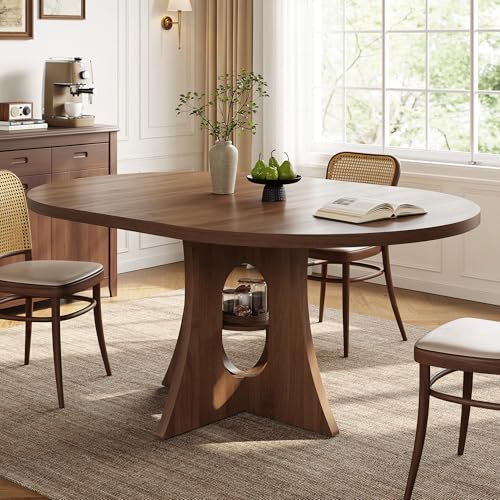
Sanyz 43.3"-59" Extendable Round-to-Oval Dining Table with Leaf & Storage | Oval Table, Round Kitchen Table, Seats 4-8, Modern Farmhouse, Space-Saving, Walnut Finish, Circle Table, Oval Dining Table
Check price on Amazon
Signature Design by Ashley Moriville Counter Height Dining Extension Table | Farmhouse Dining Table Style, Veneers, Wood and Engineered Wood, Removable Drop-In Leaves, Seats Up to 8
Check price on AmazonFrequently Asked Questions
How many people can a 6 foot dining table with leaf seat?
A standard 6 foot dining table seats six comfortably. With a leaf extended, most models accommodate eight, and some designs with dual leaves can seat up to ten when fully opened.
What is the difference between a butterfly leaf and a drop leaf?
A butterfly leaf folds and stores inside the table body, keeping the surface self-contained. A drop leaf hinges on the table edge and folds downward, adding partial width rather than full-length extension.
Do table leaves affect stability?
Quality tables with reinforced aprons and locking mechanisms maintain stability when extended. Entry-level tables may show slight flex when fully opened, so check frame construction before choosing.
Should the leaf match the table finish?
Yes. A leaf from a different production batch can look slightly different in tone. Always confirm the leaf and table body share the same finish and grain direction.
Can a 6 foot table with leaf fit in a small dining room?
It can if the room is at least 12 feet by 10 feet for the closed configuration. Extended, you need closer to 13.5 feet of length. Measure the extended length before buying.