
Travertine Rectangular Dining Table: Complete Buying Guide
Bring warmth, texture, and architectural character to your dining room with a travertine rectangular dining table. Learn how to choose the right slab, size, base, and finish before you invest.
EXPLORE TRAVERTINE TABLESWhy travertine stands out: Travertine is a natural sedimentary stone with a warm, earthy palette and a distinctive porous surface. A rectangular travertine dining table blends the organic look of natural stone with the practical, sociable layout of a classic rectangular top — making it a strong choice for dining rooms that balance elegance with everyday function.
This guide walks you through material grading, sizing, base options, edge profiles, styling, and long-term care so you can decide with confidence before you buy.
Recommended Travertine Rectangular Dining Tables
⚠️ AFFILIATE DISCLOSURE: This website contains affiliate links. As an affiliate Associate, we earn from qualifying purchases. If you make a purchase through these links, we may receive a small commission at no additional cost to you. Read our full affiliate policy.

55" Travertine Rectangular Dining Table for 4, Modern Kitchen Table | Sintered Stone Top Dining Room Table, Walnut Veneer Dual-Legs, Scratch & Heat Resistant, for Dinner (Table Only)
Check price on Amazon
ModernMate 84" Travertine Dining Table, Rectangular Natural Oak Veneer Base | 84" Rectangular Modern Dining Room Table, Natural Travertine Stone Top Meets Oak Veneer Base
Check price on Amazon
ModernMate 72" Travertine Dining Table, Rectangular Natural Oak Veneer Base | 72" Rectangular Modern Dining Room Table, Natural Travertine Stone Top Meets Oak Veneer Base
Check price on Amazon
Honyee Sintered Stone Dining Table for 6–8, 78.7" Rectangular Kitchen Table, Real Travertine Top, Rounded Corners, Walnut Pedestal Base, Large Modern Dining Room Table
Check price on Amazon
GDFStudio Oval Extendable Dining Table for 4-8, Travertine Inspired Kitchen Table, Wooden Strip Base, 63" to 79" Modern Kitchen Furniture with Rounded Corners, Simple Elegant Design, Beige
Check price on Amazon
Meridian Furniture 702Travertine-T Cosenza Collection Art Deco 78" Indoor/Outdoor Concrete Dining Table with Travertine Finish, 78" W x 44.5" D x 30" H
Check price on Amazon
Meridian Furniture 701Travertine-T Cosenza Collection Art Deco 48.5" Indoor/Outdoor Concrete Dining Table with Travertine Finish, 48.5" W x 48.5" D x 30" H, Travertine
Check price on Amazon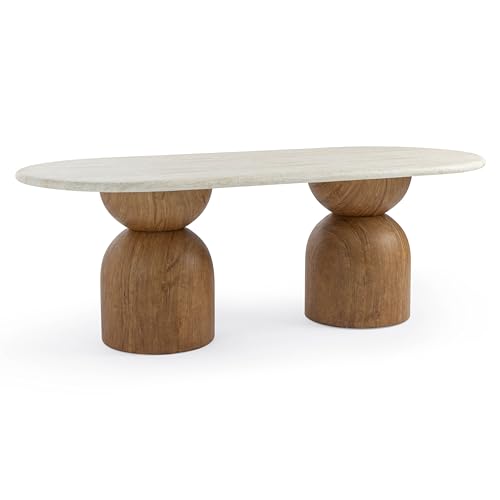
TOV Furniture Cynthia Travertine Concrete Indoor/Outdoor 87" Long Dining Table
Check price on AmazonWhat Makes a Travertine Rectangular Dining Table Different
Natural Texture With Architectural Presence
Travertine forms from mineral deposits around hot springs, which gives it its signature vein patterns, pitted surface, and soft, warm tones ranging from ivory and cream to walnut and silver-grey. Unlike polished marble, travertine often has a slightly matte or honed surface that reads as softer and more organic — ideal for dining rooms that lean rustic, Mediterranean, Japandi, or contemporary-natural.
The porous texture is part of travertine's charm. A filled and honed finish keeps the surface smoother and more practical for daily dining, while an unfilled, tumbled, or brushed finish leans into a more textured, tactile look.
Why the Rectangular Shape Works Well With Stone
A rectangular top gives you clear, usable seating along both long sides — a practical advantage for family meals and entertaining. When paired with a stone like travertine, the long horizontal plane also becomes a visual anchor for the room, balancing high ceilings and open-plan layouts.
Rectangular travertine tables typically accommodate 4, 6, or 8 diners with comfortable elbow room, and the straight edges make chair placement and table-setting straightforward. For narrower dining rooms, a rectangular travertine table also tends to line up neatly along walls and windows.
Travertine Grades and Surface Finishes Explained
Travertine is often described by quality tier and by how the surface is treated. Understanding these descriptors helps you match the table to your lifestyle — a busy family kitchen has different needs than a formal dining room used on weekends.
Entry-Level Grade
More visible pitting and greater tonal variation. Best suited to rustic and Mediterranean interiors where natural imperfection is part of the look.
Mid-Range Grade
Moderate veining with fewer open pores. A balanced choice for most dining rooms and a good middle ground between character and consistency.
Premium Grade
Tighter grain, more uniform coloration, and fewer filled areas. Well-suited to formal dining rooms and contemporary interiors that favor a cleaner look.
Luxury / Select Grade
Highly consistent slab selection with minimal visible pitting and refined veining. Typically paired with premium bases and precision edge work.
Common Surface Finishes
- Polished: Glossy, reflective, and the easiest to wipe clean. Adds a formal, hotel-like feel.
- Honed: Matte-satin finish with a smooth feel. Popular for contemporary and minimalist dining rooms.
- Filled & Honed: Pores filled with matching cement or resin, then honed. The most practical option for daily dining.
- Brushed / Tumbled: Textured and tactile, with a more rustic character. Better suited to lower-traffic dining areas.
- Unfilled: Open pores left visible. Beautiful but requires more attentive maintenance.
Sizing a Rectangular Travertine Dining Table
Getting the dimensions right is the single most important decision before you buy. A travertine top is heavy and typically custom-cut, so returns and exchanges are far less flexible than with wood or glass. Measure your room, chair footprint, and walkway clearance before committing.
| Seating Capacity | Typical Top Dimensions | Best For |
|---|---|---|
| 4 diners | Approximately 140–160 cm long, 80–90 cm wide | Smaller dining rooms, couples, compact apartments |
| 6 diners | Approximately 180–200 cm long, 90–100 cm wide | Family dining rooms, everyday entertaining |
| 8 diners | Approximately 220–240 cm long, 100–110 cm wide | Larger families, open-plan dining areas |
| 10 diners | Approximately 260–300 cm long, 100–110 cm wide | Formal dining rooms, holiday hosting |
Clearance and Walkway Rules of Thumb
- Allow roughly 60–75 cm of tabletop per diner along each long side for comfortable elbow room.
- Leave at least 90 cm between the table edge and the nearest wall or furniture for chair pull-out.
- Keep 100–120 cm of walkway behind occupied chairs where people pass behind diners.
- For 8-person layouts, cross-check your room against our standard dining table dimensions for 8 reference before finalizing a slab size.
If your dining area is tight, consider a rectangular travertine table with a pedestal or trestle base that keeps legs away from chair corners. Our guide to dining table space planning walks through the full measurement process step by step.
Base and Edge Options for Travertine Tops
Base Styles
- Pedestal base: Centered column or twin-pedestal design. Frees up chair space on all sides and suits longer rectangular tops.
- Trestle base: A-frame or trestle legs at each end. Rustic and farmhouse-friendly, with a wide footprint for stability under stone weight.
- Four-leg base: Classic and familiar. Works well on smaller rectangular tops where chair placement is predictable.
- Plinth / slab base: A solid pedestal or slab running under the length. Contemporary and architectural, often seen on high-end tier tables.
Because travertine slabs are heavy, base construction matters as much as the top. Look for reinforced steel or solid hardwood frames designed to support the slab's weight and reduce flex. Our dining table pedestal guide covers load distribution and stability in more detail.
Edge Profiles
Edge profile has a big effect on how a stone top reads visually. A straight, square edge looks minimal and modern; a bevel or eased edge softens the look; a bullnose edge feels rounded and safer with young children. A chiseled or split-face edge adds rustic character but traps crumbs and is harder to clean. For travertine, a lightly eased or beveled edge is a practical all-rounder.
Styling a Travertine Rectangular Dining Table
Room Pairings That Work
Travertine's warm, neutral palette pairs naturally with white oak, warm walnut, linen upholstery, rattan, and brushed brass. For a Mediterranean look, combine travertine with limewashed walls, terracotta accents, and natural fiber rugs. For a contemporary feel, contrast the stone's texture with clean-lined chairs in matte black or bouclé.
If you're drawn to modern minimalism overall, browse our modern dining table styles for chair and lighting pairings that complement a stone top.
Centerpieces and Table Linens
Travertine's texture means you don't need much on top. A low bowl of fruit, a simple ceramic vase, or a single sculptural object often reads best. If you prefer a styled look, our guides to dining table centerpieces and dining table runners cover proportion and layering.
For everyday protection, a rectangular tablecloth or a set of placemats keeps acidic foods and oils off the stone. See our dining table placemat guide for materials that pair safely with natural stone surfaces.
Caring for a Travertine Dining Table
Daily Care
- Wipe spills promptly with a soft, damp cloth and mild pH-neutral soap.
- Avoid acidic cleaners, vinegar, lemon juice, and bleach — they etch travertine.
- Use coasters and trivets for hot dishes and glasses; travertine is heat-resistant but not heat-proof.
- Blot, don't scrub, oily or colored spills to prevent staining.
Long-Term Protection
Sealing is essential for travertine, especially if the surface is honed or unfilled. A penetrating sealer applied every 6–12 months slows staining and gives you more working time on spills. Filled and honed surfaces are the easiest to live with day-to-day; polished surfaces are simple to wipe but can show etching more readily.
For a full maintenance routine, see our marble and stone sealing guide and dining table stain removal guide.
Travertine Rectangular Dining Table: Pros and Cons
| Strengths | Trade-offs to Plan For |
|---|---|
| Warm, natural palette that flatters many interiors | Heavy slab requires a sturdy base and careful delivery |
| Unique veining and texture on every table | Porous surface needs sealing and prompt spill cleanup |
| Rectangular shape supports easy seating and table-setting | Custom-cut slabs limit return options — measure twice |
| Durable, long-term surface when properly maintained | Acidic foods and cleaners can etch the finish |
| Reads as premium and architectural in a dining room | Colors and veining vary, so slab selection matters |
Buying Checklist Before You Order
- Confirm the actual top dimensions and seating capacity against your room measurements.
- Decide between filled and honed, polished, or textured finishes based on daily use.
- Check base construction and confirm it is rated for the stone slab's weight.
- Ask about edge profile and whether the edge is sealed.
- Confirm delivery access — door widths, stairs, and elevator dimensions.
- Review the care instructions and recommended sealer before delivery.
- Plan chair clearance so chairs tuck fully under the top when not in use.
For a broader pre-purchase checklist, see our first dining table checklist, and for common pitfalls our dining table buying mistakes guide.
Frequently Asked Questions
Is a travertine rectangular dining table suitable for everyday family use?
Yes, provided you choose a filled and honed finish and seal the surface. These finishes are smoother and less prone to trapping crumbs and spills, making them more practical for daily meals than unfilled or heavily textured travertine.
How does travertine compare to marble for a dining table?
Travertine has a warmer, softer look and a more matte texture, while marble typically offers a glossier, cooler finish. Both are porous stones that need sealing. Travertine tends to hide etching and light surface marks more gracefully than polished marble. Our marble dining table guide and marble vs granite comparison explain the differences in more detail.
Will a rectangular travertine table fit a narrow dining room?
Rectangular shapes usually suit narrow rooms well because the long side can sit parallel to a wall. Measure chair pull-out and walkway clearance carefully, and consider a pedestal base to free up space at the corners. Our narrow dining room furniture layout guide has room-specific tips.
How often should I seal a travertine dining table?
Most sealed travertine tops benefit from re-sealing every 6–12 months, depending on use and finish. A simple water test — a few drops of water on the surface — will show whether the sealer is still repelling liquid effectively.
Can I use a travertine table outdoors?
Travertine is used outdoors in many climates, but interior dining tables are usually not sealed or finished for consistent outdoor exposure. If you plan outdoor use, look for tables explicitly rated for exterior placement and follow the maker's care guidance.
What seating pairs well with travertine?
Natural materials and neutral tones work well: linen or bouclé upholstered chairs, warm wood chairs, and woven or cane-back designs. Contrasting matte black or brushed metal accents can sharpen a contemporary look. See our dining chair selection guide for sizing and comfort guidance.
Ready to Choose Your Travertine Dining Table?
Compare current travertine rectangular dining table options and find the size, finish, and base that fits your dining room.
VIEW AVAILABLE OPTIONS