
Round to Oval Extendable Dining Table: The Complete Buying Guide
One table, two shapes. Learn how a round to oval extendable dining table adapts from everyday family meals to full-house gatherings, and how to choose the right size, material, and mechanism for your dining room.
Why this table earns its place: A round to oval extendable dining table solves a very common conflict — you want a sociable, space-efficient round table for daily use, but you also need extra seating when guests arrive. The convertible design gives you the best of both shapes without committing to a permanent footprint. This guide explains exactly how the mechanism works, how much seating you gain, which materials hold up best, and how to plan your room around the table in both configurations.
How a Round to Oval Extendable Table Actually Works
Understanding the mechanism before you shop is the single most useful thing you can do. A round to oval extendable table keeps its round geometry for daily use, then lengthens along a single axis to form an oval. The transformation happens through one of a few well-established systems:
Butterfly leaf mechanism
The most common design in compact round tables. The tabletop splits at the center and two hinged leaves fold out from beneath the surface, then lock flat. In the round position the leaves are hidden inside the table body, so the silhouette stays clean. Butterfly mechanisms are typically found on entry-level and mid-range tables and are praised for simplicity — fewer moving parts means fewer failure points.
Self-storing leaf on sliding rails
The tabletop separates and glides apart on metal rails, revealing a stored leaf that is lifted and locked into the gap. This design is more common on mid-range and premium tables and produces a longer, more stable oval. The sliding rails are the critical component — look for reinforced steel rails rather than lightweight aluminum on tables that will be extended frequently.
Removable leaf
The simplest and most robust approach: a separate leaf is inserted manually into the center gap and stored elsewhere when not in use. There are no hinges or folding parts to wear out, which makes this the most durable option in the long run. The trade-off is storage — you need a closet or under-bed space for the leaf when the table is round.
Quick mechanism comparison
Butterfly leaf: self-contained, no storage needed, best for occasional extension. Sliding rail leaf: smoothest operation, longest extension, best for frequent hosting. Removable leaf: most durable, simplest to repair, requires storage space.
Seating Capacity: Round vs Oval
The main reason people choose this table type is the seating jump. The exact numbers depend on the tabletop diameter and the leaf size, but the general pattern is consistent:
| Configuration | Typical Seating | Best For |
|---|---|---|
| Round (compact) | 4 people | Daily family meals, small dining nooks |
| Round (large diameter) | 4–6 people | Sociable everyday dining with room to spare |
| Oval (one leaf) | 6 people | Weekend hosting, extended family dinners |
| Oval (full extension) | 6–8 people | Holiday gatherings, dinner parties |
Seating figures are approximate and depend on chair width and tabletop diameter. Always leave at least 24 inches of tabletop width per person for comfortable dining.
The round form is genuinely more efficient for four people because everyone sits at a similar distance from the center, making conversation easier and serving dishes more accessible. When extended to an oval, the extra length adds seats at the ends and along the long sides — ideal for a formal dinner setup where two people can face each other at each end. If you frequently host larger groups, compare this design with a dedicated formal dining table for 8 to see which layout suits your room better.
Room Planning: Space in Both Configurations
This is where many buyers make their mistake: they measure the room for the round position only, then discover the extended oval crowds the walkway. Plan for both shapes from the start.
- Measure the extended length, not just the round diameter. The oval configuration is the maximum footprint and should drive your clearance calculations.
- Allow 36 inches of clearance between the table edge and walls or furniture for comfortable chair pull-out and walkway flow.
- Check the extension direction. Some tables extend lengthwise toward a doorway or window; confirm the oval grows into open space, not into a traffic path.
- Account for chair storage. Extra chairs used only in the oval configuration need a home when the table is round.
If your dining area is tight, a round table's footprint is a real advantage — the curved edge softens the room and improves flow around corners. For very narrow rooms, review our guidance on a wood oval dining table for 6 to understand how an oval shape behaves in tighter layouts. For larger open-plan spaces, a long 96-inch dining room table may be a better permanent anchor.
Materials: What Holds Up Best on a Moving Tabletop
An extendable table has a moving surface, so material choice matters more than on a fixed table. The tabletop must resist wear along the seam and the extension gap, and the frame must stay rigid as the surface changes shape.
Solid hardwood
Oak, walnut, teak, and maple are the strongest choices for an extendable table. Solid wood tolerates the repeated movement of leaves and rails, can be refinished if the seam area shows wear, and ages gracefully. A solid wood round extendable dining table is the most durable long-term investment in this category. Premium solid wood tables typically use reinforced joinery at the split point, which is exactly where quality shows.
Engineered core with quality veneer
Engineered tops are dimensionally stable and resist seasonal movement, which is an advantage for the seam area. Mid-range and premium veneered tables with thick, well-bonded veneers perform well, but thin veneers can chip at the leaf edges over time. Check that the veneer wraps the leaf edges rather than stopping at the surface.
Stone and glass tops
These look striking but demand careful handling around the mechanism — stone is heavy and glass is fragile at the seam. If you love the look, choose a design where the extension leaf is a matching material and the frame is rated for the weight.
| Material | Tier Fit | Best For |
|---|---|---|
| Solid hardwood | Premium to luxury | Long-term investment, frequent extension, refinishing potential |
| Engineered core + veneer | Mid-range | Stable surface, consistent finish, moderate extension use |
| Stone top | High-end tier | Formal dining rooms, infrequent extension |
| Glass top | Mid-tier to premium | Modern interiors, light-filled rooms |
Frame, Legs, and Stability
An extended oval table has a longer span than a round table, so the frame must resist flexing. Three structural details separate a solid build from a wobbly one:
- Pedestal vs four legs. A pedestal base keeps legroom clear in the round position and often includes a stabilizing foot plate that spreads load when extended. Four-leg designs need an apron or stretcher to stay rigid over the longer oval span.
- Reinforced rail channels. Look for metal rail channels that run the full length of the extension, not short stubs. Full-length channels prevent the tabletop from sagging at the seam.
- Locking hardware. The leaf must lock firmly in place. A loose lock creates a rocking surface that damages the seam edges over time.
Care and Maintenance for the Extension Mechanism
An extendable table needs slightly more attention than a fixed one, but the routine is simple and keeps the mechanism working for years.
- Keep rails clean. Wipe the sliding rails with a dry cloth monthly to remove grit that accelerates wear.
- Lubricate sparingly. Follow the manufacturer's guidance — a light application of the recommended lubricant on the rails keeps operation smooth without attracting dust.
- Exercise the mechanism. Extend and retract the table every few months, even when not hosting, to prevent the rails from seizing.
- Protect the seam. Use placemats or a table pad over the leaf seam during meals to reduce wear and prevent spills from seeping into the gap.
- Avoid overloading. Do not lean heavily on the extended end or use it as a step; the leaf is supported but not designed for concentrated loads.
For surface care specific to your material, our materials and finishes hub covers wood, stone, and glass maintenance in detail.
Design Styles That Suit the Round to Oval Form
The convertible shape works across styles, but a few pairings stand out:
- Modern and Scandinavian: light wood, tapered legs, and a clean seam that disappears in the round position.
- Farmhouse and rustic: chunky turned legs, warm oak or pine, and a visible leaf that reads as part of the character. A live edge maple dining table brings natural grain into this look.
- Contemporary statement: a slab live edge dining table pairs beautifully with a bench on one side and chairs on the other.
- Outdoor-adjacent dining: if your table sits near a patio door, keep the finish protected and consider a 42-inch outdoor dining table for alfresco meals instead.
Common Buying Mistakes to Avoid
- Ignoring the extended footprint. Measure the oval length plus clearance before you commit.
- Choosing a table that only extends one way. Confirm the extension direction fits your room's open space.
- Overlooking chair storage. Plan where extra chairs live when the table is round.
- Skipping the mechanism test. If buying in person, extend and retract the table several times; online, read reviews about rail smoothness and seam alignment.
- Mismatching chair height. Standard dining height works for most tables, but check counter-height options if your room calls for a taller setup.
Who Should Choose This Table Type
A round to oval extendable dining table is the right choice if you have a compact dining area, want a sociable round table for daily meals, and host guests occasionally or seasonally. It is less suitable if you host large groups every week — a permanent formal dining table for 8 or a 8-person counter height dining table may serve that lifestyle better. If you need a very long surface for entertaining, a 96-inch dining room table offers more permanent capacity.
Frequently Asked Questions
How does a round to oval extendable dining table work?
The tabletop splits along the center and a leaf is inserted or folded out, turning the round shape into an oval. The frame and legs stay in place while the surface lengthens along one axis.
How many people can a round to oval extendable table seat?
A compact round configuration typically seats four, while the extended oval form often seats six or more depending on the tabletop diameter and leaf size.
Is a round to oval extendable table good for small dining rooms?
Yes. The round form uses floor space efficiently and offers better walkway flow, while the oval extension adds seating only when you host guests.
What materials are best for an extendable dining table?
Solid hardwood offers durability and refinishing potential, while engineered cores with quality veneers provide stability. Stone and glass tops are also available but need careful handling around moving mechanisms.
How do I maintain the extension mechanism?
Keep the sliding rails clean and free of grit, lubricate according to the manufacturer's guidance, and avoid overloading the tabletop. Extend the table periodically to keep the mechanism moving smoothly.
Explore Related Dining Table Guides
Recommended Round to Oval Extendable Dining Tables
⚠️ AFFILIATE DISCLOSURE: This website contains affiliate links. As an affiliate Associate, we earn from qualifying purchases. If you make a purchase through these links, we may receive a small commission at no additional cost to you. Read our full affiliate policy.

41 in-78 in Extendable Dining Room Table for 4-8, Round Expandable Kitchen Table with Fluted Base, Modern Farmhouse Oval Dinner Tables for Dining Room Kitchen Living Room (Walnut)
Check price on Amazon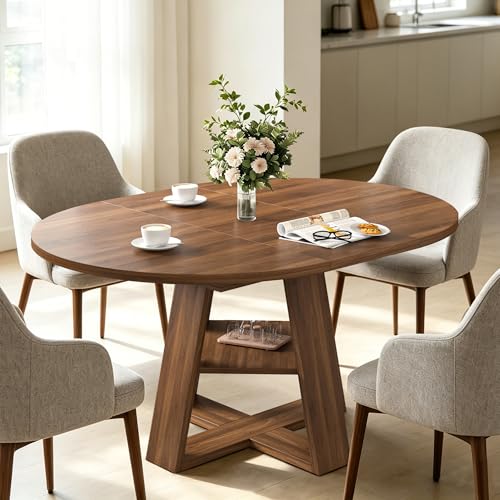
43.3"-59" Extendable Round Oval Dining Table for 4-8 with Storage Shelf | Modern Kitchen Oval Dining Table with Removable Leaves,Space Saving Extendable Table Wood Base for Kitchen Living Room Walnut
Check price on Amazon
Epecoya 59-Inch Extendable Dining Table, Kitchen Table for 4-6 People | Farmhouse Wood Space-Saving Expandable Dinner Table, Round to Oval Pedestal Dining Table, Dark Brown Walnut
Check price on Amazon
ONBRILL 41-78 Inch Extendable Dining Table for 4-8, Storage Shelf, Walnut | Expandable Kitchen Table with Fluted Base, Mid Century Modern Oval Dinner Tables for Dining Room, Kitchen, Living Room
Check price on Amazon
knoworld 39.4"-105" Extendable Dining Table for 4-12, Large Round to Oval Farmhouse Dining Table, Expandable Kitchen Table with Storage Pedestal Base, Space-Saving Design, Walnut
Check price on Amazon