
Round Leg Dining Table: Complete Buying Guide & Design Tips
Discover how round leg dining tables combine stability, timeless character, and versatile styling. Learn about leg profiles, joinery, materials, and space planning before you choose the right table for your dining room.
EXPLORE ROUND LEG TABLESWhy round legs matter: The leg profile of a dining table shapes its personality as much as the tabletop. Round legs soften the visual weight of a dining table, echo classic turned-leg craftsmanship, and pair naturally with upholstered chairs, benches, and round or oval tops. This guide walks you through every decision — from leg diameter and joinery to wood species and finish — so you can choose a round leg dining table that looks right and lasts for years.
What Is a Round Leg Dining Table?
A round leg dining table is a dining table supported by cylindrical or turned legs with a circular cross-section. Unlike square legs, which create crisp geometric lines, or tapered legs, which narrow toward the floor, round legs maintain a curved profile — sometimes perfectly cylindrical, sometimes turned with decorative beads, rings, or fluting.
Round legs are a hallmark of traditional, farmhouse, French country, and transitional dining furniture. They also appear in contemporary designs where slim cylindrical legs create a minimalist, architectural look. The rounded profile reads as softer and more inviting than sharp-edged legs, which makes round leg tables especially popular in family dining rooms and open-plan kitchens.
Because the leg is a structural element as much as a style choice, understanding how round legs are constructed — diameter, joinery, apron integration, and material — is essential before buying. A beautiful tabletop on weak legs will wobble, creak, and wear out quickly.
Types of Round Leg Profiles
Round legs are not a single design — they span a spectrum of profiles, each with its own aesthetic and practical characteristics. Here are the most common styles you will encounter:
Straight Cylindrical Legs
A consistent circular diameter from apron to floor. Clean, modern, and easy to clean. Often used in Scandinavian and contemporary round tables, sometimes with slim metal or wood profiles.
Turned Legs
Lathe-turned profiles with beads, coves, rings, or fluting. Strongly traditional and farmhouse. Turned legs add visual detail and pair beautifully with painted finishes and antique-inspired dining sets.
Tapered Round Legs
Circular cross-section that narrows slightly toward the floor. A bridge between modern and traditional styles. Common in mid-century and transitional round tables.
Spiral or Rope-Twist Legs
A carved spiral profile that adds texture and a handcrafted character. Typically found in premium and luxury traditional tables, often paired with ornate aprons.
Fluted Round Legs
Vertical grooves carved into a cylindrical leg. Adds a classical, architectural feel. Common in neoclassical and formal dining tables.
Metal Round Legs
Tubular steel or aluminum legs with a circular profile. Industrial and modern. Often powder-coated or brushed, and frequently combined with wood or stone tops.
Round Legs vs Other Leg Styles
Comparing leg profiles helps you match the table to your interior style and practical needs. The table below summarizes the key differences:
| Leg Style | Visual Character | Best For | Considerations |
|---|---|---|---|
| Round / Cylindrical | Soft, traditional to transitional | Family dining rooms, farmhouse, French country | Turned profiles can collect dust in grooves |
| Square / Block | Crisp, sturdy, modern to rustic | Industrial, rustic, contemporary | Visually heavier; corners can be hard on toes |
| Tapered | Light, mid-century modern | Scandinavian, modern, small spaces | Less stable if very thin; avoid heavy tops |
| Hairpin / Metal Rod | Minimal, industrial | Modern, loft, compact dining | Limited load capacity; check weight rating |
| Pedestal / Trestle | Statement, communal | Large round tables, benches, hosting | Legroom is centralized; no corner legs |
For a deeper dive into leg construction and how legs attach to the tabletop, see our broader guide on dining table leg design. If you are comparing a four-leg round table against a central pedestal, our article on pedestal dining tables and four chairs explains the trade-offs in legroom and seating flexibility.
Stability & Construction: What to Check
Leg diameter and wall thickness
Round legs derive strength from diameter and material thickness. Thin cylindrical legs look elegant but can flex under a heavy top or when someone leans on the table. For solid wood tables, mid-range and premium models typically use thicker leg blanks with a larger diameter; entry-level tables may use slimmer legs or hollow cores. For metal legs, check the tube wall thickness and whether the leg is solid or hollow.
Joinery between leg and apron
The strongest round leg tables use mortise-and-tenon joinery, corner blocks, or steel brackets to connect legs to the apron. Staples and glue alone are a warning sign. Ask whether the apron is reinforced and whether the leg-to-apron joint is mechanically fastened. A well-built round leg table should feel solid with no side-to-side movement when you gently push the tabletop.
Apron depth and cross-bracing
Aprons add rigidity. Deeper aprons resist racking, but they reduce legroom and knee clearance. On round tables, aprons often follow the curve of the top. Look for corner blocks or diagonal braces on larger tables. Tables with long spans and thin aprons may wobble over time, especially on uneven floors.
Feet and floor protection
Round legs end in a circular foot. Check whether the foot is fitted with felt glides, nylon caps, or adjustable levelers. Adjustable feet are a practical advantage on uneven floors. On outdoor or patio round leg tables, look for non-marking, weather-resistant foot caps.
Materials for Round Leg Tables
The material determines how a round leg table ages, how much it weighs, and how it fits your interior. Each material sits in a different tier of the market and offers different strengths:
Solid Hardwood
Oak, walnut, maple, and cherry are the classic choices for round legs. Hardwood legs can be turned, fluted, or left cylindrical, and they accept stain and paint beautifully. Solid hardwood sits in the mid-range to premium tier and is a long-term investment when finished well.
Softwood (Pine, Rubberwood)
Pine and rubberwood are common in entry-level and mid-tier round leg tables. Rubberwood is dense enough for turned legs and is often used in painted farmhouse sets. Pine is lighter and more prone to dents; it suits casual dining and painted finishes.
Engineered Wood & Veneer
MDF or particleboard cores with veneer or laminate finishes appear in entry-level round tables. Veneered round legs can look convincing but are prone to chipping at the edges. Check that the legs are solid wood even if the top is veneered — solid legs last far longer.
Metal
Steel and aluminum round legs are durable, low-maintenance, and available in powder-coated or brushed finishes. Metal legs are common in industrial and modern round tables and are often combined with wood, glass, or stone tops. Metal is efficient for outdoor and commercial-grade settings.
For material care and comparison details, browse our materials and finishes hub. If you are drawn to natural wood tones, our guide to wooden dining tables with four chairs shows how round legs work with classic wood sets.
Finish Options for Round Legs
Painted finishes
Painted round legs are a staple of farmhouse and cottage styles. White, cream, sage, and soft grey are popular. Painted legs hide wood grain and emphasize the leg profile, which is ideal for turned and fluted designs. Painted finishes show chips and scuffs more readily, so touch-up paint is worth keeping on hand.
Stained and oiled wood
Stained or oiled round legs highlight the grain and the turned details. Oiled finishes feel natural and can be repaired locally, but they need periodic re-oiling. Stained finishes offer more color consistency and are often sealed with lacquer or polyurethane for durability.
Lacquered and high-gloss
High-gloss lacquered round legs create a polished, contemporary look and are easy to wipe clean. Gloss finishes show dust and fingerprints, and deep scratches are hard to repair. They suit formal and modern dining rooms where the table is a focal point.
Powder-coated metal
Powder coating is the standard finish for metal round legs. It is durable, rust-resistant, and available in matte or satin colors. For outdoor round leg tables, confirm that the coating is rated for exterior use and that the leg caps protect the finish from moisture.
Size & Space Planning for Round Leg Tables
Round leg tables come in a wide range of sizes, from compact two-person bistro tables to large eight-seat round dining tables. The leg placement matters as much as the tabletop diameter: four round legs at the corners of a circular top leave generous legroom in the center, while a pedestal base frees up the perimeter entirely.
As a rule of thumb, allow at least 24 inches of tabletop width per seated diner and 30 to 36 inches of clearance between the table edge and walls or other furniture for comfortable chair pull-out and walkways. Round tops are efficient in tight rooms because they have no corners to navigate around.
If your dining area is compact, our guide to dining table options for small spaces covers round and drop-leaf solutions. For outdoor settings, see small dining tables for patios. And if you are curious how many people fit around a large round top, our article on how many a 72-inch round dining table seats breaks down the math.
Matching Round Leg Tables to Your Interior Style
Farmhouse & Rustic
Turned round legs in painted or distressed finishes, paired with a plank-style round top. Benches and ladder-back chairs complete the look. See our barn dining table set guide for related styling.
French Country
Fluted or spiral round legs, often in a warm wood tone or soft white paint. Curved aprons and upholstered chairs complement the classic profile.
Modern & Contemporary
Slim cylindrical legs in solid wood or metal, paired with a clean round top. Matte finishes and minimal aprons keep the look architectural.
Scandinavian
Light wood cylindrical or gently tapered round legs, pale finishes, and simple silhouettes. Pair with woven or upholstered chairs for warmth.
Industrial
Tubular metal round legs, often paired with reclaimed wood or concrete tops. Matte black or galvanized finishes reinforce the workshop aesthetic.
Traditional & Formal
Turned or fluted round legs in rich mahogany or walnut tones, with decorative aprons. Suits formal dining rooms and holiday tablescapes.
Caring for Round Leg Dining Tables
Routine cleaning
Dust round legs weekly with a soft microfiber cloth, working around the curve rather than scrubbing across it. For finished wood, use a slightly damp cloth and dry immediately. Avoid soaking the joint where the leg meets the apron, as moisture can loosen glue over time.
Protecting turned and fluted profiles
Turned beads, rings, and fluting collect dust in the grooves. Use a soft brush attachment on a vacuum or a microfiber cloth wrapped around a thin stick to clean recessed details. Avoid abrasive polishes that can build up in crevices and dull the finish.
Preventing wobble
Check leg fasteners periodically and tighten them according to the manufacturer's instructions. If the table sits on an uneven floor, fit adjustable levelers or felt shims under the offending leg. Persistent wobble usually signals loose joinery; address it early before the apron or leg joint is damaged.
Finish upkeep
Oiled finishes benefit from periodic re-oiling, while lacquered and painted finishes should be cleaned with a mild pH-neutral cleaner. For painted legs, keep a small pot of touch-up paint for chips and scuffs. Always test any cleaner on an inconspicuous area first.
For a complete maintenance routine, visit our dining table care and maintenance hub. If you need to fix scratches or wobbles, our guides on scratch touch-up and wobbly table fixes offer step-by-step instructions.
Recommended Round Leg Dining Tables
⚠️ AFFILIATE DISCLOSURE: This website contains affiliate links. As an affiliate Associate, we earn from qualifying purchases. If you make a purchase through these links, we may receive a small commission at no additional cost to you. Read our full affiliate policy.

Metal Table Legs 28 Inch, Round Dining Table Base Fits Glass Marble Wood | 1000LBS Capacity, Golden Ratio Easy To Install with Suction Cups, 4 Adjustment Pads, Suitable for Indoor and Outdoor Use
Check price on Amazon
TIEOU Metal Legs for Table V Shape 28" H Tall Metal Black Table Leg Heavy Duty Industrial Desk Legs Set of 2
Check price on Amazon
28 Inch Metal Dining Table Base, 1200 LBS Load Suitable for Glass Tops | Heavy Duty Industrial Table Legs with Height-Adjustable Foot Pads and Suction Cups for Fits Glass Marble Wood Top
Check price on Amazon
42" Round Dining Table for 2-4, Modern Kitchen Table with Faux Marble Tabletop & Metal Legs, Space Saving Circle Table with Storage, Wood Kitchen & Dining Room Tables for Kitchen Dining Room
Check price on Amazon
42" Round Dining Table for 4, Farmhouse Kitchen Table with Storage, Space Saving Circle Dinner Table, Rustic Wood Kitchen & Dining Room Tables with Metal Legs for Home, Apartment, Office, Restaurant
Check price on Amazon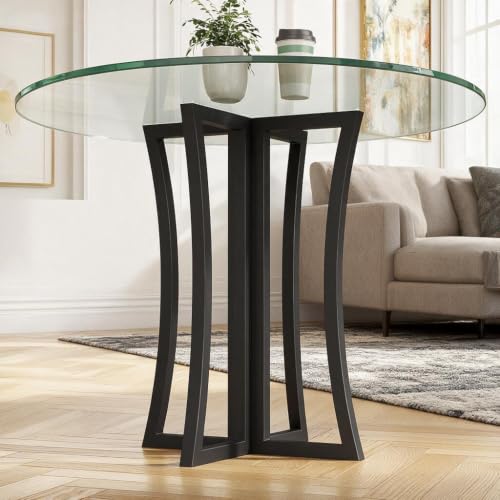
LBSLMJB Metal Table Base, 28 Inch, Black, for Glass and Wood Tops | DIY dining table and desk projects; suction cups and pre-drilled mounting holes for different tabletop materials
Check price on Amazon
Round Coffee Table Legs,Metal End Side Table Leg,Coffee Table Base Only | 16 Inch,Made of Hard Iron,3 Adjustment Pads,Stabilize The Table And Protect The Floor,Easy To Install,Satisfy Family DIY
Check price on AmazonExplore More Round & Legged Dining Tables
Browse related guides and table styles to refine your shortlist:
Frequently Asked Questions
What is a round leg dining table?
A round leg dining table is a table supported by cylindrical or turned legs with a circular cross-section, as opposed to square, rectangular, or tapered legs. The rounded profile gives the table a softer, more traditional or transitional appearance while providing stable four-point support.
Are round leg dining tables stable?
Yes, when properly constructed. Round legs distribute load evenly across four contact points, and thick, well-anchored round legs with reinforced aprons or cross-bracing deliver excellent stability. Stability depends more on leg diameter, joinery quality, and apron design than on the leg shape itself.
How do I clean round table legs?
Dust round legs weekly with a soft microfiber cloth. For finished wood, wipe with a slightly damp cloth and dry immediately. Avoid soaking the joinery where legs meet the apron, and reapply wax or oil according to the finish manufacturer's schedule to protect the curved surface.
What is the difference between round legs and tapered legs?
Round legs maintain a consistent or turned circular profile from top to bottom, while tapered legs narrow progressively toward the floor. Round legs read as traditional, farmhouse, or transitional, whereas tapered legs read as mid-century modern or contemporary. Tapered legs are lighter visually; round legs feel sturdier and more anchored.
Can round leg dining tables be used outdoors?
Only if the table is specifically built for outdoor use with weather-resistant materials and finishes. Indoor round leg tables made from solid wood, veneer, or painted finishes should not be placed on uncovered patios, as moisture and UV exposure will degrade the finish and joinery over time.
Ready to Choose Your Round Leg Dining Table?
Round leg tables bring softness, stability, and timeless character to the dining room. Review the recommended models above, compare leg profiles and materials, and pick the table that fits your space and style. For more help, explore our related guides on round dining tables, table legs, and small-space dining solutions.
VIEW RECOMMENDED TABLES