
Round Extendable Dining Table 4 6: The Complete Buyer Guide
Everything you need to know about a round extendable dining table that seats 4 in everyday use and expands to 6 for guests — sizing, mechanisms, materials, and how to choose the right one for your space.
Explore Recommended ModelsWhat Is a Round Extendable Dining Table?
A round extendable dining table is a circular table with a built-in expansion system that increases its seating capacity. The most common configuration in the "4 to 6" category starts with a closed diameter that comfortably seats 4 diners, then expands to a larger diameter that seats 6. The expansion is typically achieved through one of three mechanisms: a butterfly leaf that folds out from the center, a separate center leaf that inserts into a split top, or a drop-leaf design where side panels fold down when not in use.
The round shape is the defining feature. Unlike rectangular tables, a circular table offers no head-of-table position, which makes conversation more even and inclusive. It also eliminates sharp corners, which improves walkway flow in compact dining rooms, apartments, and open-plan kitchens. When you combine this shape with an extension mechanism, you get a table that is both space-efficient day to day and flexible for entertaining.
If you are still comparing shapes, our long round dining table guide explains how oval and elongated round forms differ from a true circle, and our oval natural wood dining table guide covers the wood-finished oval alternative.
How the 4-to-6 Expansion Works
Understanding the mechanism is important because it affects storage, assembly, and how the table looks when closed. Each type has trade-offs.
Butterfly Leaf
A butterfly leaf is hinged in the center of the table and folds inward when closed. To extend the table, you pull the two halves apart and the leaf unfolds automatically. This is the most convenient mechanism because the leaf stays attached to the table — there is no separate piece to store. When closed, the leaf is hidden underneath the tabletop. Butterfly leaves are common in mid-range and premium solid wood tables and are favored in households that expand the table frequently.
Separate Center Leaf
A separate center leaf is a removable panel that inserts into a gap between the two halves of the tabletop. This design is simpler mechanically and often found in entry-level and mid-range models. The trade-off is storage: you need a closet or a dedicated leaf-storage slot when the table is closed. Some tables include a storage compartment under the top, which solves this problem.
Drop-Leaf Design
Drop-leaf tables have side panels that fold down vertically against the frame. When both leaves are down, the table is a compact round or half-round shape. When raised, it becomes a larger round or oval table. Drop-leaf tables are ideal for very small spaces because the folded position is extremely compact. However, the extended shape is often oval rather than a perfect circle, and the folded-down leaves can obstruct chair placement on the sides.
Sizing: How Big Should a 4-to-6 Round Table Be?
Sizing is the single most important decision. A round table that is too small feels cramped; one that is too large overwhelms a compact room. Use the following benchmarks as a starting point.
| Configuration | Typical Diameter | Seats | Best For |
|---|---|---|---|
| Closed (compact) | 36–42 in | 2–4 | Apartments, small kitchens, couples |
| Closed (standard 4-seat) | 42–48 in | 4 | Families of 3–4, everyday dining |
| Extended (6-seat) | 54–60 in | 6 | Hosting, holidays, family gatherings |
| Extended (generous 6-seat) | 60–66 in | 6 | Comfortable entertaining, larger rooms |
The rule of thumb is 24 inches of table edge per diner. A 48-inch diameter gives a circumference of about 151 inches, which seats 6 tightly or 4 comfortably. A 60-inch diameter gives about 188 inches of circumference, which seats 6 with generous elbow room. Always measure your room before committing: you need 30 to 36 inches of clearance around the table for chairs to pull out and for people to walk behind seated diners.
If your room is tight, our dining table for apartment living guide covers clearance calculations in detail. If you are weighing a round table against a rectangular one for a small family, the white dining table for 4 guide offers a useful comparison for the 4-seater category.
Materials and Finishes
The material determines durability, maintenance, and the visual character of the table. For a round extendable table, material choice also affects weight and how smoothly the extension mechanism operates.
Solid Wood
Solid oak, walnut, teak, and mango wood are the most durable options for everyday dining. Solid wood can be sanded and refinished over time, which makes it a long-term investment. Oak is hard and resistant to daily wear; walnut offers a darker, richer tone; teak is naturally moisture-resistant. Solid wood tables are heavier, which means the extension mechanism must be well-engineered — look for reinforced steel tracks or solid wood glides on mid-range and premium models.
Marble and Stone
Marble and quartz tops offer a premium, luxurious look with easy cleaning. They are heavy and require periodic sealing to resist stains, especially marble. Stone tops are usually paired with metal or solid wood bases. Because stone is heavy, extension mechanisms on stone tables tend to be simpler or fixed — if you want an extendable stone table, confirm the mechanism is rated for the top's weight.
Glass
Glass tops create a visually light, modern look that works well in compact rooms because they do not visually crowd the space. Glass is easy to clean but shows smudges and scratches. Tempered glass is essential for safety. Glass extension tables are typically mid-range and use metal frames.
Veneer and Engineered Wood
Veneer and engineered wood tables are entry-level and mid-range options that offer a consistent finish and lighter weight. They are a solid choice for starter homes and rental apartments where the table may be moved. They cannot be refinished like solid wood, so inspect the edge banding and joint quality before buying.
For a deeper comparison of surface options, our materials and finishes hub covers wood species, stone types, and finish durability in detail.
Key Features to Evaluate Before Buying
- Mechanism quality: Test the extension mechanism in person if possible. Entry-level models may use simple wood glides; mid-range and premium models use metal tracks or ball-bearing slides. A smooth, wobble-free extension is the single best indicator of build quality.
- Leaf storage: If the table uses a separate leaf, confirm whether storage is built in. A missing storage solution means the leaf lives in a closet or under a bed.
- Seam stability: When extended, the joint between the leaf and the main top should be flush and rigid. A weak seam causes wobble and catches crumbs.
- Pedestal vs. legs: A central pedestal base is common on round tables because it maximizes legroom and allows chairs to be placed anywhere around the perimeter. A four-leg base is more stable but limits chair placement at the corners.
- Edge profile: Rounded or beveled edges are safer in households with children. Sharp edges on a round table defeat the purpose of the shape.
- Finish durability: Matte and oiled finishes are easier to touch up; glossy and lacquered finishes resist spills better but show scratches more.
Round Extendable vs. Other 4-to-6 Options
A round extendable table is not the only way to seat 4 to 6 people. Here is how it compares to alternatives.
| Option | Seats 4–6? | Space Efficiency | Best For |
|---|---|---|---|
| Round extendable table | Yes | Excellent | Compact rooms, sociable dining, flexible hosting |
| Rectangular extendable table | Yes | Good | Long rooms, formal dining, larger groups |
| Fixed round table | 4 only | Excellent | Households that never host more than 4 |
| Drop-leaf table | Yes | Excellent when folded | Very small spaces, occasional use |
If you are considering a larger footprint, the 6-foot long dining table guide covers the rectangular alternative for 6 to 8 diners. For formal 10-seat setups, the 10-seater dining room table and chairs guide is the right reference.
Room Layout and Clearance
Round tables are forgiving in layout because there are no corners to navigate. Still, clearance matters. Measure the closed diameter and the extended diameter, then add 30 to 36 inches on all sides for chair pull-out and walkway. In a room that is 10 feet by 10 feet, a 48-inch closed table works comfortably; a 60-inch extended table will feel tight unless the room opens onto an adjacent space.
Place the table so that the extension direction is clear. Butterfly and center-leaf tables extend symmetrically, so the table grows in both directions. Drop-leaf tables extend only on the sides with leaves, so position the folded side against a wall if space is limited. For a full walkthrough of clearance and traffic flow, see our dining table space planning guide.
Care and Maintenance Essentials
A round extendable table has one maintenance concern that fixed tables do not: the extension mechanism. Keep the tracks or glides clean and free of crumbs, and lubricate metal slides lightly once or twice a year. For solid wood, use coasters and placemats to prevent rings and heat marks, and re-oil or wax the surface according to the finish type. For stone, reseal annually and wipe spills promptly. For glass, use a non-abrasive cleaner.
If you are setting up a full dining set, our round extendable dining table set guide covers coordinating chairs, benches, and accessories. For a broader care schedule, the dining table care and maintenance hub is the central reference.
Common Mistakes to Avoid
- Buying by closed size only: Measure the extended footprint too. A table that fits when closed may not fit when extended.
- Ignoring chair clearance: A 48-inch table in a 9-foot room leaves too little walkway. Measure before you commit.
- Overlooking leaf storage: A separate leaf with no storage becomes a nuisance. Prefer butterfly leaves or tables with built-in storage.
- Choosing a heavy top with a light mechanism: Stone and thick solid wood tops need reinforced extension hardware. Check the mechanism rating.
- Skipping mechanism testing: If buying in person, extend and retract the table several times. Listen for rattles and check for wobble at the seam.
Ready to Compare Round Extendable Models?
Our curated selection below highlights round extendable dining tables that seat 4 to 6 people, organized by tier and feature set so you can compare mechanisms, materials, and dimensions at a glance.
View Recommended ModelsRecommended Round Extendable Dining Tables (4 to 6 Seats)
Recommended Round Extendable Dining Tables for 4 to 6 Diners
⚠️ AFFILIATE DISCLOSURE: This website contains affiliate links. As an affiliate Associate, we earn from qualifying purchases. If you make a purchase through these links, we may receive a small commission at no additional cost to you. Read our full affiliate policy.

Extendable Dining Table, Round Kitchen Dining Room Dinner Table with for 4 6 8 People, Space Saving Modern Oval Expandale Furniture with Storage and Pedestal for Kitchen Living Room (Black)
Check price on Amazon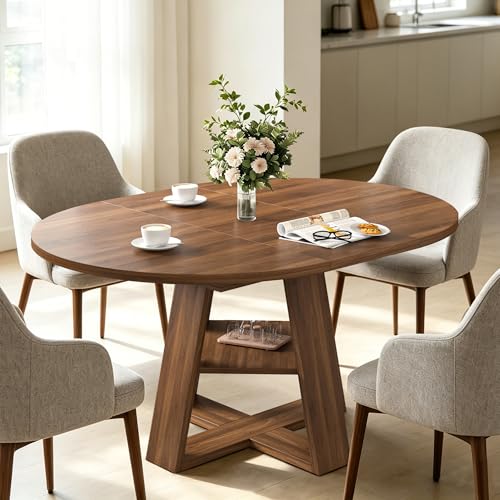
43.3"-59" Extendable Round Oval Dining Table for 4-8 with Storage Shelf | Modern Kitchen Oval Dining Table with Removable Leaves,Space Saving Extendable Table Wood Base for Kitchen Living Room Walnut
Check price on Amazon
41 in-78 in Extendable Dining Room Table for 4-8, Round Expandable Kitchen Table with Fluted Base, Modern Farmhouse Oval Dinner Tables for Dining Room Kitchen Living Room (Walnut)
Check price on Amazon
Fabulcozy 47.2"-63" Extendable Round Dining Table for 4-8, Kitchen Table | Modern Oval Kitchen & Dining Room Table with Removable Leaves & Storage Shelf, Space Saving Drop Leaf Wood Desk, Black Walnut
Check price on Amazon
YOSHOOT 43.3"-59" Extendable Round Dining Table for 4-6, Transformer Oval Dining Room Table with Removable Leaves Space Saving, Wood Dinner Table for Kitchen, Living Room(Table Only), Walnut
Check price on Amazon
Round Dining Table Extendable with Storage Shelf, Brown | Extendable round dining table,seats 4-8,wood,farmhouse style,for small kitchen and apartment,43''-59''
Check price on Amazon
OneBlis 41"-78" Round Extendable Dining Table for 4-8, Oval Expandable Kitchen Table with Storage Shelves, Fluted Dinner Table with 2 Extension Leaves for Dining Room, Kitchen, Living Room, Walnut
Check price on Amazon
Epecoya 59-Inch Extendable Dining Table, Kitchen Table for 4-6 People | Farmhouse Wood Space-Saving Expandable Dinner Table, Round to Oval Pedestal Dining Table, Dark Brown Walnut
Check price on AmazonFrequently Asked Questions
What size round extendable dining table seats 4 to 6 people?
A round table with a closed diameter of about 42 to 48 inches comfortably seats 4, and when extended with a leaf or butterfly mechanism it typically grows to 54 to 66 inches, seating 6. Allow 24 inches of width per person and 30 to 36 inches of clearance around the table for chair pull-out.
How does a round extendable dining table expand?
Most round extendable tables use one of three mechanisms: a butterfly leaf that folds into the center, a separate center leaf stored elsewhere, or a drop-leaf design where side panels fold down. Butterfly and center-leaf models keep the round silhouette when extended, while drop-leaf designs become oval or rectangular.
Is a round extendable table good for small dining rooms?
Yes. A round table has no corners to navigate, which improves walkway flow in compact rooms. When closed, a 4-seater round table occupies less floor area than a rectangular table of the same seating capacity, and the extendable option lets you host 6 guests without permanently committing the space.
Which material is best for a round extendable dining table?
Solid wood such as oak, walnut, or teak is the most durable for everyday use and can be refinished over time. Marble and quartz offer a premium look with easy cleaning but are heavier and require sealing. Glass and veneer options are lighter and more accessible within their tier but need careful handling.
Can a round extendable table seat 6 comfortably?
Yes, when extended to roughly 60 to 66 inches in diameter. Each diner needs about 24 inches of table edge, so 6 people require at least 144 inches of circumference, which corresponds to a diameter of about 46 inches minimum. A 60-inch extended diameter gives comfortable elbow room and space for serving dishes.
Where can I find a round extendable dining table nearby?
If you prefer to see the mechanism in person before buying, check local furniture showrooms and specialty stores. Our dining table nearby guide explains how to evaluate a table in-store, including what to test on the extension mechanism and how to confirm dimensions.