
Narrow Outdoor Dining Table: The Complete Buying Guide
Learn how to choose a slim outdoor dining table that fits balconies, patios, and compact terraces without sacrificing comfort, durability, or style. Everything you need to decide with confidence.
Explore Recommended TablesWhy narrow outdoor tables matter: Outdoor dining spaces are rarely generous in width. A narrow outdoor dining table solves the depth problem while preserving seating on both sides. The result is a functional, sociable dining spot that works even on a slim balcony or a long, shallow patio. This guide walks you through dimensions, materials, seating, and layout so you can pick the right table for your exact space.
Recommended Narrow Outdoor Dining Tables
⚠️ AFFILIATE DISCLOSURE: This website contains affiliate links. As an affiliate Associate, we earn from qualifying purchases. If you make a purchase through these links, we may receive a small commission at no additional cost to you. Read our full affiliate policy.

Tangkula 59" Narrow Outdoor Dining Table for 4-6, Natural | No Assembly Foldable Patio Table with Acacia Wood Top & Heavy Duty Metal Frame, Portable Table for Yard, Garden, Poolside
Check price on Amazon
Tangkula 58" Rectangular Wood Patio Dining Table for 6 | Acacia Wood Slatted Top, 1.97" Umbrella Hole, Heavy Duty Metal Frame, For Porch, Garden, Yard, Deck and Poolside
Check price on Amazon
Tangkula Acacia Wood Outdoor Dining Table for 4-6 | Rectangular Slatted Tabletop, For Patio, Garden, Balcony, Deck and Backyard
Check price on Amazon
PIZZELLO Patio Dining Table for 8, 83" Rectangular Outdoor Patio Tables | Wood-Like HIPS Slat Top, All Weather Metal Outdoor Dining Table w/Umbrella Hole for Lawn Backyard Garden, Black
Check price on Amazon
VIVIJASON 42" x 24" Cast Aluminum Outdoor Dining Table, Narrow Rectangular Bistro Table for Small Balcony, Rust Proof & Weather Resistant Patio Furniture for Backyard, Porch, Garden, Dark Bronze
Check price on Amazon
SERWALL Outdoor 84" HDPE Rectangular Dining Table for 6-8,All-Weather,White | Durable 84" rectangular dining table seats 6-8, with pre-cut umbrella hole for outdoor dining and gatherings.
Check price on Amazon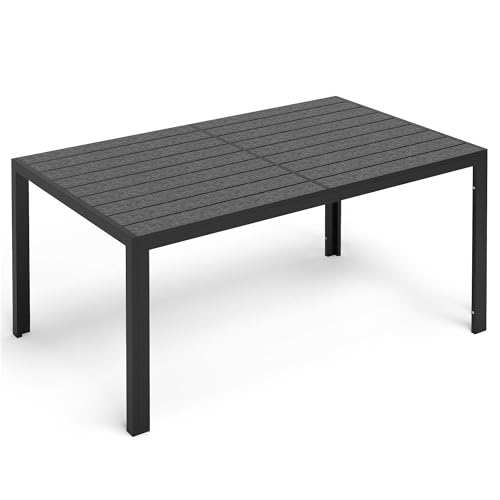
PIZZELLO Patio Dining Table for 6, 59" Rectangular Outdoor Patio Tables | Wood-Like HIPS Slat Top, All Weather Metal Outdoor Dining Table for Lawn Backyard Garden, Black
Check price on AmazonWhat Makes a Dining Table "Narrow"?
A narrow outdoor dining table is defined primarily by its depth — the distance from the front edge to the back edge. While a standard rectangular dining table usually runs 36 to 40 inches deep, narrow versions typically measure between 24 and 32 inches. This reduced depth is what allows the table to fit along a balcony wall, a slim patio, or a corridor-style terrace without blocking walkways.
Narrow tables come in several shapes. Rectangular and bar-height versions are the most common, but oval and slender round designs also exist for tight corners. When shopping, focus on the depth first, then confirm the length and seating capacity. If you are still exploring broader outdoor configurations, our guide to a dining table for limited space offers additional layout strategies.
Standard Dimensions for Narrow Outdoor Tables
Understanding typical dimensions helps you match a table to your available footprint. The table below summarizes common size categories and their seating potential. Use it as a starting reference, then measure your own space carefully.
| Category | Typical Depth | Typical Length | Seating | Best For |
|---|---|---|---|---|
| Compact two-seater | 24–26 inches | 36–42 inches | 2 people | Small balconies, coffee-style outdoor spots |
| Standard narrow | 28–30 inches | 48–55 inches | 2–4 people | Patios, narrow terraces, apartment balconies |
| Extended narrow | 30–32 inches | 60–71 inches | 4–6 people | Long patios, covered porches, garden decks |
| Bar-height narrow | 24–28 inches | 48–60 inches | 2–4 people | Standing-height socializing, small urban balconies |
Remember that usable seating depth matters more than the raw number. A table that is 28 inches deep gives each diner roughly 12 to 14 inches of personal space along the long edge, which is comfortable for a plate, glass, and cutlery. If you plan to serve family-style dishes in the center, lean toward the deeper end of the narrow range.
How to Measure Your Outdoor Space
Before choosing a table, measure the full footprint of your balcony, patio, or terrace. Then subtract clearance zones for chairs and walkways. A practical rule is to allow at least 24 to 30 inches of clearance on each seating side so chairs can slide out comfortably. On the non-seating side, 12 to 18 inches is usually enough to avoid a cramped feeling against a wall or railing.
- Measure wall to railing: This is your maximum usable depth. Choose a table depth that leaves chair clearance on both sides.
- Measure the long axis: Confirm the table length fits without blocking a door or walkway.
- Check door swing and traffic: Leave a clear path to any exterior door or step.
- Account for chair tuck-in: Chairs tucked under the table still add a few inches of depth when in use.
For a deeper walkthrough of clearance and flow, see our compact dining layout guide, which applies to both indoor and outdoor setups.
Best Materials for Narrow Outdoor Tables
Outdoor furniture faces sun, rain, and temperature swings. The material you choose determines how long the table stays attractive and stable. Here are the most common options for narrow outdoor tables and what each one brings to the table.
Powder-Coated Aluminum
Lightweight, rust-resistant, and easy to move. A strong choice for balconies where furniture may need to be repositioned. Look for a thick powder coating to protect against scratches.
High-Grade Steel
Heavy-duty and stable, ideal for windy rooftops. Choose galvanized or powder-coated steel to prevent rust. Better suited to permanent placements than frequent moving.
Teak and Weather-Resistant Wood
Warm, natural look with excellent outdoor durability. Teak develops a silver patina over time and resists moisture well. Requires occasional oiling to maintain its finish.
HDPE Resin
Maintenance-free and resistant to sun fading and moisture. Often used in slatted designs that drain rainwater quickly. A solid choice for coastal or humid climates.
Glass and Metal Combinations
Sleek and modern, with a slim profile that suits narrow spaces. Tempered glass tops are durable but should be paired with a sturdy metal frame for stability.
Concrete and Composite Tops
Very stable and heavy, offering a premium feel. Best for ground-level patios where the table will not need to be moved. Requires sealed surfaces to resist staining.
Whichever material you choose, confirm that the finish is described as weather-resistant or rust-proof. For tables with a top surface that sees heavy use, a dining table top protector can extend the life of the surface, especially during entertaining seasons.
Seating Options for Narrow Tables
Seating choice affects both comfort and footprint. Narrow tables pair well with slim chairs, benches, and backless stools. Here is how each option performs in tight outdoor spaces.
- Slim dining chairs: The most flexible option. Look for chairs with narrow frames and armless designs to maximize tuck-in space.
- Backless benches: Excellent for narrow tables because they slide fully under the table when not in use. A dining table with bench seating arrangement can work outdoors if the bench is weather-treated.
- Folding chairs: Ideal for balconies where space changes between uses. Fold them away when the table is not in service.
- Bar stools: Pair with bar-height narrow tables for a casual, space-efficient setup.
For a balanced look, consider pairing the table with a matching seating set. Our overview of a complete dining set for larger groups shows how coordinated seating improves both function and visual harmony, and the same principle applies outdoors at a smaller scale.
Layout Ideas for Narrow Outdoor Spaces
A narrow table is only as good as its placement. The goal is to keep walkways clear while giving diners enough elbow room. Here are a few proven arrangements.
- Wall-side placement: Push one long edge close to a wall or railing and seat diners on the open side. This works well for two-person setups.
- Two-sided seating: If depth allows, seat diners on both long edges. Keep the ends open for serving access.
- End-of-patio placement: Place the table against the far end of a long patio to preserve the central walkway.
- Bar-height corner setup: A bar-height narrow table in a corner frees up floor space and creates a casual social zone.
If your space is especially tight, our guide to an oval dining table with bench explores how curved edges reduce bump risk in compact areas. The same logic of soft edges and slim profiles applies to outdoor layouts.
Weather Protection and Maintenance
Outdoor tables live in harsher conditions than indoor furniture. A few habits keep a narrow outdoor table looking good season after season.
- Use a cover when not in use: A fitted cover protects against rain, pollen, and UV damage.
- Clean spills promptly: Outdoor surfaces can stain if food or drinks sit too long, especially on porous materials.
- Inspect hardware seasonally: Tighten bolts and check for rust on metal frames at the start and end of each season.
- Store or cover during storms: Lightweight tables should be secured or moved indoors during high winds.
If you are planning a larger outdoor dining area, our guide to an expandable dining table with chairs shows how flexible tables handle changing guest counts, a principle that also applies to outdoor hosting.
Common Mistakes to Avoid
- Choosing depth without measuring chairs: A 30-inch table can feel cramped if chairs are bulky. Measure the chair depth alongside the table.
- Ignoring walkway clearance: A table that blocks the path to a door will frustrate everyone. Always leave a clear route.
- Overlooking material weight: Heavy tables are stable but hard to move. Lightweight tables are easy to rearrange but may shift in wind.
- Forgetting sun exposure: Some finishes fade faster in direct sun. Check UV resistance for materials placed in full daylight.
- Skipping a test fit: Use painter's tape to mark the table footprint on your patio before ordering. It is the simplest way to confirm fit.
Ready to Choose Your Narrow Outdoor Dining Table?
Browse our recommended picks above to compare materials, sizes, and seating options. Each selection is chosen for its suitability to compact outdoor spaces.
View Recommended TablesFrequently Asked Questions
How narrow can an outdoor dining table be?
Most narrow outdoor dining tables fall between 24 and 32 inches in depth. A depth of around 28 inches is a comfortable balance that allows plates, glasses, and serving dishes while still fitting slim balconies and patios.
How many people can sit at a narrow outdoor dining table?
A narrow table with a length of 48 to 55 inches typically seats two to four people, while longer versions of 60 to 71 inches can seat four to six people when chairs are placed along both sides.
What material is best for a narrow outdoor dining table?
Weather-resistant materials such as powder-coated aluminum, high-grade steel, teak, and HDPE resin work well outdoors. Choose finishes that resist rust and fading, and consider lightweight builds if you need to move the table often.
Do I need space around a narrow outdoor dining table?
Plan for at least 24 to 30 inches of clearance on the seating sides so chairs can pull out comfortably. On the non-seating side, a smaller gap of 12 to 18 inches is usually enough for walkway or wall clearance.
Can a narrow outdoor table work on a balcony?
Yes. Balconies are one of the most common settings for narrow tables. Choose a depth that leaves chair clearance on both sides, and consider a folding or lightweight design if the balcony also serves as a walkway.