
Modern Extendable Dining Table: The Complete Buying Guide
Flexibility without compromising on design. Learn how modern extendable dining tables work, which mechanisms suit your lifestyle, and how to choose one that fits your space, seating needs, and interior style.
Explore Recommended TablesWhy a modern extendable dining table makes sense: A fixed table forces you to choose between everyday comfort and occasional hosting capacity. An extendable model lets you keep a compact footprint for daily meals while opening up to seat guests when needed. The modern category adds clean lines, minimalist silhouettes, and refined materials on top of that practicality.
This guide walks you through every decision point: mechanism types, tabletop materials, base designs, sizing math, and the small details that separate a well-engineered extension from a frustrating one. By the end, you will know exactly what to look for.
What Defines a Modern Extendable Dining Table
The word "modern" here refers to design language rather than a specific era. A modern extendable dining table typically features simplified geometry, hidden or integrated extension mechanisms, and a restrained material palette. You will notice thinner profiles, flush joints, and a focus on uninterrupted surfaces.
Key hallmarks include:
- Clean silhouettes: straight or gently tapered legs, pedestal bases, and minimal ornamentation.
- Integrated mechanisms: butterfly leaves or self-storing panels that disappear beneath the top rather than sitting in a closet.
- Refined materials: engineered wood with quality veneers, solid hardwood, sintered stone, ceramic, or tempered glass.
- Neutral and versatile finishes: matte lacquers, natural wood tones, and monochrome surfaces that blend into contemporary interiors.
If your interior leans toward a warmer, more traditional aesthetic, you may find that a farmhouse-style table offers a different character while still providing generous seating. The right choice depends on how the table integrates with the rest of your room.
Extension Mechanism Types Explained
The mechanism is the heart of any extendable table. It determines how easy the table is to operate, how much extra length you gain, and how well the table holds up over years of use. There are four main systems worth understanding.
1. Butterfly Leaf (Self-Storing Leaf)
A butterfly leaf folds in half and stows inside the table body. To extend, you pull the two halves apart, flip the leaf open, and let the table close onto it. The leaf stays attached at all times, so there is no storage problem. This is the most popular mechanism in modern extendable dining tables because it is fast, clean, and requires no extra furniture.
- Best for: households that extend and retract frequently.
- Typical expansion: one leaf adding seating for two to four people.
- Watch out for: leaf thickness and alignment—quality hinges matter more than the concept itself.
2. Self-Storing Leaf on a Track
Similar in spirit to the butterfly leaf, this design stores one or more leaves on a track beneath the tabletop. You slide the table halves apart and lift the leaf into place. It handles larger expansion ranges than a single butterfly leaf and keeps everything contained within the table.
- Best for: tables that need to convert from a compact four-seater to a full eight-seater.
- Typical expansion: one to two leaves, adding significant length.
- Watch out for: the table apron must be deep enough to house the stored leaves without interfering with legroom.
3. Telescoping Mechanism
A telescoping mechanism uses sliding rails that extend the table frame itself. The leaves sit on top of the extended rails. This system allows for a very long extension and is common on larger dining tables designed for entertaining. The trade-off is that it requires more clearance around the table during operation.
- Best for: large dining rooms and frequent formal hosting.
- Typical expansion: substantial, often doubling the seating capacity.
- Watch out for: rail quality and smoothness—cheaper telescoping systems can bind or wobble.
4. Removable Leaf
The simplest and often most robust design. You pull the table halves apart and drop in one or two loose leaves. There is no folding or internal storage, so the leaves need a safe place to live when not in use. This design is common on tables where structural simplicity is prioritized.
- Best for: occasional hosting where the table stays in one configuration most of the time.
- Typical expansion: one to two leaves, depending on the table.
- Watch out for: storage space and the risk of leaves getting damaged or lost.
Pro tip: Ask how the mechanism feels when operated. A well-engineered extension should glide smoothly with one person and lock firmly into place. If you can test a floor model, extend and retract it several times before deciding.
Comparing Extension Mechanisms at a Glance
| Mechanism | Ease of Use | Storage Needed | Best For |
|---|---|---|---|
| Butterfly leaf | Very high | None (self-storing) | Frequent everyday extension |
| Self-storing leaf on track | High | None (self-storing) | Larger seating conversions |
| Telescoping | Moderate | None | Large rooms and formal hosting |
| Removable leaf | Moderate | Yes (leaf storage) | Occasional hosting |
Tabletop Materials for Modern Extendable Tables
The top surface takes the most wear, so material choice has a real impact on longevity and maintenance. Modern designs tend to favor surfaces that look clean and uniform.
Engineered Wood with Quality Veneer
A stable core with a thin layer of real wood veneer. This is the most common construction in the mid-range and premium tiers because it resists warping and allows for consistent, wide surfaces. Look for thick veneers and sealed edges. If you prefer the look of solid timber, a wood top with metal legs can deliver warmth with a modern industrial edge.
Solid Hardwood
Oak, walnut, and similar hardwoods offer natural grain and repairability. Solid tops are heavier and may expand and contract with humidity, so the extension mechanism must account for movement. Solid wood suits buyers who want a long-term investment and are comfortable with routine care.
Sintered Stone and Ceramic
These surfaces are highly resistant to scratches, heat, and stains. They are popular in modern designs because they allow very thin profiles and large uninterrupted slabs. A marble-look table captures a similar aesthetic with more natural variation, though it requires sealing and more careful maintenance.
Tempered Glass
Glass tops create a visually light effect and are easy to wipe down. They show fingerprints and smudges more readily, and the extension mechanism must be designed to support the weight evenly. A black glass oval design is a strong choice for contemporary rooms that want a sleek, reflective surface.
Laminate and High-Pressure Laminate
Practical, durable, and available in many finishes. Laminate is common in the entry-level and essential tiers. Modern laminates can convincingly mimic wood and stone, though edges and seams reveal their construction on close inspection.
Base and Leg Designs
The base must support the table in both its compact and extended states without wobbling. Modern extendable tables typically use one of the following configurations.
- Four-leg frame: classic and stable, but the legs can interfere with chair placement at the corners. Best for rectangular tables where the legs sit at the corners.
- Pedestal base: a central column or trestle that frees up legroom on all sides. A pedestal design is especially effective on oval and round tables where corner legs would be awkward.
- Trestle base: two supports connected by a beam. Provides excellent stability for long tables and looks at home in both modern and transitional rooms.
- Splayed or tapered legs: a hallmark of mid-century and Scandinavian modern design. Verify that the splay does not reduce stability when the table is extended.
Whatever the base, check that the extension mechanism is anchored to the frame rather than relying solely on the tabletop. A reinforced sub-frame is a sign of thoughtful engineering.
Sizing: How Much Table Do You Actually Need
Extension tables are all about range. You want a compact size that fits your everyday space and an extended size that comfortably seats your largest regular gathering. Use these guidelines to plan.
- Per-person width: allow roughly 24 inches of table edge per seated person for comfortable dining.
- Per-person depth: allow about 15 inches of table depth per setting, plus room for shared dishes in the center.
- Walkway clearance: keep at least 36 inches between the table edge and walls or furniture for chair pull-out and traffic.
- Extension clearance: confirm that the fully extended table does not block doorways, cabinet doors, or primary paths.
For a household that seats four daily and eight occasionally, a table that expands from roughly 60 to 84 inches is a common and practical range. If your room is tight, a kitchen dining table configuration can keep the footprint efficient while still offering extension capability.
| Everyday Seating | Extended Seating | Typical Compact Length | Typical Extended Length |
|---|---|---|---|
| 4 | 6 | 48–60 in | 66–78 in |
| 4–6 | 8 | 60–72 in | 84–96 in |
| 6 | 10 | 72–84 in | 96–108 in |
Shape and Style Considerations
Rectangular tables are the most common shape for extendable designs because the extension runs along the long axis. They suit long rooms and make efficient use of wall-adjacent placement. Oval tables soften the corners of a rectangular footprint and improve flow around the table, which is why an oval pedestal model is a favorite in open-plan spaces.
Square tables work well in compact rooms but offer less extension range because there is only one axis to expand. Round tables are social and space-efficient but are rarely extendable in the same way; when they are, the extension usually converts them to an oval.
For larger households, an eight-person dining table with extension capability gives you a comfortable daily configuration and room to grow for holidays. If you like the idea of hidden storage for linens or flatware, a table with drawers adds practical function without visual clutter.
Quality Tiers: What Changes as You Move Up
Extendable tables span a wide range of construction quality. Understanding the tiers helps you set realistic expectations without focusing on numbers.
- Entry-level tier: basic mechanisms, laminate or thin veneer tops, and simpler hardware. Suitable for light use and occasional extension.
- Mid-range tier: smoother butterfly or self-storing mechanisms, thicker veneers or solid wood components, and better hardware. A solid choice for most households.
- Premium tier: precision mechanisms, solid hardwood or stone surfaces, reinforced sub-frames, and refined finishes. Built for frequent use and long service life.
- Luxury tier: flagship materials, custom finishes, and mechanisms engineered for near-silent operation. These tables are designed as long-term investments.
Within any tier, the mechanism quality is the single best predictor of satisfaction. A mid-range table with an excellent mechanism will usually outperform a premium table with a poorly aligned one.
Practical Features Worth Prioritizing
- Locking mechanism: the table must lock firmly in both compact and extended positions to prevent wobble.
- Adjustable feet: glides or levelers compensate for uneven floors and prevent rocking.
- Sealed edges: especially important on veneer and laminate tops to prevent moisture ingress.
- Weight distribution: check that the base remains stable when the table is fully extended and loaded.
- Finish durability: matte lacquers hide scratches better than high-gloss finishes, which show every mark.
- Chair compatibility: confirm that your chairs tuck under the apron and that the leg positions allow comfortable seating.
Care and Maintenance for Extendable Tables
Extension mechanisms need occasional attention. Keep the tracks and hinges free of crumbs and dust, and lubricate metal moving parts according to the manufacturer's guidance. Avoid dragging the table across the floor, which can misalign the mechanism. Use coasters and placemats to protect the surface, and wipe spills promptly, especially on wood and stone.
If your table has a stone or marble top, plan for periodic sealing. Wood tops benefit from occasional conditioning to prevent drying and cracking. For a broader routine, see our care guidance for a marble dining table if that is your chosen surface.
Space-planning reminder: Measure your room twice—once for the compact configuration and once for the fully extended table plus chair clearance. The extended footprint is the one that surprises buyers most often.
Common Buying Mistakes to Avoid
- Ignoring the extended footprint: a table that fits when compact may crowd the room when open.
- Overlooking mechanism clearance: telescoping and removable-leaf designs need room to operate.
- Choosing style over stability: slender legs look elegant but can wobble when the table is extended.
- Forgetting chair storage: extra chairs need a home when the table is compact.
- Skipping the test: if possible, operate the mechanism before buying to confirm smoothness and alignment.
- Mismatching materials to lifestyle: households with young children may prefer scratch-resistant stone or laminate over delicate veneers.
Matching the Table to Your Interior Style
Modern extendable tables fit a range of interior directions. In minimalist and Scandinavian rooms, pale wood tops with tapered legs keep the space airy. In industrial and loft-style spaces, a metal-and-wood combination adds texture and contrast. In transitional rooms, a colonial-inspired silhouette with extension capability bridges traditional warmth and contemporary function.
Consider the chairs as part of the composition. A wood table paired with black chairs creates a crisp, graphic contrast that reads as intentionally modern. The goal is a table that feels integrated rather than inserted.
Recommended Modern Extendable Dining Tables
⚠️ AFFILIATE DISCLOSURE: This website contains affiliate links. As an affiliate Associate, we earn from qualifying purchases. If you make a purchase through these links, we may receive a small commission at no additional cost to you. Read our full affiliate policy.

41 in-78 in Extendable Dining Room Table for 4-8, Round Expandable Kitchen Table with Fluted Base, Modern Farmhouse Oval Dinner Tables for Dining Room Kitchen Living Room (Walnut)
Check price on Amazon
19.6"-118.1" Modern Extendable Dining Table with Built-in Outlet | Expandable Dining Space for 2-12 People, Space-Saving Design, for Parties, Weddings & Meetings
Check price on Amazon
ONBRILL 41-78 Inch Extendable Dining Table for 4-8, Storage Shelf, Walnut | Expandable Kitchen Table with Fluted Base, Mid Century Modern Oval Dinner Tables for Dining Room, Kitchen, Living Room
Check price on Amazon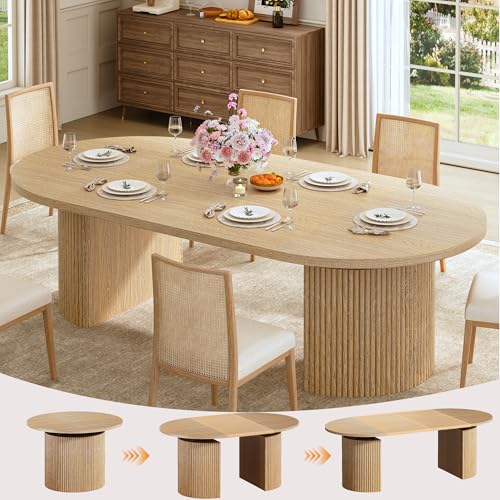
HUAHUU Extendable Round Dining Table for 4-8, 39in-77in Long Large Kitchen Table with Fluted Base, Space Saving Modern Farmhouse Oval Dinner Tables for Dining Room, Kitchen, Living Room, Natural
Check price on Amazon
55-94.5IN Extendable Oval Dining Table with Storage for 6 10 12,Black | 94.5''Modern Farmhouse Expandable Kitchen Table,Fluted Wood Door Long Wooden Tables,Double Pedestal Base for Kitchen,Dinner
Check price on Amazon
MECHYIN 55"-71" Extendable Dining Table for 4-8 with Built-in Flip Leaf | Space‑Saving Modern Rectangle Dining Table, Built‑in Flip Leaf, Sturdy Metal Legs, for Kitchen & Dining Room,Small Apartments
Check price on Amazon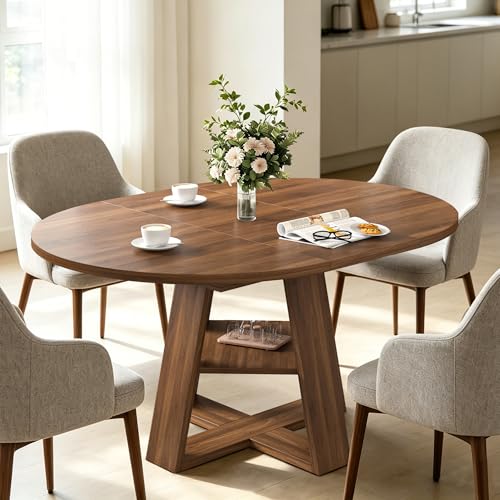
43.3"-59" Extendable Round Oval Dining Table for 4-8 with Storage Shelf | Modern Kitchen Oval Dining Table with Removable Leaves,Space Saving Extendable Table Wood Base for Kitchen Living Room Walnut
Check price on Amazon
19.6"-118.1" Modern Extendable Dining Table with Built-in Outlet (Oak) | Expandable Dining Space for 2-12 People, Space-Saving Design, for Parties, Weddings & Meetings
Check price on AmazonFrequently Asked Questions
What is a modern extendable dining table?
A modern extendable dining table is a contemporary-designed table with a built-in mechanism that expands the surface to seat more people. It combines clean lines and minimalist styling with the practical flexibility of removable or folding leaves.
Which extension mechanism is best for daily use?
Butterfly leaf and self-storing leaf mechanisms are the most convenient for daily use because the leaves remain attached and fold away under the tabletop. Telescoping mechanisms are ideal for larger expansion ranges but require more clearance.
How much space do I need around an extendable dining table?
Allow at least 36 inches of clearance around the table for chair pull-out and walkway traffic. When the table is fully extended, verify that the expansion does not block doorways, cabinets, or primary circulation paths.
Can an extendable dining table be used outdoors?
Only if the table is explicitly rated for outdoor use. Most extendable mechanisms are sensitive to moisture and temperature swings, so indoor models should stay indoors. Look for weather-resistant coatings and stainless hardware on outdoor-rated models.
Ready to Choose Your Modern Extendable Dining Table?
You now have the framework to evaluate mechanisms, materials, sizing, and style. Browse our curated selection of modern extendable dining tables to find the one that fits your room and your life.
View Recommended Tables