
Mission Style Dining Table with Leaves
Everything you need to know about choosing an Arts and Crafts dining table with extension leaves — wood selection, leaf mechanisms, sizing, and styling for a table that grows with your household.
Why a mission style table with leaves makes sense: A mission dining table brings honest craftsmanship and clean geometry into the home, while extension leaves add the flexibility modern households demand. This guide explains the defining features of the style, how leaf systems work, which woods hold up best, and how to size the table so it seats two on a weeknight and eight on a holiday. By the end, you will know exactly which configuration to look for before you commit.
What Defines a Mission Style Dining Table?
Mission style — also called Arts and Crafts — emerged as a reaction against the heavy ornamentation of Victorian furniture. Its guiding principle is honest construction: the structure of the piece is the decoration. On a dining table, that translates into a handful of recognizable hallmarks you can use to evaluate any candidate.
- Straight lines and rectilinear forms. Legs, aprons, and stretchers are square or gently tapered rather than turned or carved.
- Exposed joinery. Through-tenons, mortise-and-tenon joints, and visible pegs are celebrated rather than hidden. Look for keyed or pinned joints at the leg-to-apron connection.
- Sturdy, grounded proportions. Mission tables tend to feel substantial, with thick tops and heavy legs that communicate durability.
- Slatted or panel detailing. Vertical slats on stretchers or lower shelves are a signature motif borrowed from the movement's architectural roots.
- Solid wood construction. Oak is the classic choice, though walnut, cherry, and quarter-sawn white oak appear on higher-tier pieces.
- Restrained finishes. Matte or satin finishes that let the grain read clearly are preferred over high-gloss lacquer.
Because the style is so architectural, it pairs naturally with Craftsman bungalows and bungalow-style interiors, but it also works in modern, farmhouse, and transitional rooms. If you are still narrowing down silhouettes, our comparison of round versus rectangular dining tables is a useful next read, since most mission tables are rectangular or softly squared off.
How Leaves Work on a Mission Dining Table
The extension leaf is what turns a mission table from a fixed statement piece into a practical family table. There are three common mechanisms, and each has trade-offs worth understanding before you shop.
1. Standard Removable Leaves
The tabletop splits in the center, and one or more leaves are inserted manually. You lift the top halves apart on a sliding mechanism, drop the leaf in, and lock it down. This is the most traditional approach and the easiest to repair, but it requires somewhere to store the leaves when they are not in use. On mission tables, the leaf is usually a solid wood panel that matches the top grain.
2. Self-Storing Butterfly Leaf
A butterfly leaf is hinged in the middle and folds in half to stow inside the table when closed. Pulling the two halves of the top apart unfolds it automatically. This is the most convenient option for households that extend the table frequently, because there is no separate leaf to store or misplace. The trade-off is a slightly more complex mechanism and a visible seam where the leaf folds.
3. Drop-Leaf Design
Drop-leaf tables have hinged sections on one or both ends that fold down against the sides. Mission drop-leaf tables are less common than center-split designs but appear in compact and apartment-friendly variants. They are ideal when the table sits against a wall most of the time but needs to open for guests. Our guide to extendable versus fixed dining tables covers the practical differences in more depth.
Quick comparison of leaf systems
| Leaf Type | Best For | Storage Need | Ease of Use |
|---|---|---|---|
| Standard removable leaf | Occasional hosting, traditional look | Separate storage required | Moderate — manual insertion |
| Self-storing butterfly leaf | Frequent extension, no storage space | Built-in compartment | High — unfolds in one motion |
| Drop leaf | Compact rooms, wall placement | None — folds against table | High — single hinge action |
Choosing the Right Wood for a Mission Table
The wood species affects both the visual character of the table and how it ages. Mission furniture is closely associated with oak, but several species are viable depending on the tier you are shopping.
Solid Oak
Oak is the canonical mission material. Its open grain takes a matte finish beautifully, and its density makes it resistant to daily wear. Quarter-sawn white oak is the premium choice because the cut exposes ray fleck — the shimmering flecks of medullary ray that authenticate the Arts and Crafts look. Plain-sawn oak is more common and more economical, with a broader cathedral grain. For a deeper comparison of wood versus glass tops, see our wood versus glass dining table article.
Walnut
Walnut is a high-end tier option that brings a darker, warmer tone and a finer grain than oak. It suits mission tables that lean toward a more refined, contemporary interpretation of the style. Walnut is softer than oak and benefits from a protective pad during heavy use.
Cherry and Maple
Cherry darkens gracefully with exposure to light and suits warmer palettes. Maple offers a clean, pale surface that works well in Scandinavian-leaning rooms. Both are mid-tier choices that can look excellent when the joinery is well executed.
Wood selection at a glance
| Wood | Market Tier | Character | Best For |
|---|---|---|---|
| Plain-sawn oak | Entry-level to mid-range | Bold cathedral grain, honey to medium brown | Traditional mission look with broad grain |
| Quarter-sawn white oak | Premium | Ray fleck, straight grain, pale to medium | Authentic Arts and Crafts authenticity |
| Walnut | Premium to luxury | Dark, fine-grained, warm undertones | Refined, contemporary mission interiors |
| Cherry | Mid-range | Warm red-brown that darkens over time | Cozy, traditional dining rooms |
| Maple | Mid-range | Pale, uniform, closed grain | Light, Scandinavian-influenced rooms |
Sizing a Mission Table with Leaves
The whole point of a leaf is flexibility, so size the table by its extended length rather than its closed footprint. A workable rule is to allow 24 inches of table edge per seated guest, and to plan for a minimum of 36 inches of clearance between the table edge and any wall or furniture so chairs can pull out comfortably.
- Closed length around 60 inches: seats four comfortably, extends to six with one leaf.
- Closed length around 72 inches: seats six, extends to eight with one leaf or ten with two.
- Closed length around 84 inches: seats eight, extends to ten with a single wide leaf.
Mission tables typically add 12 to 18 inches per leaf. A 60-inch table with one 18-inch leaf reaches 78 inches and seats six comfortably. Confirm the leaf width before buying, and measure the extended footprint plus chair clearance in your room. If your space is tight, our guide to compact dining nook arrangement offers layout strategies that preserve walkway space.
Styling a Mission Style Dining Table
Mission furniture rewards restraint. Because the table already carries strong visual structure, the surrounding décor should complement rather than compete. Start with the chair choice: slat-back chairs in matching oak are the classic pairing, while upholstered neutral chairs soften the rectilinear lines for a transitional look. A bench on one side is a practical way to seat more people without crowding.
For the tabletop, keep centerpieces low and linear so sightlines across the table stay open. A simple runner, a low bowl of greenery, or a pair of ceramic vessels reads well against oak grain. If you want to explore specific aesthetics, our guides to rustic dining table styling and modern dining table styling show how the same mission table can shift mood through accessories alone. For palette direction, the neutral dining table palette guide is a natural fit for oak and walnut tones.
Lighting matters too. A linear pendant or a pair of pendants aligned with the table's long axis reinforces the horizontal lines of the style. Avoid oversized chandeliers that fight the table's geometry.
Care and Maintenance Considerations
Solid wood mission tables are durable but not indestructible. A few habits keep the finish and the leaf mechanism in good condition for decades:
- Use coasters and trivets — heat and moisture are the two most common causes of surface damage on oiled and matte finishes.
- Dust with a soft, slightly damp cloth and avoid silicone-based polishes that can build up on matte surfaces.
- Re-oil or wax according to the manufacturer's guidance, typically once or twice a year for oiled finishes.
- Keep the leaf mechanism clean and free of grit; a dry brush along the slides prevents binding.
- Maintain indoor humidity between 35 and 55 percent to reduce seasonal wood movement that can make leaves fit tightly or loosely.
For a detailed routine, see our dining table surface care guide. If you are assembling a flat-pack mission table, the dining table setup guide covers the sequence for installing leaf slides correctly.
Who Should Choose a Mission Table with Leaves?
This configuration suits several specific buyer profiles:
- Growing households that need a four-seat everyday table but host six to eight regularly.
- Craftsman or bungalow owners looking for furniture that matches the architecture of the home.
- Buyers who value repairability — solid wood and mechanical leaf slides can be serviced, unlike veneered or glass-topped alternatives.
- Design-conscious shoppers who want a statement piece that still reads as understated.
If you are still comparing styles, our dining table style and design hub is the best starting point, and the editor's choice dining tables roundup includes mission-influenced picks worth shortlisting.
Recommended Mission Style Dining Tables with Leaves
⚠️ AFFILIATE DISCLOSURE: This website contains affiliate links. As an affiliate Associate, we earn from qualifying purchases. If you make a purchase through these links, we may receive a small commission at no additional cost to you. Read our full affiliate policy.
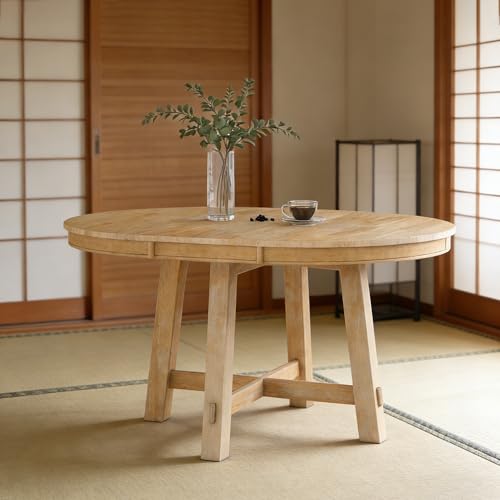
Bellemave 42"-58" Extendable Dining Table for 4-6, Solid Wood Oval Dining Kitchen Table with Removable Leaf, Farmhouse Circle Desk for Kitchen Living Room Space Saving (Natural Wood Wash)
Check price on Amazon
Signature Design by Ashley Extendable Dining Table, Grayish Brown, Seats 8 | Wood, Acacia veneer, Engineered wood, Rectangular farmhouse style, 2 extension leaves, Moriville Series
Check price on Amazon
Fabulcozy 47.2"-63" Extendable Round Dining Table for 4-8, Kitchen Table | Modern Oval Kitchen & Dining Room Table with Removable Leaves & Storage Shelf, Space Saving Drop Leaf Wood Furniture, Walnut
Check price on Amazon
Drop Leaf Dining Table, 31.5"-55.1" Foldable Solid Pine Wood Kitchen Table | Expandable,Dual Hinged Leaves, Brown And White Finish, Seats 4 To 6, Compact Layout For Apartments, Farmhouse, Small Space
Check price on Amazon
knoworld 43"-59" Extendable Round Dining Table for 4-8, V-Leg | Kitchen Modern Oval Dining Table with Removable Leaves, Wood Base with Storage Shelf for Kitchen Living Room, Walnut
Check price on Amazon
Signature Design by Ashley Haddigan Dining Extension Table, Seats 6-8 | Veneers, wood and engineered wood, Farmhouse style wood dining table, Self-storing 18-inch butterfly leaf, Kitchen table
Check price on Amazon
Best Choice Products 42" Round Drop Leaf Dining Table for 4, Solid Wood Expandable Small Dining Table W/Storage Shelf, Space Saving Kitchen Table for Kitchen, Dining Room, & Small Spaces - Chestnut
Check price on Amazon
East West Furniture AVT-SBR-TP Avon Kitchen Dining Table - an Oval Wooden Table Top with Butterfly Leaf & Pedestal Base, 42x60 Inch, Saddle Brown
Check price on AmazonFrequently Asked Questions
What defines a mission style dining table?
A mission style dining table is characterized by clean straight lines, exposed joinery, geometric forms, and sturdy Arts and Crafts construction. It typically uses solid wood such as oak and avoids ornate carving, emphasizing functional craftsmanship instead.
How do leaves work on a mission style dining table?
Leaves are removable or self-storing panels that extend the tabletop. On mission tables, leaves usually slide into a central split or fold into a leaf storage compartment beneath the table. A self-storing butterfly leaf is often the most convenient mechanism for occasional hosting.
Which wood is best for a mission dining table?
Solid oak is the most traditional choice because its grain and density suit the Arts and Crafts aesthetic and hold up to daily use. Quarter-sawn white oak in particular shows the distinctive ray-fleck figure associated with authentic mission furniture. Walnut and cherry are also suitable premium alternatives.
How much extension do I need for a mission dining table?
A single leaf typically adds 12 to 18 inches of length, which seats two additional guests. For regular hosting of six to eight people, a table that extends from around 60 to 84 inches with one or two leaves works well. Always leave at least 36 inches of clearance around the extended footprint.
Does a mission style table fit modern or farmhouse interiors?
Yes. Mission furniture blends naturally with modern, Craftsman, bungalow, and farmhouse interiors because its simple geometry and honest materials feel at home in many palettes. Pair it with neutral upholstered chairs for a contemporary look or slatted benches for a rustic feel.
Ready to narrow down your shortlist? Compare the top-rated mission and Arts and Crafts tables on the market.
View Highest-Rated Dining Tables