


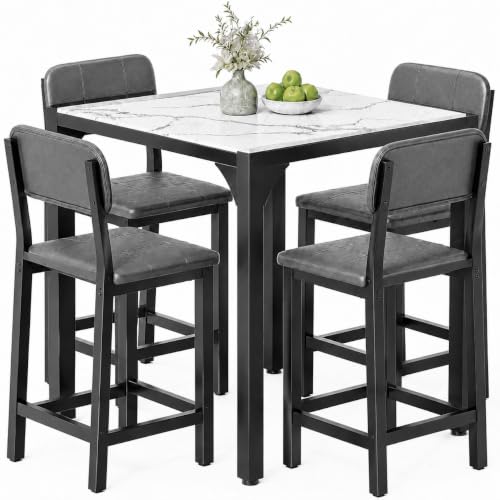


What Is a Marble Top Counter Height Dining Table?
A marble top counter height dining table is a dining table whose surface is made from natural or engineered marble, mounted on a base that raises the tabletop to counter height — typically between 34 and 36 inches from the floor. That is noticeably taller than a standard dining table (roughly 28 to 30 inches) but shorter than a bar height table (around 40 to 42 inches).
The combination matters because each element solves a different problem. Marble delivers a cool, luminous, upscale surface that resists heat and scratches well. Counter height delivers a more casual, transitional seating experience that feels closer to a kitchen island than a formal dining room. Together, they create a table that works as a breakfast station, a homework hub, a casual entertaining surface, and a design focal point all at once.
Counter height dining tables are particularly popular in open-plan homes where the dining area flows into the kitchen. The taller profile creates visual separation without needing a wall, and the marble surface echoes the stone often used on kitchen counters — producing a cohesive look. If you are exploring related height options, our broader guide to bar height dining tables explains how the two heights differ in practice.
Marble Top Options: Natural vs Engineered
The word "marble" on a product listing can mean several different things, and the distinction has a major effect on durability, care, and long-term appearance. Understanding the three main categories helps you interpret specifications accurately.
1. Natural Marble
Natural marble is quarried stone, typically calcite or dolomite based, with distinctive veining that no two slabs share. It is the most visually authentic option and the one most associated with luxury dining furniture. However, natural marble is porous and reacts to acidic substances such as vinegar, citrus, wine, and many cleaning products. It requires sealing and mindful maintenance.
2. Engineered Marble (Marble-Look Quartz or Composite)
Engineered marble is a manufactured surface — usually ground stone mixed with resin — designed to look like marble while offering more uniform appearance and lower porosity. It is generally more stain-resistant and easier to maintain than natural marble, though it can be less heat-tolerant depending on the resin content. Many mid-range counter height marble tables use engineered surfaces for exactly this reason.
3. Marble Veneer or Laminate Overlay
Some entry-level tables use a thin marble-look layer over a composite core. These are lighter and easier to move, and they can look convincing at a distance, but they are less resistant to impact and edge damage. They suit light-use settings such as a secondary breakfast table or a rental property.
| Surface Type | Durability | Care Level | Best For |
|---|---|---|---|
| Natural marble | High hardness, porous, needs sealing | Moderate — reseal periodically | Design-focused homes, formal-casual dining |
| Engineered marble / quartz | High, low porosity, uniform | Low — wipe and go | Family homes, daily use, busy kitchens |
| Marble veneer / laminate | Moderate, edge-sensitive | Low | Light-use settings, secondary tables |
Why Choose Counter Height With a Marble Top?
Counter height tables sit at a sweet spot between formal dining and casual kitchen seating. Here is what that translates to in everyday life:
- Transitional seating comfort. Counter height chairs are easier to get in and out of than bar stools, making them friendlier for children and older family members.
- Visual height and presence. A taller table with a stone top reads as a design statement without dominating a room the way a large formal dining table might.
- Kitchen-to-dining cohesion. The height aligns with many kitchen islands, and the marble echoes counter surfaces for a unified palette.
- Casual entertaining. Guests can perch, chat, and graze — ideal for brunches, wine-and-cheese evenings, and holiday overflow seating.
- Storage underneath. The taller clearance beneath a counter height table allows for stools that tuck in, and sometimes a lower shelf on the base.
If your space leans more toward formal dining, a standard height marble table may suit better. If you want maximum casual flexibility, you might also compare with a bar height dining table guide to see which profile fits your room and household.
Sizing a Marble Counter Height Dining Table
Counter height tables follow the same footprint logic as standard tables, but you need to account for the taller profile when planning walkways and chair clearance. The table below gives practical starting points.
| Shape | Typical Dimensions | Seats | Best Room Context |
|---|---|---|---|
| Round | 36–48 in diameter | 2–4 | Breakfast nooks, small kitchens, conversation-focused spaces |
| Square | 36–48 in per side | 4 | Compact dining areas, symmetrical layouts |
| Rectangular | 60–72 in long, 36–40 in wide | 4–6 | Open-plan dining zones, family kitchens |
| Oval | 60–72 in long, 36–40 in wide | 4–6 | Rooms with traffic flow around the table |
As a rule of thumb, allow about 24 inches of table width per seated person and at least 36 inches of clearance between the table edge and any wall or obstacle to allow chairs to pull out comfortably. For a deeper look at placement, see our guide to dining table space planning and the walkway clearance guide.
Base and Frame Construction
Marble is heavy — a natural stone top on a 60-inch table can weigh well over a hundred pounds on its own. The base must be engineered accordingly. Three base styles dominate the market:
Pedestal Bases
A central pedestal with a wide foot distributes weight and maximizes legroom. On counter height tables, pedestal bases are popular because they let stools tuck in from all sides. Look for a wide, weighted foot and internal metal reinforcement rather than a purely decorative column.
Trestle Bases
Trestle bases use two vertical supports connected by a stretcher. They feel sturdy and traditional, and they suit rectangular marble tops well. Ensure the stretcher sits low enough that counter stools can still tuck under the table.
Four-Leg Bases
Four-leg designs are the most familiar and offer clear, predictable legroom. On marble-topped counter height tables, look for legs made from solid hardwood or metal with cross-bracing, since the top's weight concentrates at the joints.
Stability check before you buy
Because marble is heavy and counter height raises the center of gravity, stability is critical. Confirm that the base has a wide footprint relative to the top, that joints are reinforced with metal hardware rather than glue alone, and that the table includes leveling feet for uneven floors. A wobbly counter height marble table is a safety concern, not just an annoyance.
Seating: Chairs and Stools That Fit
Counter height tables pair with counter stools or chairs with a seat height of roughly 24 to 26 inches. The goal is about 10 to 12 inches of clearance between the seat and the underside of the tabletop — enough for comfortable legroom without the seat feeling too low.
When choosing seating, consider the marble top's thickness. A thick marble slab reduces the space between the underside of the table and the floor, which can affect whether taller stools fit comfortably. Backless stools work well in tight spaces, while low-back or full-back counter chairs offer more support for longer meals. Our dining table chair height guide and dining chair selection guide go deeper into matching seat height to table height.
Caring for a Marble Top Table
Marble is beautiful but not maintenance-free. A simple routine keeps it looking its best for years.
- Seal natural marble regularly. Depending on use, reseal every six to twelve months with a stone sealer. Engineered marble typically needs less frequent sealing.
- Wipe spills promptly. Acidic foods and drinks — citrus, wine, vinegar, tomato — can etch natural marble if left standing.
- Use coasters and trivets. Marble handles moderate heat well, but sudden temperature changes and prolonged direct heat from hot pans can cause damage, especially on engineered surfaces.
- Clean with pH-neutral products. Avoid acidic or abrasive cleaners. A damp cloth with mild dish soap is usually sufficient.
- Blot, don't scrub, stains. For stubborn marks, a poultice may be needed on natural marble.
For a full routine, see our marble dining table sealing guide and dining table stain removal guide. If you notice a wobble over time, our wobbly dining table fix guide walks through the common causes and solutions.
Marble Counter Height vs Other Dining Configurations
Comparing configurations helps you confirm that counter height marble is genuinely the right choice for your home. The table below summarizes the trade-offs.
| Configuration | Seating Feel | Space Efficiency | Best Suited To |
|---|---|---|---|
| Marble counter height | Casual, transitional, easy in/out | Good — tall clearance for stools | Kitchens, breakfast nooks, open-plan homes |
| Marble standard height | Formal, traditional | Moderate | Dining rooms, formal entertaining |
| Wood counter height | Casual, warmer texture | Good | Farmhouse and rustic interiors |
| Glass counter height | Casual, lighter visual weight | Excellent in small rooms | Compact spaces, modern interiors |
If you are still deciding on shape, our guides to round dining tables and rectangular dining tables break down the spatial and social dynamics of each. For extendable flexibility, the extendable dining table guide is a useful companion read.
How to Evaluate Quality Without Seeing It in Person
Most shoppers buy online, so it helps to know which specification details separate a well-built table from a mediocre one.
- Top thickness. A natural marble top of 1 inch or more reads as substantial and resists cracking better than thin slabs. Engineered tops often run slightly thinner but should still feel solid.
- Edge profile. Rounded or eased edges are safer for counter height tables where people lean in. Our dining table edge profile guide explains the options.
- Base material. Solid hardwood or powder-coated metal bases outperform particle board or thin tubular frames on heavy marble tops.
- Weight capacity and stability notes. Listings that specify weight capacity and base reinforcement are generally more reliable than those that omit them.
- Assembly and hardware. Look for metal-to-metal connections, included leveling feet, and clear assembly instructions.
Styling a Marble Counter Height Dining Table
Marble is a strong visual element, so styling works best when it is allowed to lead. A few principles hold across most interiors:
- Keep centerpieces low and simple. A small vase, a bowl of fruit, or a single sculptural object preserves sightlines across the table.
- Choose stools that echo the base material. Wood stools warm up a marble top; metal stools reinforce a modern look.
- Layer textiles for softness. A runner or placemats soften the stone's coolness and add seasonal color.
- Use lighting at counter height. Pendant lights hung 30 to 36 inches above the tabletop illuminate the surface and anchor the dining zone.
For more ideas, our dining table vignette ideas and dining table centerpiece guide cover styling in depth.
Common Mistakes to Avoid
- Buying stools before the table. Confirm the exact table height and apron depth first, then choose seating.
- Underestimating walkway clearance. Counter height tables need the same or more clearance than standard tables because stools pull out further.
- Ignoring marble porosity. Skipping sealing on natural marble invites etching and staining.
- Overlooking base stability. A heavy marble top on a light or narrow base is a tipping risk, especially with kids and pets.
- Mismatching height and room. Counter height works best in casual, open spaces; in formal dining rooms, standard height may be more appropriate.
Our dining table buying mistakes article covers additional pitfalls across all table types.
Frequently Asked Questions
What is a marble top counter height dining table?
A marble top counter height dining table is a dining table with a natural or engineered marble surface set at counter height, typically around 34 to 36 inches from the floor. It combines the elegance of marble with a taller, more casual seating profile.
Is a marble top counter height dining table durable for daily use?
Yes, when properly sealed. Marble is a hard stone that resists scratching better than many softer surfaces, but it is porous and can stain if unsealed. Regular resealing and prompt cleanup of acidic spills keep it durable for everyday family dining.
What chair height works with a counter height dining table?
Counter height dining tables typically pair with counter stools or chairs with a seat height of about 24 to 26 inches. Look for roughly 10 to 12 inches of clearance between the seat and the underside of the tabletop.
How many people fit at a marble counter height dining table?
A 36-inch round counter height table seats two to three people, a 42 to 48-inch round or square seats four, and a 60-inch rectangular counter height table seats four to six. Allow about 24 inches of width per person for comfortable dining.
Does marble need special cleaning products?
Natural marble should be cleaned with pH-neutral products. Avoid acidic cleaners like vinegar or lemon-based sprays, which can etch the surface. A damp cloth with mild dish soap is usually sufficient for daily cleaning.
Final Checklist Before You Buy
- Confirm the table height (34–36 in) and seat height compatibility (24–26 in).
- Measure the room and walkways, allowing at least 36 inches of clearance around the table.
- Decide between natural and engineered marble based on your tolerance for maintenance.
- Verify base construction — solid hardwood or metal, reinforced joints, leveling feet.
- Plan for sealing and a pH-neutral cleaning routine if you choose natural marble.
- Check the edge profile for comfort and safety, especially with children in the home.
- Review the assembly process and hardware quality before committing.
With these steps complete, you are ready to choose a marble top counter height dining table that fits your space, your household, and your maintenance habits — and enjoy it for years to come.