
Furniture Dining Table and Chairs: The Complete Guide
Learn how to choose a dining table and chair combination that fits your room, your seating needs, and your everyday life. This guide covers sizing, materials, chair pairing, and styling so you can build a balanced dining set with confidence.
Explore Recommended SetsWhy tables and chairs should be planned together: A dining table is only half of the equation. The chairs you pair with it determine comfort, traffic flow, and the visual balance of the room. Buying them as a coordinated set or with deliberate pairing in mind prevents the most common furniture mistakes, such as chairs that are too tall for the tabletop, seats that crowd the room, or finishes that clash. This guide walks you through the decisions step by step.
Start With the Room, Not the Furniture
Before comparing individual tables or chairs, measure the space you actually have. The floor area available determines the table size, and the table size determines how many chairs you can comfortably seat. Working in this order keeps you from falling in love with a set that physically will not fit.
As a rule of thumb, leave at least 36 inches of clearance on every side of the table where chairs are placed. That space lets people pull chairs out, walk behind seated guests, and serve food without squeezing. If your room is tight, a round or oval table often fits better than a rectangular one because it removes sharp corners from walkways.
- Small rooms: A compact round table paired with two to four chairs keeps the footprint efficient.
- Medium rooms: A rectangular or oval table seating four to six is the most versatile configuration.
- Large rooms: An extendable table or a long rectangular table allows you to seat eight or more without crowding.
If your dining area doubles as a breakfast nook or a passageway, consider a smaller footprint design such as a round breakfast dining table that stays sociable without dominating the room.
The Table and Chair Height Relationship
Height is the single most overlooked factor when buying furniture dining table and chairs. A mismatch here causes knee collisions, awkward arm positions, and uncomfortable meals. The standard relationship is straightforward: a dining table around 30 inches tall pairs best with chairs that have a seat height of 17 to 19 inches.
Counter-height dining sets sit higher, with tables around 34 to 36 inches and seats around 24 to 26 inches. Bar-height sets are taller still. The key is to choose a table and chairs from the same height category. Mixing a standard table with counter-height stools, for example, creates an uncomfortable gap between the seat and the tabletop.
| Height Category | Typical Table Height | Seat Height Range | Best For |
|---|---|---|---|
| Standard dining | Around 30 inches | 17–19 inches | Everyday family meals, formal dining rooms |
| Counter height | 34–36 inches | 24–26 inches | Casual kitchens, open-plan spaces |
| Bar height | 40–42 inches | 28–30 inches | Entertaining, small footprints, high-top areas |
Quick fit check
When seated, there should be roughly 10 to 12 inches of clear space between the top of your thighs and the underside of the table. If your knees touch the apron or the tabletop, either the table is too low or the chair is too tall.
How Many Chairs Does Your Table Need?
Seating capacity depends on table shape and size. A rectangular table generally allows about 24 inches of width per person along the long edges. Round and oval tables distribute seating around the perimeter, which often feels more generous and encourages conversation.
- Two-seater: Compact round or square tables, ideal for couples or small nooks.
- Four-seater: The most common configuration, usually a 36 to 48 inch square or a medium rectangular table.
- Six-seater: A rectangular table of around 60 to 72 inches, or a large round table.
- Eight or more: Long rectangular tables or extendable designs that grow for holidays and gatherings.
If you host occasionally but live with a smaller day-to-day group, an extendable table is a practical solution. You keep a compact footprint for daily use and expand when guests arrive, which pairs naturally with a oval dining table set for 6 or larger configurations.
Pairing Chairs With Your Table: Styles That Work
There is no rule that says chairs must be identical to the table, but they should feel related. The most reliable approach is to match one or two design elements while letting the rest contrast gently.
Match the finish, not necessarily the material
If your table is a warm mid-tone wood, chairs in a similar wood tone or a complementary neutral fabric will feel cohesive. A light oak table, for example, pairs naturally with chairs that echo that warmth, such as a light wood round dining table matched with pale wood or woven-seat chairs.
Contrast with intention
A dark wood table with metal-framed chairs creates a deliberate, modern contrast. Similarly, a metal table can be softened with upholstered chairs. The trick is to repeat one element, such as a black frame or a brass accent, so the contrast reads as designed rather than accidental.
Consider a mixed chair approach
Some designers pair a bench on one side with chairs on the other. This works especially well in narrow rooms because a bench tucks fully under the table, freeing up walkway space. It also adds visual variety without breaking the overall harmony of the set.
Chair style pairing cheat sheet
Farmhouse table: ladder-back or cross-back wooden chairs, or a bench on one side. Modern minimalist table: slim upholstered chairs or molded shell seats. Industrial table: metal-framed chairs with wood seats. Marble or stone table: upholstered chairs in soft neutrals to balance the hard surface.
Materials: What to Know Before You Buy
Both the table and the chairs carry a material story, and the two should be considered together for durability and maintenance.
Table materials
- Solid wood: Durable and repairable, with a natural warmth that suits almost any chair style. It is a long-term investment when properly cared for.
- Engineered wood and veneer: Stable and consistent, often found in mid-range sets. Good value for its tier and less prone to seasonal movement.
- Stone and faux stone: Marble and stone-look surfaces offer a premium look and are easy to wipe clean. A faux marble dining room table delivers that aesthetic with lighter weight and simpler maintenance.
- Metal: Steel and aluminum frames are heavy-duty and weather-resistant, making them a solid choice for high-traffic or multi-use spaces. A square metal dining table pairs especially well with metal or composite chairs.
Chair materials
- Wooden chairs: Sturdy and timeless. Look for reinforced joints and solid build quality, especially on the legs and back rails.
- Upholstered chairs: Comfortable and design-forward. Performance fabrics in the mid-range and premium tiers resist stains and wear well in family homes.
- Metal chairs: Durable and easy to clean, ideal for industrial and modern interiors. Check for rust-proof finishes on painted frames.
- Woven and rattan seats: Light and breathable, adding texture to natural wood tables.
Quality Tiers Explained
To help you compare options without focusing on numbers, here is how dining table and chair sets generally fall into quality tiers. Use this as a guide to relative positioning rather than as a ranking of specific products.
| Tier | Typical Construction | Best For |
|---|---|---|
| Entry-level | Engineered wood, basic joinery, simpler finishes | First apartments, guest rooms, short-term setups |
| Mid-range | Solid wood frames, reinforced joints, performance fabrics | Family homes, everyday use, long-term ownership |
| Premium | Hardwood construction, refined finishes, high-grade upholstery | Design-focused dining rooms, formal entertaining |
| Luxury | Hand-finished hardwoods, natural stone, artisan detailing | Statement dining spaces, heirloom-quality investment |
Mid-range sets usually offer the most balanced combination of durability and design flexibility, while premium and luxury tiers focus on materials and craftsmanship that hold up over decades of use.
Practical Details That Affect Daily Use
- Apron clearance: A deep apron under the tabletop can limit legroom. If you plan to use armchairs, check that the arms slide under the apron.
- Chair weight and glides: Heavier chairs feel more stable but are harder to move. Felt glides protect wood floors and make sliding easier.
- Extendable mechanisms: If you choose an extendable table, test the leaf mechanism. Mid-range and premium models typically offer smoother, more durable hardware than entry-level designs.
- Finish care: Matte finishes hide scratches better; glossy finishes show fingerprints but wipe clean easily. Match the finish to how you actually use the room.
- Stability: A table that wobbles on day one rarely improves. Look for leveling feet or a sturdy pedestal base on uneven floors.
For larger households or frequent hosting, a dining table for 10 people with a reinforced frame and matching sturdy chairs prevents the sagging and wobble that lighter sets develop under constant use.
Styling Your Table and Chair Set
Once the functional decisions are made, styling brings the set together. Keep the palette cohesive by repeating one or two colors from the table or chairs in your centerpiece, rug, or wall decor. A dark cherry table, for example, pairs beautifully with warm neutrals and soft lighting, while a dark cherry dining table anchoring a formal room benefits from lighter upholstered chairs to prevent the space from feeling heavy.
Round tables are naturally sociable and work well with a single low centerpiece, while rectangular tables can handle a runner or a pair of symmetrical arrangements. Leave enough open surface for serving dishes, and avoid over-styling if the table is used for daily meals.
Common Mistakes to Avoid
- Buying chairs before measuring the table height. Always confirm the seat-to-tabletop relationship first.
- Ignoring walkway clearance. A beautiful set that blocks the room becomes frustrating within a week.
- Mixing too many finishes. Two or three complementary tones work; five competing ones look chaotic.
- Choosing chairs for looks alone. Sit in them. Comfort over a long meal matters more than a perfect silhouette.
- Overlooking maintenance. A high-maintenance finish is fine for a formal room but impractical for a busy family kitchen.
For a deeper comparison of shapes and their seating implications, our guide on the extendable large round dining table explains how round designs balance capacity with flow in larger rooms.
Recommended Furniture Dining Table and Chairs Sets
⚠️ AFFILIATE DISCLOSURE: This website contains affiliate links. As an affiliate Associate, we earn from qualifying purchases. If you make a purchase through these links, we may receive a small commission at no additional cost to you. Read our full affiliate policy.

IRONCK Dining Table Set for 4, Rustic Brown | Wood Kitchen Table with Upholstered Chairs for Kitchen Room and Small Spaces
Check price on Amazon
Signature Design by Ashley Caitbrook Dining Table Set for 6, Gray Wash | Acacia Veneer & Engineered Wood, X-Back Cushioned Chairs, 36x60 Inch Footprint, Nailhead Trim Accents
Check price on Amazon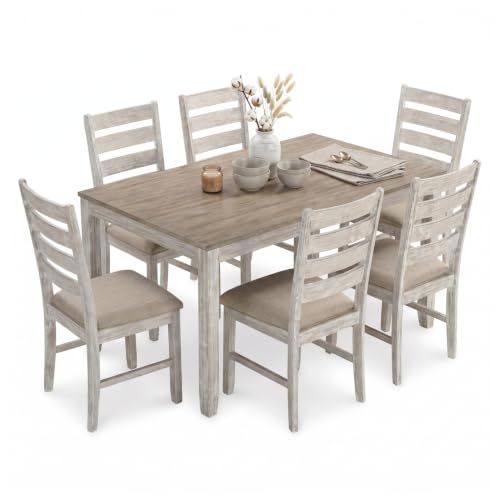
Signature Design by Ashley Skempton 7-Piece Dining Table Set for 6 | Solid Wood, Engineered Wood & Acacia Veneer Construction, 60-In Table, Cushioned Polyester Seating, Two-Tone Finish
Check price on Amazon
IRONCK Dining Table Set for 4, Kitchen Table and Chairs Set, Rustic Brown | Kitchen Table with Upholstered Bench and 2 Chairs for Small Space, Apartment
Check price on Amazon
Vexwalx Outdoor Dining Set, Aluminum Dining Table Set for 6, Patio Table and Chairs Set with Umbrella Hole, All Weather HDPS Outdoor Table and Chairs for 6 (7-Piece, Gray-Teak)
Check price on Amazon
COLAMY Wooden Dining Chairs Set of 4, Upholstered Kitchen Side Chair, Beige | Modern Fabric Farmhouse Dining Room Chairs with Solid Wood Legs and Curved Backrest for Kitchen/Apartment/Small Space
Check price on Amazon
Dining Table Set for 4,Kitchen Table and Chairs for 4, Round Dining Room Table with Upholstered Chairs, 5 Piece Space Saving Circle Wood Kitchen & Dining Room Dinner Dinette Table Set (Vintage, 42In)
Check price on Amazon
Devoko 7 PCS Acacia Wood Patio Dining Set, Black Rattan | Outdoor Patio Furniture Set, Patio Dining Table Set for 6, Patio Table and Chairs Set For Garden Backyard Pool Side
Check price on AmazonFrequently Asked Questions
Should dining table and chairs match exactly?
They do not need to match exactly. A coordinated approach, where the chairs share a wood tone, finish, or silhouette with the table, often looks more intentional and designer-driven than a perfectly identical set.
How much clearance do I need between the dining table and chairs?
Aim for at least 12 inches between the table edge and the seat front for comfortable seating, and roughly 36 inches of walkway clearance behind the chairs so people can pull out and pass through.
What is the ideal seat height for a standard dining table?
A standard dining table is around 30 inches tall, so chairs with a seat height of 17 to 19 inches provide the most comfortable relationship between seat and tabletop.
Are upholstered dining chairs practical for families?
Yes, when you choose performance fabrics or treated upholstery. Mid-range and premium upholstered chairs often use stain-resistant textiles that clean up easily, making them family-friendly.
Can I mix a round table with rectangular-style chairs?
Absolutely. Round tables work with almost any chair silhouette, from curved-back wooden chairs to slim upholstered seats. The key is to keep the proportions balanced so the chairs do not overwhelm the tabletop.
Ready to Build Your Dining Set
Use the guidance above to narrow down table shape, height, and chair pairing, then browse the recommended sets to compare features and find the combination that fits your space.
Compare Recommended Sets