
Extendable Circle Dining Table: The Complete Buying Guide
Discover how a round extendable dining table combines the sociable shape of a circle with the flexibility of a leaf system — perfect for compact rooms, growing households, and occasional hosting.
Explore Recommended ModelsWhy this guide matters: A round extendable table solves a specific problem — you want the warm, conversational feel of a circular table without sacrificing seating capacity when guests arrive. This guide walks you through mechanisms, sizing, materials, and practical trade-offs so you can choose with confidence.
Recommended Extendable Circle Dining Tables
⚠️ AFFILIATE DISCLOSURE: This website contains affiliate links. As an affiliate Associate, we earn from qualifying purchases. If you make a purchase through these links, we may receive a small commission at no additional cost to you. Read our full affiliate policy.

41 in-78 in Extendable Dining Room Table for 4-8, Round Expandable Kitchen Table with Fluted Base, Modern Farmhouse Oval Dinner Tables for Dining Room Kitchen Living Room (Walnut)
Check price on Amazon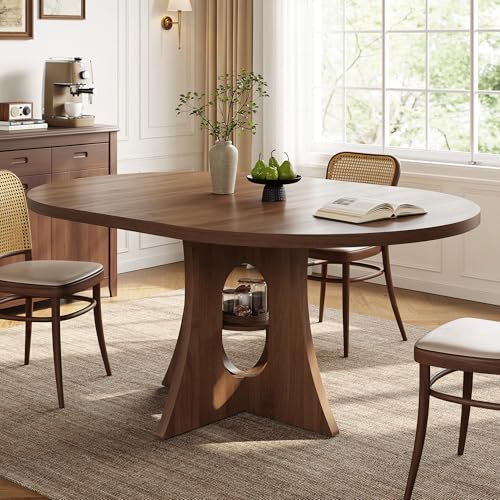
Sanyz 43.3"-59" Extendable Round-to-Oval Dining Table with Leaf & Storage | Oval Table, Round Kitchen Table, Seats 4-8, Modern Farmhouse, Space-Saving, Walnut Finish, Circle Table, Oval Dining Table
Check price on Amazon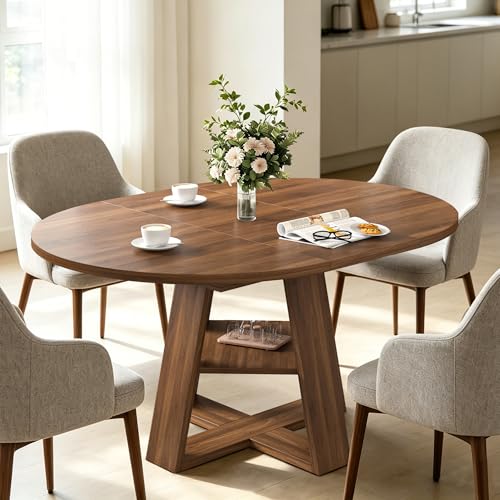
43.3"-59" Extendable Round Oval Dining Table for 4-8 with Storage Shelf | Modern Kitchen Oval Dining Table with Removable Leaves,Space Saving Extendable Table Wood Base for Kitchen Living Room Walnut
Check price on Amazon
IRONCK 43.3"–59.1" Extendable Round Dining Table for 4-6 People, Walnut | Wood Kitchen Table with Removable Leaves and Wood Strip Base, Circle Dinner Table for Dining Room, Living Room
Check price on Amazon
Limirix 47.2"–63" Extendable Dining Room Table for 4-8, Round-to-Oval Expandable Dining Table with Dust-Proof 2-Tier Shelf, Space-Saving Wood Kitchen Table for Living Room, Walnut
Check price on AmazonWhat Is an Extendable Circle Dining Table?
An extendable circle dining table — often called a round extendable dining table or a circular dining table with leaf — is a round table whose top can expand to accommodate more diners. Instead of a fixed diameter, the table includes one or two removable or self-storing leaves, or a split-top folding mechanism, that lengthens the surface into an oval or a larger circle.
The appeal is straightforward: a round table encourages conversation because everyone faces the center, and it eliminates sharp corners that interrupt walkways. The extension adds hosting capacity without permanently committing floor space. For households that host occasionally but live daily in a compact dining area, this dual personality is the main selling point.
If you are still weighing shapes, our guide on round dining tables that seat six to eight explains how diameter affects seating comfort in more detail.
How Round Extension Mechanisms Work
The mechanism is the single most important structural decision, because it determines how easy the table is to expand, how stable it feels when extended, and how long it will last. There are four common systems:
1. Butterfly Leaf
A butterfly leaf folds in half and stores inside the table when not in use. You pull the two halves of the top apart, unfold the leaf, and lock it in place. This system is popular because the leaf is always stored with the table — no searching for a leaf in a closet. Mid-range and premium models typically offer smoother sliding tracks than entry-level versions.
2. Self-Storing Leaf
Similar to the butterfly system but the leaf is stored in a dedicated compartment beneath the top. It is convenient and common on circular tables because the extra storage does not add much height.
3. Drop-Leaf
Hinged panels on one or both sides fold down against the table edge. When down, the table becomes a compact half-round or smaller circle; when up, it expands. Drop-leaf designs are excellent for very small spaces, but the extended surface is usually less rigid than a full butterfly leaf.
4. Split-Top Folding Mechanism
The top splits into two halves that slide apart on a central track, and a leaf is inserted between them. This is common on larger circular tables and offers good rigidity when properly engineered. Look for reinforced metal tracks rather than plastic guides.
Across all systems, the practical rule is simple: entry-level mechanisms work but require more care; mid-range models offer smoother operation; premium and luxury tiers deliver heavy-duty hardware that stays aligned after years of use.
Sizing: How Many People Can It Seat?
Seating capacity on a round table depends on diameter, not on the extension alone. The table below gives a practical planning reference. Allow roughly 24 inches (60 cm) of table edge per person for comfortable dining.
| Configuration | Typical Diameter | Comfortable Seating | Best For |
|---|---|---|---|
| Compact circle (no extension) | 36–42 in | 2–4 people | Apartments, breakfast nooks |
| Circle + one leaf | 42–48 in (extended) | 4–6 people | Small families, occasional guests |
| Circle + two leaves | 48–54 in (extended) | 6–8 people | Regular hosting, larger households |
| Large circular with dual leaves | 54–60 in (extended) | 8–10 people | Dedicated dining rooms |
Remember to measure clearance around the table: allow at least 36 inches (90 cm) between the table edge and walls or other furniture so chairs can pull out and people can walk behind them. For a deeper breakdown, see our guide on round dining tables with leaf extensions.
Materials and Finishes
Because a round extendable table has moving parts, material choice affects both durability and how well the mechanisms stay aligned over time.
Solid Wood
Solid oak, walnut, and mango wood are the most popular choices for round extendable tables. Solid wood handles the mechanical stress of repeated extension well and can be refinished if the surface shows wear. Natural oak is a classic for bright, airy rooms, while walnut brings a deeper, more formal tone. Our guide on the natural oak extendable dining table covers finish options and care in depth.
Engineered Wood and Veneer
Veneered tops over engineered cores are common in entry-level and mid-range models. They offer stable surfaces that resist seasonal movement, which can actually help a leaf mechanism stay aligned. The trade-off is that veneer cannot be sanded and refinished as many times as solid wood.
Mango Wood
Mango wood is a sustainable, character-rich option with visible grain variation. It is often used in rustic and farmhouse designs. See our mango wood dining table guide for care tips.
Glass and Metal
Glass tops on round tables create a light, open look, and metal frames can support a clean modern aesthetic. A glass and brass dining table style works well in compact rooms where visual weight matters. Note that glass tops are heavier and require careful handling when the extension mechanism is operated.
Finishes
Matte and oiled finishes are the most forgiving on a table that gets extended and retracted frequently, because they hide small scuffs. Glossy lacquered finishes look striking but show fingerprints and fine scratches more readily. If the table will see heavy daily use, a matte or oiled finish is usually the more practical choice.
Market Tiers: What to Expect at Each Level
Rather than comparing specific figures, it helps to understand how round extendable tables are positioned in the market. Use these tiers as a relative guide.
Entry-Level Tier
Veneered or engineered wood tops, basic butterfly or drop-leaf mechanisms, simplified hardware. Suitable for light use and smaller households. Good value for its tier if the mechanism is properly lubricated and the table is not extended daily.
Mid-Range Tier
Solid wood or high-grade veneer tops, smoother self-storing leaf systems, reinforced tracks. A balanced tier that handles regular extension without noticeable play in the mechanism.
Premium Tier
Solid hardwood construction, heavy-duty metal hardware, precise alignment and tighter tolerances. Well-specified for the category and built for frequent extension over many years.
Luxury Tier
Flagship materials such as thick solid slabs, premium stone or glass inserts, and commercial-grade mechanisms. A long-term investment for dedicated dining rooms and frequent entertaining.
Stability and Build Quality Checks
A round table with a leaf system relies on its base and frame for rigidity. When you evaluate a model, look for the following:
- Pedestal vs. four legs: A central pedestal frees up legroom around the circle, which is a major advantage on round tables. A sturdy pedestal base with a wide foot is generally more stable when the table is extended.
- Reinforced apron: The apron connects the legs or pedestal to the top and supports the leaf track. A reinforced apron prevents sagging when the table is fully extended.
- Metal track hardware: Metal guides and locking pins outlast plastic components. Check that the locking mechanism engages firmly with no wobble.
- Leveling feet: Adjustable feet compensate for uneven floors, which matters more on a round table because any wobble is felt around the whole circumference.
- Weight distribution: A heavier top with a wide base resists tipping when someone leans on the extended edge.
For a broader look at frame and base construction, our guide on the sturdy dining room table covers what separates solid builds from fragile ones.
Choosing Chairs for a Round Extendable Table
Chair selection affects both comfort and how many people actually fit. On a round table, chairs with slightly curved backs or rounded seats follow the table edge more naturally than wide, square-backed chairs. Avoid oversized armchairs on compact circles — they consume edge space and make the table feel crowded.
When the table is extended into an oval, you can add chairs at the ends. Keep a consistent chair style so the extended configuration still looks intentional. If you have a dark wood table, our guide on dining room chairs for a dark wood table offers pairing advice.
Placement and Room Planning
Round tables are forgiving in awkward rooms because there are no corners to navigate. Still, plan the layout carefully:
- Measure the extended footprint, not just the compact diameter, and confirm the room can absorb it during hosting.
- Keep at least 36 inches of clearance to walls and sideboards.
- Position the table so the extension opens toward open floor space, not toward a wall.
- Consider lighting: a round table pairs well with a single pendant or a circular chandelier centered above it.
- In open-plan rooms, a round table can act as a natural conversation island. See our fire pit dining table and chairs guide for outdoor and hybrid setups.
For corner or nook arrangements, our guide on the farmhouse corner dining table explores how circular and corner layouts can coexist.
Care and Maintenance for Extension Mechanisms
An extendable table needs slightly more care than a fixed one. Follow these habits to keep the mechanism smooth:
- Clear the top before extending or retracting — never operate the leaf with items on the surface.
- Lubricate metal tracks lightly once or twice a year with a dry lubricant, not oil, to avoid attracting dust.
- Wipe crumbs and spills from the leaf channel regularly; debris in the track is the most common cause of stiffness.
- Store the leaf in its compartment or a dry, flat location — never lean it against a wall for long periods.
- Use coasters and placemats to protect the finish, especially on veneered tops.
For wood-specific care, a golden oak dining table benefits from periodic oiling, while veneered tops mainly need gentle cleaning and prompt spill removal.
Common Mistakes to Avoid
- Buying by compact size only: Confirm the extended footprint fits your room before committing.
- Ignoring the mechanism quality: A table that is difficult to extend will rarely be extended — defeating the purpose.
- Overcrowding chairs: Round tables look generous but seating capacity is limited by circumference, not by the visual space.
- Choosing a glossy finish for heavy use: Matte and oiled finishes hide wear better on moving surfaces.
- Skipping leveling: A wobble on a round table is more noticeable than on a rectangular one.
Frequently Asked Questions
Is a round extendable table stable when fully extended?
Yes, provided the base is wide and the track hardware is reinforced. Pedestal bases with a broad foot and metal locking pins provide the most stable extended configuration. Entry-level models with narrow bases may show slight flex at the extended edge.
Can I use a round extendable table in a small apartment?
Absolutely — this is one of its best use cases. In compact mode it occupies a small footprint, and the extension is reserved for occasional hosting. Just confirm the extended size still leaves walkway clearance.
Does the extension change the table shape?
Usually yes. Adding a leaf to a circle produces an oval surface. Some split-top designs maintain a larger circle. If maintaining a perfectly circular shape matters to you, look for models marketed specifically as circle-preserving extensions.
How many leaves should I choose?
One leaf is enough for most households that host occasionally. Two leaves suit regular entertaining or larger families. More leaves add flexibility but also add storage and alignment considerations.
Which material is best for a round extendable table?
Solid hardwood is the most durable choice for tables with moving parts because it holds alignment well and can be refinished. Veneer over engineered cores is a practical alternative that resists seasonal movement, which can help the mechanism stay smooth.
Ready to Choose Your Extendable Circle Dining Table?
Browse our curated selection of round extendable dining tables and compare mechanisms, materials, and seating capacity side by side.
View Recommended Models