
Draw Leaf Dining Table: The Space-Smart Extending Classic
A draw leaf dining table hides extra surface area beneath its main top and pulls out only when you need it. This guide explains how the mechanism works, which materials hold up best, how to size one correctly, and what to check before you commit.
Why the draw leaf design deserves attention: Unlike a drop-leaf table that folds down at the sides, a draw leaf table tucks its extension leaves underneath the main tabletop. Pull both ends and the leaves slide out on tracks, expanding the surface without any loose panels to store. The result is a clean silhouette in everyday use and generous seating when guests arrive — a genuinely practical solution for dining rooms that need to adapt.
What Exactly Is a Draw Leaf Dining Table?
A draw leaf dining table is an extending table built with leaves that are stored inside the table frame, directly below the top surface. When you need more room, you pull the two ends of the table outward; the leaves slide out on guides and then lift or lock into place level with the main top. Many traditional versions use a simple friction-and-lock approach, while contemporary designs add metal runners for smoother travel.
The key distinction is that nothing folds down along the sides and nothing gets carried to a closet. That makes the draw leaf format a strong candidate if you want the visual tidiness of a fixed versus extendable comparison to lean toward extension, but you dislike the look of folded flaps or the hassle of storing separate boards.
Draw leaf tables appear most often in solid wood, particularly oak, teak, and walnut. You will also find veneered versions and occasional metal-and-wood hybrids. The mechanism is the differentiator, so it deserves more scrutiny than the surface finish when you are evaluating options.
The Practical Advantages of the Draw Leaf Mechanism
Zero Loose Storage
Leaves live inside the table frame, so there are no extra panels leaning against a wall or cluttering a closet between gatherings.
Clean Closed Profile
In its compact state the table looks like a standard fixed-top piece. The mechanism disappears, which suits minimalist and traditional rooms alike.
Fast Transition
A single pull at each end is usually enough to extend or retract. There are no separate legs to reposition or latches to hunt for.
Structural Continuity
Because the leaves emerge from within the frame, the table often retains a more cohesive look when extended compared with tables that add mismatched insert panels.
How the Draw Leaf Mechanism Works
Understanding the internal geometry helps you evaluate build quality. A draw leaf table generally has three or four key parts: the central fixed top, two sliding leaf sections, and a set of runners or guides mounted to the apron or frame.
When the table is closed, the leaf sections rest on ledges directly under the fixed top. To extend, you pull the table ends outward. The leaves travel along the runners until they clear the fixed top, then they are lifted or rotated into a flush position and locked. On better-engineered models the leaves settle level with the main surface without shims or adjustment.
Mechanism quality is where tiers diverge sharply. Entry-level models may rely on simple wooden cleats and friction, which can become stiff over time if the wood swells. Mid-range and premium tables typically add metal slides, nylon glides, or a ratchet-style lock for consistent travel. If the table will be extended frequently — say, weekly — it is worth prioritizing the smoother mechanisms found in the higher tiers.
Draw Leaf vs Other Extending Designs
| Design | Where Extra Surface Comes From | Best For | Typical Tier Positioning |
|---|---|---|---|
| Draw Leaf | Leaves stored under the main top, pulled out at the ends | Rooms that need a tidy closed look and no loose storage | Mid-range to premium |
| Butterfly Leaf | Hinged leaves folded beneath the center, flipped open | Compact round or square tables with occasional extension | Entry-level to mid-range |
| Drop Leaf | Side flaps hinged to the frame, folded down when not needed | Very tight spaces where even the closed footprint matters | Entry-level to mid-range |
| Separate Insert Leaf | Loose board(s) added to a split top and stored elsewhere | Formal dining rooms with predictable large gatherings | Premium to luxury |
If you are weighing shapes as well as mechanisms, our guide to round versus rectangular dining tables pairs usefully with this comparison, since draw leaf designs are most common on rectangular and oval frames.
Honest Pros and Cons Before You Buy
Strengths
- No loose leaves to store, label, or lose.
- Closed profile reads as a standard fixed table.
- Extension is quick — usually one pull per end.
- Solid wood versions age well and can be refinished.
- Works for both everyday family meals and guest seating.
Trade-offs
- The internal cavity reduces under-table storage space.
- Cheaper mechanisms can stiffen or jam over time.
- Repairing a failed runner may require partial disassembly.
- Draw leaf options are less common than drop leaf or insert designs.
- Very wide extensions may need additional center support legs.
Which Materials Suit a Draw Leaf Table?
Because the leaves slide against the frame, material choice affects both durability and how smoothly the table operates. Wood moves with humidity, so the fit between leaf and frame needs a little tolerance; a well-built table accounts for this.
- Solid oak: The most common draw leaf material. Hard, stable, and forgiving of refinishing. Oak tables in the mid-range and premium tiers usually pair well with metal runners.
- Teak and walnut: Denser and more decorative. Walnut especially suits premium and luxury positioning, though its softer surface needs care against sharp objects.
- Pine and softer woods: Frequently found in entry-level and starter-tier tables. Lighter and easier to move, but the mechanism and frame deserve extra inspection since soft wood can dent at the slide points.
- Veneered substrates: Can look excellent and stay dimensionally stable, which helps leaf alignment. Check that the veneer edges on the leaves are properly sealed, since these are high-wear spots.
For a deeper dive into surface options and their upkeep, the materials and finishes hub is the natural next stop. If you are specifically comparing glass and timber, wood versus glass dining tables covers the trade-offs clearly.
Sizing a Draw Leaf Table for Your Room
Sizing needs two numbers, not one: the closed footprint and the extended footprint. A table that fits beautifully when closed can block a walkway when the leaves are out, so measure both states against your room.
As a working rule, allow roughly 24 inches (about 60 cm) of table edge per seated diner for comfortable place settings, and keep at least 36 inches (about 90 cm) of clearance behind chairs for walkways. Our pathway width guide and space planning guide give you the fuller arithmetic, including chair pull-out and sideboard spacing.
- Closed state: Should seat your everyday household without extension.
- Extended state: Should add two to four settings depending on leaf count.
- Overhead lighting: Center the fixture on the extended footprint, not the closed one, so the room still reads as intentional when opened.
- Rug sizing: Plan the rug around the extended table plus chair pull-out, as explained in our rug placement guide.
A Practical Buying Checklist
- Test the slide, not just the look. Ask whether the mechanism uses metal runners, nylon glides, or bare wood. Smoother hardware matters more the more often you expect to extend.
- Check leaf alignment. A good table locks leaves flush with the main top. Gaps or wobble at the join are a warning sign.
- Confirm the extension capacity. Know exactly how many extra diners the leaves add and whether a center support leg is included for wide extensions.
- Inspect the underside. Look at how the runners are fastened. Reinforced brackets and screws into solid stock outlast staples and shallow fixings.
- Match the frame to the room. A pedestal base suits oval and round draw leaf tables; straight legs suit rectangular ones. Our dining table leg guide explains the stability implications.
- Plan the care routine. Wooden slides benefit from occasional dry lubrication, and surfaces need the routine outlined in the material care guide.
- Keep the paperwork. Extending mechanisms are moving parts; a clear warranty path matters. See the warranty claim process so you know what to expect.
Recommended Draw Leaf Dining Tables
⚠️ AFFILIATE DISCLOSURE: This website contains affiliate links. As an affiliate Associate, we earn from qualifying purchases. If you make a purchase through these links, we may receive a small commission at no additional cost to you. Read our full affiliate policy.

HNY Extendable Dining Table for 4-8, 67"-82" Wood Dining Room Table with Self-Storing Butterfly Leaf, Modern Kitchen Table for Family, Small Spaces, Apartments, Living Room, Natural
Check price on Amazon
Signature Design by Ashley Extendable Dining Table, Grayish Brown, Seats 8 | Wood, Acacia veneer, Engineered wood, Rectangular farmhouse style, 2 extension leaves, Moriville Series
Check price on Amazon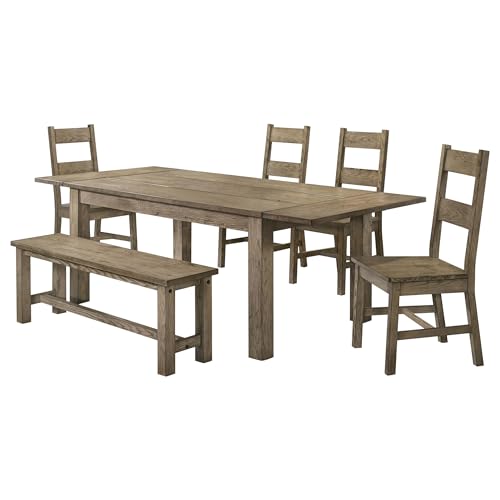
Coaster Cardova 6-Piece Extension Dining Set Vineyard Oak 192921-S6 | Solid rubberwood draw-leaf table with two end extensions and four ladder-back chairs plus bench
Check price on Amazon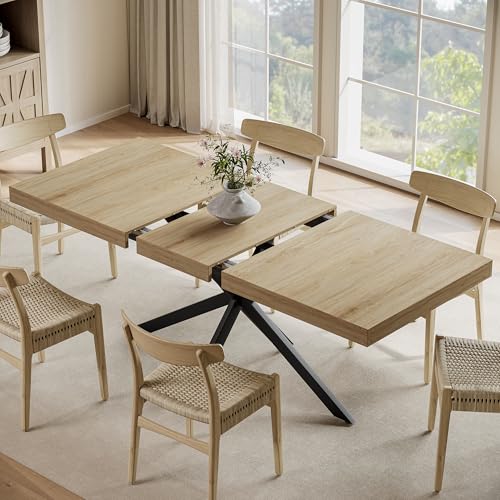
Extendable Dining Room Table for 4 6 8,55"-70" Kitchen Table Leaf,Oak | Expandable Rectangle Dining Table,Wood Dining Table w/ Hidden Leaf & Storage, Space Saving, Kitchen Dining Living Room,Modern
Check price on Amazon
Epecoya Extendable Dining Tables for 4-10, Modern Farmhouse Kitchen Table | 55"-87" Expandable Rectangular Dining Table with 2 Leaves, Dinner Tables for Living Room, Natural Oak Brown
Check price on Amazon
DONGMUWUJEE 47.2"-70.8" Solid Wood Extendable Dining Table for 4-8 | 3-in-1 Design Expandable Table, Easy Assembly Extendable Dining Room Table, Ideal for Dining Room, Kitchen, Living Room
Check price on Amazon
Signature Design by Ashley Haddigan Dining Extension Table, Seats 6-8 | Veneers, wood and engineered wood, Farmhouse style wood dining table, Self-storing 18-inch butterfly leaf, Kitchen table
Check price on AmazonStyling a Draw Leaf Table in Different Rooms
The draw leaf format is visually quiet, which makes it a flexible base for several interiors. A few directions worth considering:
- Modern and minimalist: Keep the tabletop clear and pair a pale wood draw leaf table with sculptural chairs. Our modern dining table styling guide covers the restraint this look demands.
- Farmhouse and rustic: Chunky oak with visible grain suits farmhouse styling and the warmer variants covered in rustic styling.
- Scandinavian: Lighter timbers, tapered legs, and a neutral palette work well; see Scandinavian dining table styling.
- Compact nooks: In smaller rooms a closed draw leaf table behaves like a fixed table until guests arrive — useful for compact dining nook arrangements.
When the table is extended for a holiday meal, the tabletop styling changes too. Our holiday tablescape ideas and vignette ideas show how to dress the longer surface without it looking sparse.
Care and Long-Term Upkeep
Moving parts need a little more attention than a fixed top. Three habits keep a draw leaf table working smoothly for years:
- Keep the runners clean. Dust and crumbs on the slides cause binding. A soft brush along the runner channel every few months is enough.
- Lubricate sparingly. Use a dry lubricant such as paraffin wax on wooden slides, or a silicone spray on metal runners. Avoid oily products that attract grit.
- Control humidity. Wooden leaves expand and contract. Keeping the room in a moderate humidity range prevents seasonal stiffness, as outlined in the humidity care guide.
For surface-level maintenance — ring marks, scratches, and routine polishing — the care and maintenance hub collects the relevant procedures in one place. If the table arrives flat-packed, our assembly instructions cover safe setup of frame and mechanism.
Draw Leaf vs a Fixed Dining Table
A fixed table is simpler, has no moving parts to fail, and usually offers more knee clearance underneath. A draw leaf table gives up some of that simplicity in exchange for flexibility. The decision usually hinges on how often your household size changes at the table.
If you host large gatherings only a few times a year, a fixed table plus a separate folding option may be the tidier choice. If you regularly shift between four diners and six or eight, the draw leaf format earns its extra complexity. Our extendable versus fixed comparison lays out the full decision framework, and the common buying mistakes article flags the sizing errors that catch people out most often.
Frequently Asked Questions
Is a draw leaf table the same as a drop leaf table?
No. A drop leaf table has hinged flaps on the sides that fold down vertically. A draw leaf table stores its leaves underneath the main top and pulls them out horizontally at the ends. The two are often confused because both are space-saving extendables, but the mechanism, footprint, and feel in use differ.
Can a draw leaf mechanism be repaired if it jams?
Usually yes, though the difficulty depends on construction. Stiffness is often solved by cleaning and lightly lubricating the runners. Broken slides or stripped fixings may require partial disassembly. Check whether replacement runner parts are available for the model before buying, and keep the warranty documentation.
How many extra diners does a draw leaf extension add?
Most draw leaf tables add two settings at a minimum, and some wider models add four across both ends. The exact number depends on leaf depth and table width. Always confirm the extended length and the seating count rather than assuming.
Does the internal leaf storage reduce under-table space?
Yes. The cavity that houses the leaves occupies volume beneath the top, which can limit knee clearance or the ability to tuck chairs far in. It is worth checking the apron depth on pedestal and four-leg versions if under-table space matters to you.
What material works best for a draw leaf table?
Solid oak is the most practical all-rounder because it is hard, stable, and easy to refinish. Walnut and teak suit premium and luxury tiers where appearance is the priority. Softer woods are common at entry level but need gentler handling around the slide points.
Can I use a draw leaf table outdoors?
Standard draw leaf tables are intended for indoor dining rooms. The internal mechanism is vulnerable to moisture and grit outdoors. For open-air dining, a purpose-built weather-resistant piece is the safer route; see our guide to outdoor weatherproof dining tables.
Ready to Compare Real Options?
The recommended draw leaf dining tables above are a useful starting point. Pair them with the sizing and mechanism checks in this guide, then verify leaf travel and closed footprint before you commit.
Explore Highest-Rated Dining Tables