
Dining Table With Leaves Stored Inside: The Complete Buyer's Guide
Discover how self-storing leaf tables work, why they solve the storage problem that plagues traditional extension tables, and how to pick the right one for your dining room, kitchen, or hosting space.
Why this design matters: A dining table with leaves stored inside keeps its extension panels hidden within the table body, so you can expand for guests and shrink back for everyday life without hunting for panels in a closet. This guide explains the mechanism, the trade-offs, and the exact questions you should ask before you buy.
What Is a Dining Table With Leaves Stored Inside?
A dining table with leaves stored inside is an extension table whose removable or folding panels live within the table itself. Instead of pulling a separate leaf from storage and laying it on top, you open the table and the leaf panel is already there, tucked underneath the top or held in a central compartment between the two halves of the tabletop.
This design is often called a self-storing leaf table, a butterfly leaf table, or an internal leaf extension table. The most common version is the butterfly leaf, where two hinged panels fold together and drop into a compartment under the tabletop. When you need more room, you separate the table halves, flip the leaf up, and lock the sections back together.
For anyone who hosts occasionally but wants a compact table day to day, this mechanism removes the single biggest annoyance of traditional extension tables: finding a safe place to keep loose leaves. If you are still mapping out your options, our broader guide to extendable dining tables that seat eight is a useful companion read.
How the Internal Leaf Mechanism Works
Most self-storing tables follow one of two patterns. Understanding them helps you judge build quality and how easy the table will be to use over the years.
1. The Butterfly Leaf System
The tabletop is split into two sections mounted on sliding rails. A hinged leaf sits folded underneath the center. To extend the table, you pull the two halves apart, lift the folded leaf so it lies flat, and then push the halves back together so the leaf sits flush between them. The leaf locks into place with a latch or pin system. This is the most common self-storing design and works well for both rectangular and oval tables.
2. The Drawer or Compartment System
Some tables store one or more leaves in a hidden drawer beneath the top or in a compartment accessed from the end of the table. You slide the leaf out, place it on the extension rails, and close the table. This style is often found on larger tables where a butterfly fold would be too heavy to lift comfortably.
Build-quality signal: Ask whether the table uses steel or aluminum sliding rails rather than plastic glides. Metal rails with locking latches are the mark of a table built to be extended often. Entry-level models sometimes rely on wooden runners, which can bind over time if the table is not kept level.
Benefits of Self-Storing Leaf Tables
- No separate storage needed. The leaves never leave the table, so you never lose them, scratch them in a closet, or forget where they are.
- Faster setup for guests. Extending the table takes seconds instead of a trip to the garage or storage room.
- Cleaner everyday look. With the leaves tucked away, the table reads as a normal fixed dining table and fits a compact dining area.
- Fewer moving parts to misplace. Because the leaf is attached, there is no risk of buying a table that later needs a replacement leaf that no longer matches the finish.
- Good fit for open-plan and small homes. A self-storing table lets a kitchen or dining nook stay compact most of the week and expand for holidays or dinner parties. Round and oval versions work especially well in tight footprints, which is why we cover round dining tables that seat seven and extra-large round dining tables separately.
Trade-Offs You Should Know Before Buying
Self-storing leaf tables are not perfect for every home. Here is what to weigh honestly:
- Weight and lifting. A solid wood butterfly leaf can be heavy. If anyone in the household has limited strength or mobility, check the leaf weight before committing, or look for a two-leaf drawer design where each panel is lighter.
- Seam visibility. When extended, you will see seam lines where the leaf meets the main top. Premium tables minimize this with tight tolerances and matched grain; entry-level tables may show a more obvious gap.
- Mechanism wear. Any moving part wears over time. Tables with metal rails and locking latches hold up far better than those with plastic or wooden glides.
- Slightly thicker apron. The leaf compartment adds depth under the tabletop, which can slightly reduce legroom compared with a fixed table of the same height.
- Finish matching. Because the leaf is stored away from sunlight, it can age slightly differently from the exposed top. This is usually minor but worth knowing on natural wood finishes.
Sizing: How Much Extra Seating Do Internal Leaves Add?
The amount of extra seating depends on the leaf width and how many leaves the table holds. Use this general guide as a starting point:
| Leaf Configuration | Typical Extra Seating | Best For |
|---|---|---|
| Single butterfly leaf | 2 additional guests | Everyday four-seat table that needs to become a six-seat table for holidays |
| Two internal leaves | 4 additional guests | Six-seat tables that need to reach ten seats for larger gatherings |
| Drawer-style leaf set | Varies by leaf count | Long rectangular tables where lifting a butterfly leaf would be awkward |
When measuring your space, remember that the extended table needs clearance for chairs to pull out on all sides. Leave at least 36 inches of walkway around the extended footprint, and more if the table sits in a main traffic path. If you are working with a tight room, our guide to 59-inch dining tables shows how compact tables balance seating and clearance.
Materials and Finishes That Suit Self-Storing Leaves
The mechanism puts stress on the tabletop edges, so material choice matters. Here is how common options perform:
Solid Wood
Solid oak, walnut, and maple are the most durable choices for a leaf table. They hold screws and latches well and can be refinished if the edges show wear. Solid wood butterfly leaves are heavier, so look for a table with a smooth rail system to reduce friction.
Veneered Wood and Engineered Core
Veneered tops over a stable engineered core are lighter and more dimensionally stable than solid wood, which helps the leaves move smoothly. The trade-off is that edges can chip if the table is handled roughly, so check that the leaf edges are banded and sealed.
Stone and Glass Tops
Stone and glass tops are less common on self-storing leaf tables because the leaf panels would be very heavy and fragile. When you do find them, they usually use a drawer-style leaf in a lighter material that matches the top visually. If a stone look is your priority, our guide to dining tables with resin tops explains how resin can mimic natural surfaces while staying lighter.
Quality Tiers: What to Expect at Each Level
Self-storing leaf tables are available across the market. Rather than focusing on numbers, use these tier descriptors to compare what you get at each level:
Entry-Level
Basic butterfly leaf with simple wooden or plastic runners. Works well for occasional use, but expect more flex and a visible seam when extended. A solid choice for a starter home or a second table in a compact kitchen.
Mid-Range
Metal sliding rails, locking latches, and tighter leaf tolerances. The table feels stable when extended and the mechanism is smoother than entry-level models. This is the sweet spot for most households that host regularly.
Premium
Reinforced frames, matched grain across the leaf and top, and precision hardware. Seams are minimal, the leaf moves with little effort, and the extended table feels as rigid as a fixed top.
Luxury
Hand-finished solid wood or high-grade veneers, custom hardware, and often a two-leaf drawer system that keeps each panel light. These tables are designed to be extended often and last for decades with proper care.
The key takeaway: if you will extend the table more than a few times a year, moving from entry-level to mid-range is the most meaningful upgrade you can make. The mechanism quality, not the surface finish, is what determines how pleasant the table is to live with.
How to Choose the Right Self-Storing Leaf Table
- Measure the everyday footprint first. Start with the size you need day to day, then confirm how far the table extends. The extended size should comfortably fit your largest expected gathering.
- Check the leaf weight. If you will be the one extending the table, make sure you can lift the leaf comfortably. Two-leaf drawer designs distribute weight better than a single large butterfly leaf.
- Test the mechanism in person if possible. Extend the table a few times. A good mechanism glides smoothly and locks with a positive click. A poor one binds, wobbles, or requires force.
- Confirm the extended stability. With the leaf locked, press down on the seam area. There should be minimal flex. Some flex is normal on entry-level tables but should be minimal on mid-range and above.
- Match the shape to the room. Rectangular tables suit long dining rooms and open-plan layouts, while round and oval tables soften tight corners and improve conversation flow. Our guide to rectangle counter-height dining sets is useful if you prefer a taller table profile.
- Plan the chair pairing. An extended table often needs extra chairs. Consider a bench on one side to save space and add flexibility, as covered in our guide to dining tables with bench and upholstered chairs.
Care and Maintenance for Internal Leaf Tables
A self-storing leaf table needs the same care as a fixed table plus a little attention to the mechanism. Follow these habits to keep it working smoothly:
- Keep the rails clean. Dust and crumbs collect in the leaf compartment. Vacuum or wipe the rails every few months, and apply a dry lubricant designed for furniture hardware if the mechanism starts to feel stiff.
- Extend the table on a level floor. Uneven floors put stress on the rails and can cause the leaf to sit unevenly. Adjust the table's leveling feet if it has them.
- Protect the seam. Use placemats or a table pad over the seam when serving heavy dishes, especially on veneered tops.
- Store the leaf extended occasionally. On natural wood tables, leaving the leaf extended for a few weeks each year helps the finish age evenly with the main top.
- Avoid dragging the table. Always lift rather than drag the table when moving it, since the leaf compartment adds weight and stress points.
Common Mistakes to Avoid
- Buying for the extended size only. If the table is too large in its closed position, it will crowd your everyday space. Buy for the closed size first and treat the extension as a bonus.
- Ignoring the mechanism. A beautiful top on a weak mechanism is a frustrating table. Prioritize hardware quality over surface finish.
- Forgetting the chairs. An extended table with no extra chairs defeats the purpose. Plan seating alongside the table.
- Assuming all leaves are equal. A single large butterfly leaf and two lighter drawer leaves behave very differently. Match the design to who will actually operate the table.
Frequently Asked Questions
What does it mean when a dining table has leaves stored inside?
It means the extension panels are held within the table body, usually under the tabletop or in a central compartment. You pull or fold them out when you need extra seating and tuck them back inside when the table returns to its standard size.
Are self-storing leaf tables as sturdy as fixed tables?
Quality self-storing leaf tables use reinforced frames and locking mechanisms that keep the extended surface stable. Mid-range and premium models generally feel as solid as a fixed table when the leaves are locked in place, while entry-level models can show more flex.
How much extra seating can internal leaves add?
Most self-storing leaf tables add one or two leaf panels. A single butterfly leaf typically adds seating for two guests, while a table with two internal leaves can seat four or more additional guests depending on the table length.
Do I need extra storage space for the leaves?
No. That is the main advantage of this design. Because the leaves live inside the table, you never need a closet, garage shelf, or under-bed space to store them.
Can a self-storing leaf table work in a small dining room?
Yes, and it is often the best choice for a small room. The table stays compact most of the time and expands only when guests arrive. Just confirm the extended footprint still leaves enough walkway clearance.
How do I keep the leaf mechanism working smoothly?
Keep the rails clean, extend the table on a level floor, and apply a dry lubricant designed for furniture hardware if the mechanism stiffens. Avoid dragging the table when moving it.
Recommended Dining Tables With Leaves Stored Inside
⚠️ AFFILIATE DISCLOSURE: This website contains affiliate links. As an affiliate Associate, we earn from qualifying purchases. If you make a purchase through these links, we may receive a small commission at no additional cost to you. Read our full affiliate policy.

MILYUGUA 7-Piece Extendable Dining Table Set with 6 Tufted Velvet Chairs | Extend from 62.99 to 78.74 inches, store the leaf inside the table, and enjoy comfortable velvet dining chairs.
Check price on Amazon
MILYUGUA 7-Piece Extendable Dining Table Set with 6 Tufted Velvet Chairs | Extend from 62.99 to 78.74 inches, store the leaf inside the table, and enjoy comfortable velvet dining chairs.
Check price on Amazon
HNY Extendable Dining Table for 4-8, 71"-89" Modern Farmhouse Dining Table with Self-Storing Butterfly Leaf, Solid Wood Frame with Natural Veneer Top, for Small Spaces, Family Gatherings, Dark Walnut
Check price on Amazon
Fucxeoy Folding Dining Table Set with 6 Chairs, Mobile Solid Wood Expandable Table, Space-Saving Drop Leaf Table, Multi-Functional Kitchen Island Cart for Small Apartment, Dining Room - 1.4m
Check price on Amazon
COMUHOME Drop Leaf Folding Dining Table with Storage, Wheels, Space Saving | Foldable Design, 18mm Thick Plywood, 300 lbs Capacity, Locking Wheels, Farmhouse Style, for Living Room Kitchen Small Spaces
Check price on Amazon
Folding Drop Leaf Dining Table with 4 Chairs, Space Saving Set, Walnut, 59" | Fully Assembled, Foldable Table with Storage, Hidden Chairs, Solid Wood, Locking Wheels, for Dining Room Kitchen Small Spaces
Check price on Amazon
MECHYIN 55"-71" Extendable Dining Table for 4-8 with Built-in Flip Leaf | Space‑Saving Modern Rectangle Dining Table, Built‑in Flip Leaf, Sturdy Metal Legs, for Kitchen & Dining Room,Small Apartments
Check price on Amazon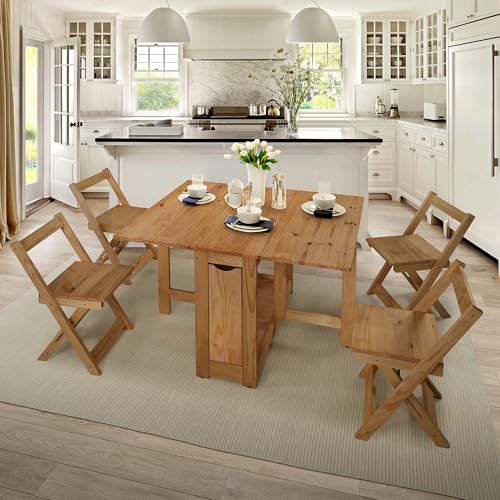
SECONIQUE Santos Butterfly Folding Dining Table Set with 4 Chairs – Space-Saving Table with Nesting Chairs and Storage Shelf – Rustic Pine Finish
Check price on AmazonBefore you decide: A self-storing leaf table is a long-term furniture decision. Take a few minutes to confirm the closed size, the extended size, the leaf weight, and the mechanism type. If all four match how you actually live and host, you will have a table that works for everyday meals and special occasions for many years. You can also browse discount dining table options if you want to compare value-focused picks within the same category.