
Dining Table Chair Height Guide
Get the seat-to-table fit right the first time. This guide explains standard chair heights, clearance rules, and how to match chairs to dining, counter, and bar height tables for comfortable everyday meals.
Why chair height matters: A dining set only feels right when the chair, the tabletop, and the diner work together. When the seat sits too low, elbows hover above the table and food feels out of reach. When the seat sits too high, knees press against the apron and posture suffers. The correct chair height creates a relaxed, balanced posture where forearms rest comfortably near table level and feet stay planted on the floor.
The Core Rule: Seat-to-Table Clearance
The single most useful measurement is the gap between the top of the chair seat and the underside of the tabletop. This clearance is what determines comfort far more than the absolute height of either piece. As a general rule, aim for 10 to 12 inches of clearance between the seat surface and the underside of the table.
If the gap is smaller than about 10 inches, the legs feel boxed in and the table apron may press against the thighs. If the gap grows beyond roughly 12 inches, diners end up reaching upward or leaning forward to eat. Because the tabletop thickness and apron depth vary between designs, always measure the actual clearance rather than assuming the standard table height tells the whole story.
Quick Reference
Standard dining table surface: about 30 inches. Standard dining chair seat height: about 18 inches. Resulting clearance: about 12 inches — the sweet spot for most adults.
Standard Dining Table and Chair Heights
Most residential dining tables share a familiar surface height, which is why standard dining chairs are also fairly consistent. The table below summarizes the typical pairings. Treat these as starting points, then verify against the specific product specifications before you commit.
| Table Type | Typical Surface Height | Matching Seat Height | Best For |
|---|---|---|---|
| Standard dining table | About 30 inches | About 18 inches | Everyday family meals |
| Counter height table | About 34 to 36 inches | About 24 to 26 inches | Casual dining with a taller look |
| Bar height table | About 40 to 42 inches | About 28 to 30 inches | Entertaining and pub-style settings |
| Low or coffee-height table | About 18 to 20 inches | About 10 to 12 inches | Lounge and floor-seating areas |
When space is tight and you are weighing a compact setup, the same clearance logic still applies. A small dining table for a studio keeps the standard 30-inch surface, so standard 18-inch chairs remain the right match. Likewise, a mini dining table for two does not require shorter chairs — it simply uses fewer of them.
Understanding Counter Height vs Bar Height Seating
Counter height and bar height furniture is often confused because both sit higher than a standard table, but they are not interchangeable. The difference in surface height translates directly into a different chair height, and using the wrong pairing creates an uncomfortable gap.
Counter Height
Surfaces around 34 to 36 inches pair with chairs or stools that have seat heights of roughly 24 to 26 inches. This tier feels slightly elevated but still approachable for daily meals.
Bar Height
Surfaces around 40 to 42 inches pair with seats of roughly 28 to 30 inches. This is the tallest common dining tier and works well for social, stand-and-sit entertaining.
Standard Height
Surfaces around 30 inches pair with seats of roughly 18 inches. This remains the most versatile and widely compatible tier for family dining rooms.
A common mistake is buying bar stools for a standard table because they look striking. In practice, a 28-inch stool paired with a 30-inch table leaves the diner's knees jammed against the underside. Always match the chair tier to the table tier, then confirm the clearance falls within the 10-to-12-inch range.
How Table Shape and Edge Design Affect Fit
Chair height is only half of the equation. The table's shape and edge profile also influence how comfortable a given seat feels. A round table with a pedestal base, for example, often allows chairs to tuck in more freely than a rectangular table with legs at the corners.
If you are drawn to a circular layout, a 36-inch round marble dining table pairs naturally with standard-height chairs and gives each diner a clear knee space. For larger gatherings, a 72-inch round glass-top dining table spreads seating around the perimeter, so the chair-to-table clearance stays consistent on every side.
Edge profile matters too. A thick, chunky tabletop reduces the effective clearance even when the surface height looks correct, because the underside sits lower. A slim or beveled edge preserves more knee room. When comparing tables, measure from the seat to the lowest point of the table's underside, not just to the top surface.
Matching Chairs to Your Table: A Practical Checklist
- Measure the table surface height from floor to top, then measure the underside height to account for tabletop thickness and apron depth.
- Measure the chair seat height from floor to the top of the seat cushion, not the frame.
- Calculate the clearance by subtracting seat height from underside height. Confirm it lands between 10 and 12 inches.
- Check seat depth and width so the chair tucks under the table without hitting legs or a pedestal.
- Test the footrest position on taller stools — feet should rest comfortably, not dangle.
- Consider the diner — taller adults may prefer slightly more clearance, while children benefit from boosters or adjustable seats.
If you are furnishing a dual-purpose space, a computer desk and dining table combination can work well, but pay extra attention to chair height because the same seat will be used for both sitting tasks. A chair that suits dining posture may feel low for desk work, so choose a height that balances both uses.
Special Cases: Antique, Outdoor, and Mixed Sets
Not every table follows modern standards. Antique pieces in particular can sit at unusual heights. An antique Spanish dining table may have a surface that differs from the modern 30-inch norm, which means standard chairs might not fit cleanly. Measure first, then choose chairs that restore the correct clearance.
Outdoor dining brings its own considerations. A 108-inch outdoor dining table is often built slightly taller to accommodate weather-resistant construction and ground unevenness, so confirm the surface height before pairing benches or chairs. Similarly, decorative or statement pieces like a stained glass dining table or a grey marble dining table with six chairs may come as matched sets where the chair height is already tuned to the table — in those cases, trust the set but still verify the clearance.
If you are adding individual seats to an existing table, a pair of two dining table chairs is a simple way to extend seating, but check that their seat height matches your current chairs so the row stays visually and physically consistent.
Ergonomics Beyond Height
Height is the foundation, but comfort also depends on a few supporting details. Seat depth should let the back rest against the backrest while the backs of the knees stay clear of the seat edge. A seat that is too deep forces slouching; one that is too shallow feels unstable. Backrest angle and cushion firmness also shape how long a diner can sit comfortably.
For taller stools and counter chairs, a footrest is essential. Without one, legs dangle and pressure builds behind the thighs. For standard dining chairs, feet should rest flat on the floor with knees bent at roughly a right angle. These small ergonomic details turn a correctly sized chair into a genuinely comfortable one.
Measuring Tip
Use a rigid tape measure and record both the table surface height and the underside height. Photograph the measurements alongside the product label so you can compare options later without re-measuring.
Common Chair Height Mistakes to Avoid
- Assuming all tables are 30 inches. Antique, outdoor, and specialty tables often differ. Always measure.
- Ignoring the apron. A deep apron eats into clearance even when the surface height looks standard.
- Mixing tiers. Bar stools with a standard table, or dining chairs with a bar table, create an awkward gap.
- Overlooking seat cushion compression. A soft cushion compresses under weight, effectively lowering the seat and reducing clearance.
- Forgetting the diners. Children and taller adults may need different solutions, such as boosters or adjustable seats.
Frequently Asked Questions
What is the ideal chair height for a standard dining table?
For a standard dining table with a surface height of about 30 inches, a dining chair with a seat height of roughly 18 inches works best. This creates about 12 inches of clearance between the seat and the tabletop, which is the comfort zone for most adults.
How much space should be between the chair seat and the tabletop?
Aim for 10 to 12 inches of clearance between the top of the seat and the underside of the tabletop. Less than 10 inches can feel cramped for the legs, while more than 12 inches can leave diners reaching awkwardly for their plates.
Can I use bar stools with a standard dining table?
No, bar stools are too tall for a standard dining table. Bar stools are designed for surfaces around 40 to 42 inches high, while standard dining tables sit around 30 inches. Mixing them creates an uncomfortable gap and poor posture.
What is the difference between counter height and bar height chairs?
Counter height chairs pair with surfaces around 34 to 36 inches and usually have seat heights of 24 to 26 inches. Bar height chairs pair with surfaces around 40 to 42 inches and typically have seat heights of 28 to 30 inches.
Does chair height matter for children?
Yes. Children need a seat that lets their feet rest flat and their elbows sit near table level. A booster seat or a height-adjustable chair helps younger diners reach the table safely and comfortably.
Recommended Dining Chairs and Seating
⚠️ AFFILIATE DISCLOSURE: This website contains affiliate links. As an affiliate Associate, we earn from qualifying purchases. If you make a purchase through these links, we may receive a small commission at no additional cost to you. Read our full affiliate policy.

NAFORT Dining Table Set with Counter Height Table & 4 Bar Stools, 5-Piece Bar Table and Chairs with Footrest & Back Support, Space-Saving Dinette Set for Pub, Kitchen &Dining Room, Restaurant
Check price on Amazon
Brafab Dining Table Set for 4, Bar Table and Chairs Set, White&Grey | 4-Person Seating, Bar Height, Dining Room Use, Table & Chairs Included
Check price on Amazon
NicBex 5 Piece Counter Height Dining Table Set, Farmhouse Wooden Dinner Table Set for 4, 39" Square Table & 4 High Back Bar Stools, Black&Gray
Check price on Amazon
Signature Design by Ashley 5-Piece Round Counter Height Dining Set, Gray | 42-Inch Round Dining Table with 2 Storage Shelves, 4 Upholstered Bar Stools, Wrenning Series
Check price on Amazon
Signature Design by Ashley Round Counter Height Dining Set for 4 | Built-In Storage Shelves, Beige Polyester and Foam Stools, Solid Wood and Engineered Wood Frames, Cherry Brown Finish
Check price on Amazon
LUMISOL 5-Piece Solid Wood Table Set for 4, Farmhouse Counter Height Kitchen Dining Table Set with 4 Upholstered Chairs for Kitchen, Dining Room, Home Bar, Grey
Check price on Amazon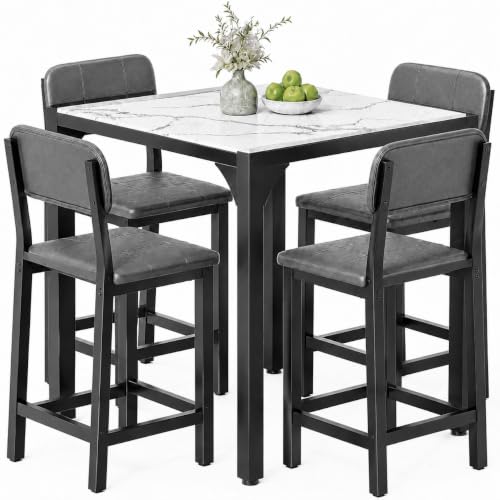
5-Piece Counter Height Dining Table Set for 4, Marble-Look, Charcoal Gray | Counter height table, Dining table set for 4, Wide padded chairs, Marble-look top, Space-saving tuck-away frame
Check price on Amazon