
Buy Dining Table Set: The Complete Buyer's Guide
Everything you need to know before you buy a dining table set — sizing, seating, materials, and styles that fit the way your household actually lives.
START THE GUIDEWhy a complete dining set makes sense. When you buy a dining table set, you are not just choosing furniture — you are choosing the table and chairs as one coordinated system. The proportions, finish, and seat height are already matched, which removes a long list of compatibility decisions and lets you focus on fit, comfort, and durability.
This guide walks you through the same decision path that experienced buyers follow: define the room, count the seats, choose the shape, confirm the material, then verify build quality and chair comfort. Each section builds on the previous one, so by the end you will know exactly which type of dining set matches your household.
Start With Your Room, Not the Set
The most common mistake when buying a dining table set is falling in love with a design before measuring the room. Before you browse any catalog, sketch the space. Note the doorways, the window positions, the traffic path from the kitchen, and any fixed furniture that cannot move. A dining set that fits the room feels calm; a set that crowds the room feels stressful every day.
As a working rule, allow roughly 24 to 30 inches of clearance around the table on every side that people will use. That clearance covers the chair footprint plus the space needed to push the chair back and stand up. If a walkway passes behind the seating, add extra room so diners are not trapped against a wall. For tight or oddly shaped rooms, an oval dining table for six to eight diners softens the footprint and keeps the traffic path smooth.
Measure the Room
Record the length, width, and the location of doors and windows. Mark where the table will sit and confirm clearance on all sides.
Count Regular Diners
Plan for your everyday household plus one or two extra seats. Extra seats can come from an extendable mechanism rather than a permanently larger table.
Define the Traffic Flow
Trace the path diners and hosts use to reach the table. A dining set should not block the route between the kitchen and the rest of the home.
Note the Lighting
Check where ceiling fixtures and windows fall. A table that sits under a pendant or near natural light feels more intentional and inviting.
Choose Seating Capacity for Real Life
Seating capacity is where many buyers overshoot or undershoot. A permanent eight-seat set in a household of three creates empty space that makes the dining room feel formal and unused. A four-seat set in a household that hosts every weekend forces guests to eat in shifts. The practical answer is usually a set sized for everyday use, with a flexible mechanism for hosting.
Extendable sets are the most common solution. They stay compact for daily meals and expand when family or friends arrive. If you regularly seat a large group and want a fixed footprint, a dining table for eight with a bench can seat more people along one side and works well against a wall. For taller seating arrangements, a counter-height dining set for eight changes the posture of the meal and can suit open-plan kitchens.
- Two-seat sets suit couples and compact apartments where the table doubles as a workspace.
- Four-seat sets are the most common everyday configuration for small families.
- Six-seat sets are the practical middle ground for households that host occasionally.
- Eight-seat and larger sets suit dedicated dining rooms and households that entertain often.
- Bench seating along one side adds capacity without adding chair backs to the footprint.
Match the Table Shape to the Room
Shape is the single most visible decision in a dining set, and it also has the biggest effect on how the room feels. Rectangular tables use long walls efficiently and suit narrow rooms. Round tables feel sociable and work well in square or compact rooms because they avoid sharp corners. Oval tables combine the length of a rectangle with the softness of a circle. Square tables suit small, symmetrical spaces where four diners sit close together.
If you have a long, narrow dining room, a rectangular set is usually the most efficient use of the space. If the room is square and small, a round set reduces the visual weight of the table and improves movement. A 36-inch round marble dining table is a good example of a compact round set that still seats four comfortably. For an indoor-outdoor setup, a stone patio dining table shows how shape and material interact differently outdoors.
| Table Shape | Best For | Watch Out For |
|---|---|---|
| Rectangular | Long or narrow rooms, formal dining rooms, hosting | Corners can feel sharp in tight spaces |
| Round | Compact or square rooms, sociable meals, small households | Larger round sets need generous clearance to reach seats |
| Oval | Rooms that need length without hard corners | Requires careful measurement of the widest point |
| Square | Small symmetrical spaces, four-diner households | Limited expansion for extra guests |
Understand the Material Before You Commit
The material of a dining set determines how it ages, how much care it needs, and how it feels during a meal. Solid hardwood is the most forgiving for everyday family use because scratches can be sanded and refinished. Stone and quartz tops resist heat and scratches but are heavy and cold to the touch. Glass tops are visually light but show fingerprints and require frequent cleaning. Metal frames add structural strength and pair well with wood or stone tops.
A bleached wood dining table is a good example of a material choice that changes the mood of a room — lighter tones make a small dining space feel larger and brighter. A black eight-seater dining table shows how a darker finish anchors a large dining room and hides everyday wear. For rooms with softer, Japandi-inspired interiors, a Japandi extendable dining table combines a warm wood tone with a clean, minimal silhouette.
| Material | Durability | Best For |
|---|---|---|
| Solid hardwood | High — can be refinished | Family households, long-term use |
| Veneer over engineered core | Moderate — stable and consistent | Design-led sets in stable climates |
| Marble or stone | High — heat and scratch resistant | Formal dining rooms, luxury interiors |
| Glass top | Moderate — needs careful cleaning | Small rooms that need visual lightness |
| Metal frame | High structural strength | Industrial or modern dining sets |
Compare Dining Sets by Quality Tier
Instead of comparing sets by numbers, compare them by tier. Tier describes where a set sits in the market relative to others, and it tells you what to expect from construction, finish, and chair comfort. A set in a higher tier usually has tighter joinery, smoother extension mechanisms, and more comfortable chair padding — but a well-specified entry-level set can still be a solid choice for a first home or a secondary dining space.
| Tier | Typical Characteristics | Best For |
|---|---|---|
| Entry-Level | Simpler joinery, lighter chair padding, basic finish | First apartments, secondary dining spaces |
| Mid-Range | Solid construction, smoother mechanisms, better upholstery | Everyday family dining, long-term household use |
| Premium | Hardwood frames, refined finishes, comfortable chairs | Dedicated dining rooms, households that host often |
| Luxury | Designer silhouettes, premium materials, precise detailing | Statement dining rooms, high-end interiors |
A mid-range set usually offers a better balance of durability and comfort than an entry-level set, while a premium or luxury set focuses on materials and craftsmanship. If you are furnishing a room that will be used daily for years, the long-term investment in a higher tier is often worthwhile. If the set is for a weekend home or a short-term rental, a well-specified entry-level set can be a practical choice.
Do Not Ignore the Chairs
When you buy a dining table set, the chairs are half the purchase. A beautiful table paired with uncomfortable chairs will be used less often. Check the seat height relative to the tabletop: standard dining tables sit around 28 to 30 inches high, and standard chairs have a seat height of about 17 to 19 inches. Counter-height sets sit higher and require taller chairs. If you mix and match later, keep the height relationship consistent.
Also check the seat depth, the back angle, and whether the chairs can tuck under the table when not in use. Chairs that tuck in fully keep the room looking tidy and reduce the footprint of the set. Upholstered seats add comfort but need more care; solid wood or woven seats are easier to wipe down. If you plan to host long meals, prioritize chair comfort over chair style.
- Confirm the seat height matches the tabletop height category (standard, counter, or bar).
- Check that chairs tuck fully under the table when not in use.
- Test the seat depth and back angle for comfort during a long meal.
- Consider upholstered seats for comfort and wood seats for easy cleaning.
- Verify the chair weight capacity matches the people who will use them.
Verify Build Quality Before You Buy
Build quality is where the difference between tiers becomes visible. Look at the joinery where the legs meet the apron, the thickness of the tabletop, and whether the frame is reinforced at the stress points. A table that wobbles in the showroom will wobble more at home. Extension mechanisms are another checkpoint: a smooth, well-aligned mechanism is a sign of a set that will last, while a stiff or misaligned one will frustrate you every time you host.
If you are shopping online, read the specification carefully. Look for solid wood versus veneer, the tabletop thickness, the extension type, and the chair frame material. A set described as solid build with reinforced joinery is a better indicator of durability than a set that only describes the finish. For large sets, check that the table can be assembled in the room where it will live — a nine-foot dining table may not fit through every doorway once assembled.
Joinery
Look for tight, reinforced joints at the legs and apron. Loose or visible gaps suggest a weaker build.
Tabletop Thickness
A thicker top resists flexing and feels more solid. Thin tops can bow over time under daily use.
Extension Mechanism
Test the extension if the set has one. It should slide smoothly and lock firmly in both positions.
Chair Frame
Check the chair frame for reinforcement at the seat and back. Wobbly chairs are a common weak point.
Choose a Style That Fits Your Interior
Style is the easiest part of the decision once the practical questions are answered. A dining set should feel like it belongs in the room rather than competing with it. Modern sets favor clean lines and minimal ornament; rustic and farmhouse sets favor warm wood tones and visible grain; industrial sets combine metal frames with wood or stone tops; Scandinavian sets favor light woods and simple silhouettes.
A sit-down dining table is a useful reference for how a set can be designed around the act of gathering rather than around decoration. If your room already has strong architectural features, keep the set simple. If the room is plain, the set can carry more visual weight. The goal is a set that looks intentional in the space, not one that looks like it arrived from a different home.
Ready to Choose Your Dining Table Set?
Browse curated dining sets that match the sizing, seating, and material guidance in this guide. Compare features, check availability, and explore options that fit your room and household.
Explore Recommended Dining SetsRecommended Dining Table Sets
⚠️ AFFILIATE DISCLOSURE: This website contains affiliate links. As an affiliate Associate, we earn from qualifying purchases. If you make a purchase through these links, we may receive a small commission at no additional cost to you. Read our full affiliate policy.

71-87 Inch Extendable Dining Room Table, Rustic Wooden Kitchen Table 6-10 | STHOUYN Expandable Dining Table, Farmhouse Rustic Style, Rectangular Wooden Top, Seats 6-10, Brown Kitchen or Dining Room
Check price on Amazon
AMERLIFE 7-Piece Dining Table Set, 71" Faux Marble Modern Table, Dark Brown | Dining Table Set with 6 PU Leather Upholstered Chairs, Heavy-Duty Solid Wood Set for Kitchen & Dining Room
Check price on Amazon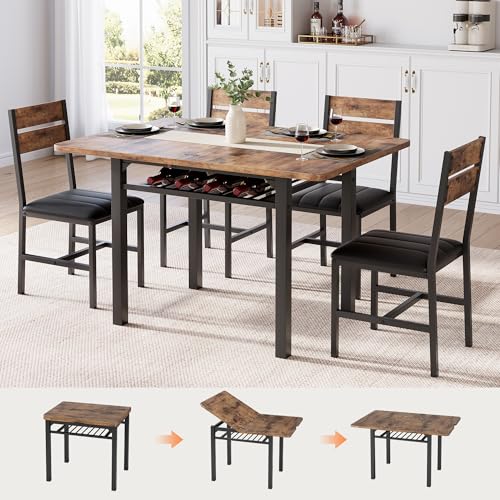
MapleGrace Extendable Dining Table Set for 4 with Built-in Shelf Rack Brown | Kitchen Table Set with 4 PU Leather Upholstered, Wood Dining Room Chairs for Dining & Small Spaces
Check price on Amazon
IRONCK 5-Piece Dining Table Set for 4,Kitchen Table and Chairs Set with Rubberwood Legs & MDF Tabletop, Suitable for Dining Room/Living Room, Solid Wood 1 Table with 4 Chairs
Check price on Amazon
Dining Table Set for 4,Kitchen Table and Chairs for 4, Round Dining Room Table with Upholstered Chairs, 5 Piece Space Saving Circle Wood Kitchen & Dining Room Dinner Dinette Table Set (Vintage, 42In)
Check price on Amazon
DUMOS Dining Table Set for Kitchen, Apartment and Corner Grey 3 Pack | Space-Saving Ideal, Easy Clean, Scratch Resistant, Robust Iron Frame, Anti-slip Feet Pad, Living Room, Patio
Check price on AmazonFinal Buying Tips Before You Commit
Before you finalize a dining set, run through a short final check. Confirm the room measurements one more time with the set dimensions in hand. Confirm the seating count against your everyday household and your hosting habits. Confirm the material against your cleaning routine and the climate in your home. Confirm the chair comfort and the extension mechanism if the set has one. Confirm that the set can be delivered and assembled in the room where it will live.
If all of those checks pass, you are ready to buy with confidence. A dining table set is a long-term purchase, and the right set becomes the quiet center of daily life — the place where meals, conversations, and routines happen. Take the time to choose well, and the set will serve your household for years.
Frequently Asked Questions
What should I check before I buy a dining table set?
Confirm the room dimensions, the number of regular diners, the table shape that fits your space, the material that suits your lifestyle, and whether chairs are included. Measure walkway clearance around the table before committing.
Is a complete dining set better than buying the table and chairs separately?
A complete set is usually simpler to coordinate because the table and chairs share a consistent style, finish, and height. Buying separately offers more flexibility but requires extra attention to seat height, proportion, and finish matching.
Which dining table shape works best in a small room?
Round and oval tables generally work best in compact rooms because they soften corners and allow smoother movement. A round set also lets diners reach the center more easily and feels more sociable in tight spaces.
How many seats should a family dining set have?
Plan for your everyday household plus one or two extra seats for guests. An extendable set is a practical middle ground because it stays compact for daily use and expands when you host.
What material is most durable for a dining table set?
Solid hardwood sets are generally the most durable for everyday family use, while stone and quartz tops resist scratches and heat well. Metal frames add structural strength, and glass tops require more frequent cleaning.