
7 Foot Round Dining Table: The Complete Buying Guide
A seven foot round dining table is a statement piece built for large gatherings. This guide covers seating capacity, room clearance, base styles, materials, and styling so you can choose with confidence.
Explore Recommended TablesWhy go round at this size? A 7 foot (84 inch) round table seats a crowd without creating the sharp corners and long sight lines of an equivalent rectangular table. It is the natural centerpiece for square dining rooms, open-plan spaces, and homes that host family dinners and celebrations regularly. Below we break down exactly what to check before you commit.
What Does "7 Foot Round" Actually Mean?
A 7 foot round dining table measures 84 inches (roughly 213 cm) across its diameter. That is significantly larger than the common 48 to 60 inch round tables, and it places this size in the premium and luxury tier of residential dining furniture. It is a true centerpiece table rather than a compact everyday option.
At this diameter, the table crosses an important threshold: it stops being a "small to medium" round table and becomes a genuine banquet table. That changes the seating math, the base requirements, and the amount of floor space you need to reserve.
| Specification | 7 Foot Round Table |
|---|---|
| Diameter | 84 inches / 7 feet (about 213 cm) |
| Comfortable seating | 8 people |
| Maximum seating | 10 people with tighter place settings |
| Recommended place setting width | 24 to 30 inches per guest along the edge |
| Minimum room footprint | About 13 to 14 feet across for comfortable clearance |
| Typical base styles | Single wide pedestal, double pedestal, or four-leg frame |
How Many People Fit at a 7 Foot Round Dining Table?
The circumference of an 84 inch round table is roughly 264 inches. Divide that by a generous 30 inch place setting and you get about 8 comfortable seats. Divide by a tighter 24 inch setting and you can accommodate up to 10 guests, though elbows and serving dishes become tight.
- 8 guests: the sweet spot for everyday elegance and holiday dinners, with room for centerpieces and serving platters.
- 10 guests: achievable with narrower chairs and minimal table decor, ideal for occasional entertaining.
- 12 guests: not realistic on a single round without an extension mechanism or a larger banquet format.
If your household regularly hosts more than eight, compare this size against a dining table for 8 to 10 people in a rectangular format, which can be extended more easily. For those who love the round silhouette but need flexibility, a 72 inch dining table with leaf is a useful reference point for how extension mechanisms change seating.
Room Clearance: The Most Overlooked Step
A large round table fails in a room that looks big but lacks usable floor. Reserve a minimum of 36 inches between the table edge and any wall, cabinet, or traffic path. This allows chairs to pull out and guests to walk behind seated diners.
Working backward from an 84 inch diameter table plus 36 inches of clearance on all sides, you need a room roughly 13 to 14 feet across to feel comfortable. In a square room of that size, a round table is actually more efficient than a rectangular one because it uses the center of the floor without pushing corners into dead zones.
For tighter spaces, consider how a 30 inch dining room table or a round bistro dining table solves the opposite problem. Those compact formats show how dramatically seating and clearance scale with diameter.
If the room is long and narrow, a round table wastes the length. In that case, a rectangular format such as a long marble dining table uses the space more efficiently.
Base Styles for a 7 Foot Round Table
At this diameter, the base is not just aesthetic. It determines stability, legroom, and how the table behaves over years of use. Three base families dominate this size:
Single Wide Pedestal
The most elegant look and the most legroom for guests. Requires a wide, heavily weighted foot to prevent tipping at 84 inches. Best for stationary dining rooms where the table is not moved often.
Double Pedestal
Two pedestals joined by a stretcher. More stable than a single pedestal and better for tables that are occasionally shifted. Slightly less legroom at the center but far more forgiving on uneven floors.
Four-Leg Frame
The most stable option and the most traditional. Legs sit near the edge, which reduces usable legroom and can interfere with chairs. Best for rustic and farmhouse styles where the frame is part of the design.
If you pair the table with rotating seating, a round dining table with swivel chairs is worth reviewing for how chair movement interacts with a large radius. Swivel chairs reduce the need to push back, which helps in tighter clearances.
Materials That Work Best at This Size
A 7 foot round table has a large uninterrupted surface, so material choice is highly visible. Each material family carries a different maintenance profile and a different position in the market.
| Material | Market Position | Best For |
|---|---|---|
| Solid hardwood (oak, walnut, teak) | Mid-range to premium | Long-term investment, warmth, refinishing in future |
| Marble or stone top | Premium to luxury | Formal dining rooms, dramatic centerpieces |
| Glass top | Mid-range | Visually lighter spaces, smaller perceived footprint |
| Engineered wood with veneer | Entry-level to mid-range | Balanced look and cost profile within the category |
| Concrete or composite | Premium to commercial-grade | Industrial and modern interiors, high-traffic homes |
Marble is a popular pairing at this size because the large surface reads as a design feature. A long marble dining table guide offers transferable care advice, and the counter-height marble dining table article covers how stone behaves on taller frames. For a visually lighter alternative, a round glass dining table shows how glass changes the perception of scale.
If you want a two-material look, a black dining table with wood top demonstrates how contrasting bases and tops work at scale.
Styling a Large Round Table
A 7 foot round table is generous enough to carry a real centerpiece. The rule of thumb is to keep the centerpiece within roughly one third of the diameter so place settings remain usable. That gives you about 28 inches of centerpiece width to work with.
- Layered linens: a round tablecloth plus a runner or placemats adds depth without crowding.
- Low centerpieces: keep arrangements low enough to see across the table, since round tables are conversational by design.
- Symmetry: a round table naturally invites radial symmetry, so place candle groupings or floral clusters in a balanced pattern.
- Lighting: a single large pendant centered above the table works well; consider a chandelier sized to about half the table diameter.
If your space is outdoors or semi-outdoor, a plastic wood outdoor dining table shows how weather-resistant materials handle large-format dining.
Choosing the Right Market Tier
Because a 7 foot round table is a significant piece of furniture, it helps to think in tiers rather than in numbers. The table below describes what each tier typically delivers so you can match expectations to your needs.
| Tier | What It Typically Delivers | Best For |
|---|---|---|
| Entry-level | Veneer or engineered wood top, lighter base, simpler joinery | Occasional hosting, first large-table purchase |
| Mid-range | Solid wood or stone-look top, sturdier pedestal, better finish | Everyday family dining with regular entertaining |
| Premium | Solid hardwood or genuine stone, refined base engineering | Design-focused dining rooms, long-term ownership |
| Luxury | Book-matched stone, hand-finished hardwoods, custom sizing | Statement centerpieces, formal dining spaces |
| Commercial-grade | Reinforced frames, heavy-duty hardware, high-traffic finishes | Hospitality, rental properties, frequent large gatherings |
Mid-range models usually offer smoother base mechanisms and better edge finishes than entry-level options, while premium and luxury tiers focus on material authenticity and joinery. A well-specified mid-range table is often the most efficient choice in the long run for a family that hosts regularly.
Common Mistakes to Avoid
- Ignoring chair pull-out space: the most common error. Measure from the table edge, not the room wall.
- Underestimating the base footprint: a wide pedestal foot needs its own floor space and can interfere with rugs.
- Overcrowding the centerpiece: a large table tempts you to fill it. Keep the center functional.
- Skipping floor protection: a heavy table on a hard floor needs pads or a rug to prevent scratches.
- Choosing a table that cannot be disassembled: an 84 inch round top is difficult to move through doorways. Confirm the top ships in sections or that the base detaches cleanly.
Recommended 7 Foot Round Dining Tables & Large Round Options
⚠️ AFFILIATE DISCLOSURE: This website contains affiliate links. As an affiliate Associate, we earn from qualifying purchases. If you make a purchase through these links, we may receive a small commission at no additional cost to you. Read our full affiliate policy.

Round Dining Table Extendable with Storage Shelf, Brown | Extendable round dining table,seats 4-8,wood,farmhouse style,for small kitchen and apartment,43''-59''
Check price on Amazon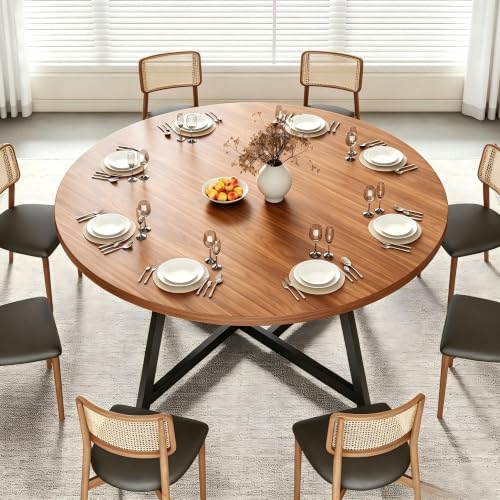
59 INCH Round Dining Table for 8, Metal Base, Waterproof Tabletop,Brown | Wood Tabletop, Rustic Brown Kitchen Table with Metal Base
Check price on Amazon
Andehomy 55" Fluted Round Dining Table for 4-6, Mid-Century Modern Kitchen Table with Rotating Tray, 2-Tier Storage Shelf, Wood Sliding Doors and Pedestal Base, Walnut
Check price on Amazon
DalyLuxa Large Round Dining Table for 6-8, Wooden Dinner Table with Heavy Duty Metal Pedestal Base, for Kitchen Living Room, Space Saving, 59 Inch, Brown
Check price on Amazon
VASAGLE 47.2" Round Dining Table for 4-6 People, Fluted Kitchen Table | Mid-Century Modern, with Pedestal Base and 2-Tier Hidden Storage, Tambour Design, MIRIANA Collection UKDT028K101
Check price on Amazon
LITTLE TREE 31.5" Round Dining Table for 4, Kitchen Table for Dining Room | Wood Small Dinner Table with Wooden Tabletop and Octagonal Base for Apartments, Office & Restaurants
Check price on Amazon
ONBRILL 47 Inch Round Dining Table for 4-6,Square Pedestal Base,Walnut | Circle Kitchen Table with Thickened Tabletop, Modern Dining Room Tables, Dinner Tables for Kitchen Small Space (Table Only)
Check price on Amazon
Tribesigns 47 inch Round Dining Table Wood Kitchen Table for Dining Room, 47" Dinner Room Tables for 4-6, Farmhouse Accent Furniture with Wooden Tabletop and Cross Base, Black
Check price on AmazonReady to Choose Your Table?
Compare the recommended options above, then match the base style and material to your room shape and hosting habits. A 7 foot round table is a long-term centerpiece, so take the time to get the clearance and tier right.
View Recommended OptionsFrequently Asked Questions
How many people can sit at a 7 foot round dining table?
A 7 foot round dining table comfortably seats 8 people, and up to 10 with a place setting of roughly 24 inches per person. Larger settings of 30 inches per guest reduce it to 8 seats.
How much room do I need for a 7 foot round dining table?
Plan for at least 36 inches of clearance between the table edge and any wall or obstacle for chair pull-out and walkway. That means a room footprint of roughly 13 to 14 feet across for a comfortable layout.
Is a 7 foot round table better than a rectangular table?
A 7 foot round table encourages conversation and works well in square rooms, while a rectangular table of similar length suits long narrow rooms and offers more usable edge space. Choose based on room shape and how you entertain.
What base style should I choose for a large round table?
A single pedestal frees up legroom for guests but needs a wide, weighted foot for stability at this diameter. A double pedestal is more stable and better for tables that are frequently extended or moved.
Can a 7 foot round table fit through a doorway?
An 84 inch round top will not pass through a standard doorway as a single piece. Confirm that the top ships in sections or that the base detaches cleanly so the table can be moved in and out of the room.