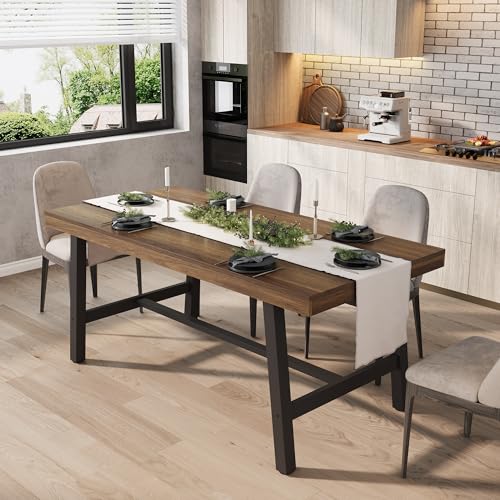
Why a 5 Person Dining Table Needs Careful Planning
Most dining tables sold today are designed around even seating counts — four, six, or eight. A household of five therefore faces a subtle mismatch: a four-seater is too tight, while a six-seater can feel oversized in a compact dining room or leave an empty chair that disrupts the visual balance. The right five-seater bridges that gap by offering enough surface for five place settings while keeping the footprint manageable.
The key is understanding how seating actually works at a table. Comfortable dining requires roughly 24 inches of table edge per person for standard place settings, and a bit more if you serve family-style platters or expect guests to linger. That math is what separates a table that technically seats five from one that seats five well. Throughout this guide, we focus on that practical distinction rather than marketing labels.
If your household size may grow or shrink, an extendable dining table for small spaces offers a flexible middle ground — compact for five on most days, expanded when guests arrive.
Seating Layouts for Five Diners
There is no single "correct" way to seat five people, but a few layouts work far better than others. The layout you choose depends on your table shape and how often you host.
Two + Two + One
Two diners on each long side and one at a head seat. This is the most common arrangement for rectangular tables and keeps the group visually balanced. Ideal for a 60–72 inch rectangular table.
Even Ring Seating
Five diners spaced evenly around a round or oval table. No head seat means no awkward hierarchy, and everyone can see each other. Best on round tables of 48–54 inches.
Three + Two
Three on one long side and two on the other. Works on wider rectangular tables and avoids the head seat entirely, but requires extra width so the middle diner on the three-side is not cramped.
Two + Two + One (Corner)
Two per side with the fifth diner at a rounded corner. Suits oval tables and gives the corner seat more breathing room than a sharp rectangle.
For a round table, a 48-inch diameter comfortably seats four; to seat five with real comfort, look at 54 inches or above. If you like round tables but need extra flexibility, a round dining table with built-in leaf lets you convert a four-seater into a five- or six-seater when the occasion calls for it.
Choosing the Right Shape
Rectangular Tables
Rectangular tables are the most versatile for five diners, especially in narrow or long rooms. A table around 60 to 72 inches long and 36 to 40 inches wide gives each diner adequate edge space and leaves room for serving dishes in the center. Rectangular tables also align well with walls and open-plan layouts, making them easy to place against a window or partition.
Round Tables
Round tables shine when your dining area is square or when conversation matters more than formal structure. With no head seat, five diners sit as equals, and the circular shape softens the look of a compact room. The trade-off is that round tables need more diameter than rectangular tables need width to seat the same number of people. For a larger round option that still handles five comfortably, a 42-inch round dining table with chairs is a good starting reference point for compact setups, though five adults will usually prefer 54 inches or more.
Oval Tables
Oval tables combine the sociability of round tables with the seating efficiency of rectangles. They suit long narrow rooms and are especially forgiving when you need to seat five at a table that also hosts guests. The curved ends make head-seat diners feel less isolated than at a sharp rectangle.
Square Tables
A square table seating five usually means four on the sides and one at a corner, which can feel cramped. Square tables work best for four, so treat them as a secondary choice for five-person households unless the room geometry strongly favors a square footprint.
Sizing Your 5 Person Table to the Room
The single most common mistake buyers make is choosing a table that seats five comfortably but leaves no room to walk around it. Table size and room size must be planned together.
As a rule of thumb, allow at least 36 inches of clearance between the table edge and any wall or large furniture to let chairs pull out and people pass behind them. For main walkways, 44 to 48 inches is far more comfortable. Measure your room, subtract that clearance on every side, and you have your maximum table footprint.
If your dining space is genuinely tight, consider a stowaway dining table or a folding design that collapses when not in use. These are especially useful in apartments where the dining area doubles as a workspace.
Materials & Finishes for Five-Person Tables
Because a five-person table sees daily use and more surface area than a four-seater, material choice matters more than ever. Here is how the main categories compare for a five-person household.
| Material | Tier Positioning | Best For | Care Notes |
|---|---|---|---|
| Solid Wood | Mid-range to premium | Long-term daily use; classic and rustic interiors | Oil or wax periodically; avoid prolonged moisture |
| Wood Veneer | Entry-level to mid-range | Consistent grain look with a lighter frame | Wipe spills promptly; avoid abrasive cleaners |
| Marble / Stone | Premium to luxury | Formal dining rooms; statement centerpieces | Seal periodically; use coasters and placemats |
| Glass | Entry-level to mid-range | Small rooms that benefit from visual lightness | Clean with glass-safe products; check edge quality |
| Metal & Composite | Mid-range to premium | Industrial and modern interiors; high-traffic homes | Check powder-coating quality; tighten joints over time |
For a warm, natural look that ages gracefully, an oak veneer dining table balances durability with a lighter footprint than solid oak. If you prefer the classic solid-wood feel, our guide to a wood dining table set for six explains how a slightly larger table can be sized down for five diners while keeping generous elbow room.
Chairs, Benches, and Mixed Seating
A five-person table does not have to mean five matching chairs. Mixed seating is one of the most practical ways to make five seats work elegantly:
- Four chairs + one bench: A bench along one long side adds flexibility and lets you squeeze in an extra guest when needed. It also tucks neatly under the table, freeing floor space.
- Five matching chairs: The most formal look, best for dedicated dining rooms where visual symmetry matters.
- Two armchairs + three side chairs: Adds visual interest and lets you designate a comfortable head seat without breaking the seating count.
- Chairs + a corner banquette: Ideal for nooks and kitchen corners, where a banquette can seat two or three along one wall.
Whatever combination you choose, verify the seat height matches the table height. Standard dining tables are around 30 inches tall and pair with chairs around 18 inches at the seat. Bar- and counter-height tables need matching tall seating — mixing heights is a common source of discomfort.
Protecting Your 5 Person Dining Table
A table that seats five sees more hands, plates, and drinks than a smaller one, so protection pays off. A dining room table protector pad shields the surface from heat, spills, and scratches during daily meals and special occasions, and extends the finish life of wood, veneer, and stone alike.
For outdoor or dual-use setups, an indoor-outdoor dining table and chairs set is worth considering if your five-person meals sometimes happen on a patio or sunroom. Just confirm the finish is rated for the environment where it will live.
Extendable Options for Five-Person Households
If your household of five regularly hosts a sixth or seventh diner, extendable tables are the smartest solution. They let you keep a compact footprint day to day and expand for holidays, birthdays, and dinner parties. Look for:
- Butterfly or self-storing leaves for convenience — no need to store extra boards.
- Reinforced aprons and sturdy leg joinery so the table stays stable when fully extended.
- Consistent finish across leaves and main top so the table looks unified when open.
- Smooth glide mechanisms — mid-range and premium extendables generally offer noticeably smoother operation than entry-level models.
For larger gatherings, a round dining table for 8–10 is worth bookmarking as your future upgrade path if your household is likely to grow.
Space-Saving Alternatives Worth Knowing
Not every five-person household has a dedicated dining room. If your dining area is a corner of an open-plan space, a kitchen island, or a multipurpose room, some alternative formats make better use of the footprint:
- Accordion tables: Fold down to a slim profile and expand when needed — an accordion dining table is a strong option for compact apartments.
- Drop-leaf tables: Keep one or both leaves down for everyday use and raise them for five-person meals.
- Nesting tables: Useful in studios where the dining table doubles as a desk or prep surface.
A Practical Checklist Before You Buy
- Measure your room and subtract a 36-inch clearance perimeter on all sides.
- Confirm seat count needs — will five be the maximum, or will you sometimes host six or seven?
- Choose a shape that fits your room geometry (rectangular for narrow, round for square, oval for long).
- Pick a material tier that matches your daily use and care willingness.
- Decide on seating mix — chairs, benches, or a combination.
- Check clearance under the table for chair tucking and legroom.
- Plan for protection with placemats, a protector pad, or a tablecloth.
- Verify assembly and delivery — larger tables may require two people to assemble safely.
Related Guides on DiningTablePicks
- Extendable Tables for Small Spaces
- Round Table with Built-in Leaf
- Oak Veneer Dining Table
- Wood Dining Set for Six
- Table Protector Pad
- 42-Inch Round Table with Chairs
- Stowaway Dining Table
- Accordion Dining Table
- Indoor-Outdoor Dining Set
- Round Table for 8–10
Frequently Asked Questions
What size dining table seats 5 people comfortably?
For a rectangular five-seater, aim for a table around 60 to 72 inches long and at least 36 inches wide. Round tables of 48 to 54 inches in diameter also seat five comfortably. Always allow 24 inches of table width per diner for elbow room, and more if you serve family-style.
Is a round or rectangular table better for five people?
A round table creates even conversation flow and works well in square or compact rooms, while a rectangular table suits narrow spaces and open-plan layouts. For five diners specifically, round tables avoid the awkward empty head seat that rectangular tables can create when only one person sits at the end.
How much clearance is needed around a 5 person dining table?
Leave at least 36 inches of clearance between the table edge and walls or other furniture to allow chairs to pull out and people to walk behind. For high-traffic walkways, 44 to 48 inches is more comfortable.
Can an extendable table work for a household of five?
Yes. An extendable table gives you a compact everyday footprint for five diners and expands for guests or holidays. Look for smooth leaf mechanisms and reinforced aprons for stability when fully extended.
Should I choose chairs or a bench for a five-seater?
Four chairs plus one bench is a flexible, space-efficient combination that lets you squeeze in an extra guest when needed. Five matching chairs offer a more formal look. Either works — match seat height to table height in all cases.