
4 Person Dining Table with Leaf: The Complete Buying Guide
Everything you need to know about selecting a versatile four-person dining table with a leaf extension for everyday meals and occasional hosting.
EXPLORE OPTIONSWhy Choose a 4 Person Dining Table with Leaf? A four-person dining table with a leaf offers the perfect balance between compact everyday living and flexible entertaining. When the leaf is stored, it seats four comfortably in a modest footprint. When extended, it accommodates extra guests during holidays, dinner parties, or family gatherings. This guide walks you through every consideration—from leaf mechanism types and table dimensions to material durability and room layout—so you can make a confident, well-informed decision.
Understanding the 4 Person Dining Table with Leaf
A four-person dining table with a leaf is one of the most practical furniture investments for modern homes. It solves a common dilemma: how to seat a family of four comfortably without sacrificing floor space, while still being prepared for occasions when additional seating is needed. Unlike fixed tables, a leaf mechanism allows the tabletop to expand—typically by 12 to 24 inches—transforming a cozy four-seater into a six- or even eight-seater when the situation calls for it.
The leaf itself may be a butterfly leaf that folds and stores inside the table, a drop-leaf panel that hangs at the side, or a separate board stored elsewhere. Each design has distinct advantages in terms of convenience, storage requirements, and structural integrity. Understanding these differences is essential before committing to a purchase.
Types of Leaf Mechanisms for 4 Person Tables
The leaf mechanism is the defining feature of this table category, and it directly affects usability, durability, and the table's overall footprint. Here are the primary types you will encounter:
Butterfly Leaf
A butterfly leaf—sometimes called a self-storing leaf—folds in half and tucks neatly beneath the tabletop when not in use. This design eliminates the need for external storage and keeps the leaf protected from dust and damage. The mechanism typically involves a sliding track or a hinged system that allows one person to open the table and unfold the leaf without assistance. Butterfly leaves are common in mid-range and premium tables because they combine convenience with a clean, uncluttered look. However, the internal storage mechanism adds complexity, so build quality matters greatly—reinforced hinges and smooth-gliding tracks are hallmarks of well-engineered models.
Drop-Leaf
Drop-leaf tables feature panels hinged to the sides of the table that can be raised or lowered. When both leaves are down, the table may seat only two people; when one leaf is up, it seats three or four; and when both leaves are raised, it can accommodate four to six. Drop-leaf designs are exceptionally space-efficient and work well in apartments, kitchens, and narrow dining areas. The trade-off is that the leaves are exposed when folded down, making them more susceptible to wear and requiring careful handling. Entry-level drop-leaf tables often use simple wooden supports, while high-end tier models may feature metal hinges with locking mechanisms for added stability.
Separate Leaf Board
The simplest and most traditional approach involves a separate leaf board that is inserted into the center of the table when needed. The table splits into two halves that slide apart on a track, and the leaf is dropped into the gap. This design is common in older furniture and in some contemporary models that prioritize structural simplicity. While separate leaves offer excellent stability when installed, they require storage space when not in use—a consideration that matters in smaller homes. Tables with separate leaves often have a more traditional aesthetic and can be easier to repair or replace components on.
When evaluating these options, consider how often you will actually use the leaf. If you host frequently, a butterfly leaf offers the most convenience. If space is your primary constraint, a drop-leaf may be the better fit. And if you prefer a classic look with straightforward mechanics, a separate leaf board remains a solid choice. For a broader comparison of extendable options, see our extendable dining table guide.
Size and Seating Capacity: What to Expect
A standard four-person dining table measures roughly 36 to 48 inches in length and 30 to 36 inches in width when closed. This provides comfortable seating for four adults with enough room for plates, glassware, and serving dishes. When the leaf is extended, the table typically gains 12 to 24 inches in length, pushing the total length to 48–72 inches—enough to seat six adults comfortably, or eight in a pinch with narrower chairs.
The shape of the table also matters. Rectangular tables are the most common configuration for leaf extensions because the leaf inserts along the length, preserving the table's proportions. Square tables with leaves exist but are less common and may require a larger footprint when extended. Round tables rarely feature leaves in the traditional sense; instead, they may have drop-leaf panels or convertible designs. If you are considering a round option, our round dining table guide covers seating dynamics and space planning in detail.
For a deeper look at how table dimensions translate to real-world seating, consult our 4-seater dining table guide, which includes clearance recommendations and chair-to-table proportions.
Materials and Durability for Leaf Tables
The material of a leaf-extendable table is more than an aesthetic choice—it directly impacts the table's weight, stability, and how the leaf mechanism performs over time. Solid wood remains the gold standard for durability and repairability. Hardwoods like oak, walnut, and teak resist warping and hold up well to repeated leaf insertions. Softer woods like pine are lighter and easier to move but may show wear more quickly, particularly around the leaf joint.
Engineered wood products—such as MDF with veneer—offer a more uniform surface and are often used in entry-level and mid-range tables. While they can be perfectly serviceable, the leaf mechanism in these tables may not tolerate decades of use as gracefully as solid wood. For a detailed comparison of wood types, see our rectangular dining table guide, which covers frame construction and material trade-offs.
Stone and glass tabletops introduce their own considerations. A marble or glass leaf adds significant weight, requiring heavy-duty hardware and careful handling. These materials are visually striking but may not be ideal for households with young children or frequent reconfiguration. If you are drawn to stone surfaces, our oval dining table guide discusses how shape and material interact in extendable designs.
Space Planning: Fitting a Leaf Table in Your Room
One of the greatest advantages of a four-person table with leaf is its ability to adapt to your room's dimensions. When closed, the table occupies a footprint similar to a standard four-seater, making it suitable for compact dining areas, kitchens, and open-plan living spaces. When extended, you will need to account for the additional length plus clearance for chairs and walkways.
As a rule of thumb, allow at least 36 inches of clearance between the table edge and any wall or furniture to accommodate seated diners and allow them to push back from the table. When the leaf is extended, that clearance requirement remains the same, but the overall footprint grows. In smaller rooms, a drop-leaf table that extends along one side may be more practical than a center-leaf design that requires space on both ends.
For a comprehensive walkthrough of dining room dimensions and traffic flow, refer to our square dining table guide, which includes layout diagrams and clearance charts that apply equally to rectangular leaf tables. If you are working with a very tight space, our 2-seater dining table guide offers strategies for maximizing functionality in minimal footprints.
Evaluating Leaf Mechanism Quality
The leaf mechanism is the most complex component of this table type, and it is where quality differences between tiers become most apparent. Here is what to look for:
- Track and Glide System: Entry-level tables often use simple wooden tracks or basic metal slides. Mid-range models typically feature steel or aluminum tracks with nylon or ball-bearing glides for smoother operation. Premium and luxury tiers employ precision-machined tracks with locking mechanisms that hold the table firmly in both closed and extended positions.
- Hinge Quality: For butterfly and drop-leaf designs, hinge quality is critical. Look for reinforced steel hinges with multiple screw points. High-end tier tables may use concealed or European-style hinges that distribute stress more evenly and resist loosening over time.
- Locking Mechanism: A secure locking system prevents the table from accidentally folding or sliding when in use. Entry-level models may rely on simple friction or gravity locks, while professional-grade tables feature spring-loaded or cam-lock mechanisms that provide audible and tactile confirmation when engaged.
- Weight Capacity: The leaf joint is a structural weak point. Reinforced aprons and cross-bracing beneath the tabletop distribute weight away from the mechanism. Commercial-grade tables often include metal reinforcement plates at the leaf joint.
When shopping, always test the mechanism in person if possible. A well-made leaf should operate smoothly without excessive force, lock securely, and show no wobble when locked in place. Online reviews that mention mechanism durability over months or years of use are invaluable indicators of long-term quality.
Comparing Leaf Table Tiers at a Glance
The following table summarizes how different market tiers compare across key criteria. Note that these are relative comparisons—a well-made entry-level table can still provide excellent service for light use.
Practical Tips Before You Buy
Measure twice, extend once. Before committing to any table, measure your dining area with the leaf fully extended. Use painter's tape to outline the extended footprint on your floor. Then walk around it. This simple exercise reveals whether the extended table will block walkways, doorways, or adjacent furniture—problems that are frustrating to discover after delivery.
Consider chair storage. When the table is closed, where do the extra chairs go? A four-person table typically pairs with four chairs, but if you plan to extend for six or eight, you will need somewhere to store the additional seating. Benches that tuck under the table, stackable chairs, or folding chairs are practical solutions. If you are still deciding on seating, our 6-seater dining table guide discusses chair-to-table ratios and seating density.
Check the weight. Leaf tables are heavier than fixed tables of similar size due to the additional hardware. If you plan to move the table regularly—for cleaning or reconfiguring—consider a design with locking casters or a lighter material. Hardwood tables can be surprisingly heavy, and moving them alone may risk injury or floor damage.
Review the assembly process. Some leaf mechanisms arrive fully assembled, while others require significant setup. If you are not comfortable with tools, look for tables that ship mostly assembled or that offer professional assembly services. Product listings and reviews often mention assembly difficulty, which can help set expectations.
Frequently Asked Questions
Can a 4 person dining table with leaf seat six comfortably?
Yes. When the leaf is extended, a typical four-person table gains enough length to seat six adults with adequate elbow room. The exact comfort level depends on the width of the extended table and the width of your chairs. Narrower chairs—such as those without armrests—allow for more generous spacing.
What is the difference between a butterfly leaf and a drop-leaf?
A butterfly leaf folds in half and stores inside the table, while a drop-leaf is a hinged panel that folds down at the side. Butterfly leaves keep the leaf protected and require no external storage; drop-leaves are simpler mechanically but leave the panel exposed when folded. Both designs extend the table's seating capacity, but they suit different room layouts and usage patterns.
Is a leaf table stable when fully extended?
A well-made leaf table with a reinforced mechanism is stable when extended. Look for tables with metal tracks, locking mechanisms, and cross-bracing beneath the tabletop. Entry-level tables with simpler mechanisms may show slight movement at the leaf joint, particularly if weight is concentrated at the center of the extended surface.
How much clearance do I need around an extended table?
Allow at least 36 inches of clearance on all sides where chairs will be used. This provides enough room for a person to sit, stand, and push back from the table without feeling cramped. If the table is against a wall, the wall side requires less clearance—typically 12 to 18 inches—since no one sits there.
Can I replace a lost or damaged leaf?
In many cases, yes—especially for tables with separate leaf boards. Contact the manufacturer with your table's model number to inquire about replacement parts. Butterfly and drop-leaf mechanisms are more integrated, but replacement hinges and tracks are often available for premium and luxury tier tables. Entry-level tables may have proprietary parts that are harder to source.
Final Thoughts
A four-person dining table with leaf is a smart, adaptable choice for households that need everyday efficiency without sacrificing the ability to host. The key to a satisfying purchase lies in understanding your space, your hosting habits, and the quality of the leaf mechanism. By measuring your room carefully, evaluating mechanism durability, and choosing a material that matches your lifestyle, you can select a table that serves your family well for years to come. Whether you lean toward the convenience of a butterfly leaf, the space-saving nature of a drop-leaf, or the traditional simplicity of a separate board, the right table is within reach when you know what to look for.
Recommended 4 Person Dining Tables with Leaf
⚠️ AFFILIATE DISCLOSURE: This website contains affiliate links. As an affiliate Associate, we earn from qualifying purchases. If you make a purchase through these links, we may receive a small commission at no additional cost to you. Read our full affiliate policy.
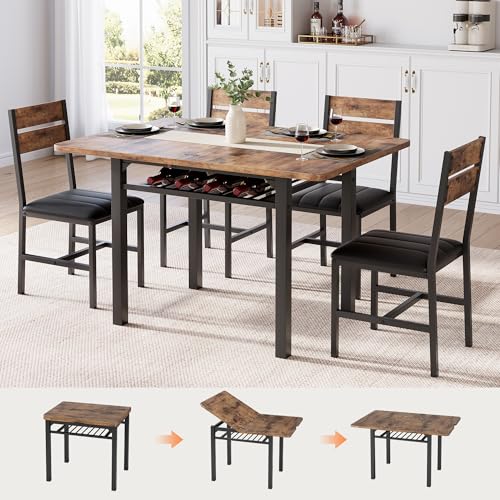
MapleGrace Extendable Dining Table Set for 4 with Built-in Shelf Rack Brown | Kitchen Table Set with 4 PU Leather Upholstered, Wood Dining Room Chairs for Dining & Small Spaces
Check price on Amazon
IRONCK Dining Table Set for 4, Extendable Kitchen Table Chairs Set of 4 | Dining Room Table with 4 Upholstered Chairs, Folding for Small Space, Apartment, Walnut
Check price on Amazon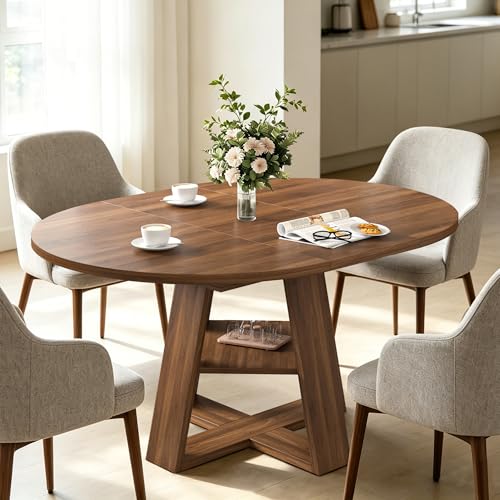
43.3"-59" Extendable Round Oval Dining Table for 4-8 with Storage Shelf | Modern Kitchen Oval Dining Table with Removable Leaves,Space Saving Extendable Table Wood Base for Kitchen Living Room Walnut
Check price on Amazon
DONGMUWUJEE Solid Wood Small Dining Table for 2-6, 23.6"L-47.2"L Expandable Kitchen Table, Designed for Small Spaces, Easy Assembly, Suitable for Kitchen, Dining Room, Living Room, Apartment (Walnut)
Check price on Amazon
VASAGLE Folding Dining Table, Kitchen Table | Drop Leaf Extendable Table for Small Spaces, Seats 2-4 People, Industrial, Rustic Brown and Black UKDT077B01
Check price on Amazon